

7.5 Damping in MDF Systems
277
in which proportionality constants α and β have units of sec
−1 and sec, respectively.
The left-hand equation of Eq. (7.28a, 7.28b) is mass-proportional damping, and the
right-hand equation of Eq. (7.28a, 7.28b) is stiffness-proportional damping
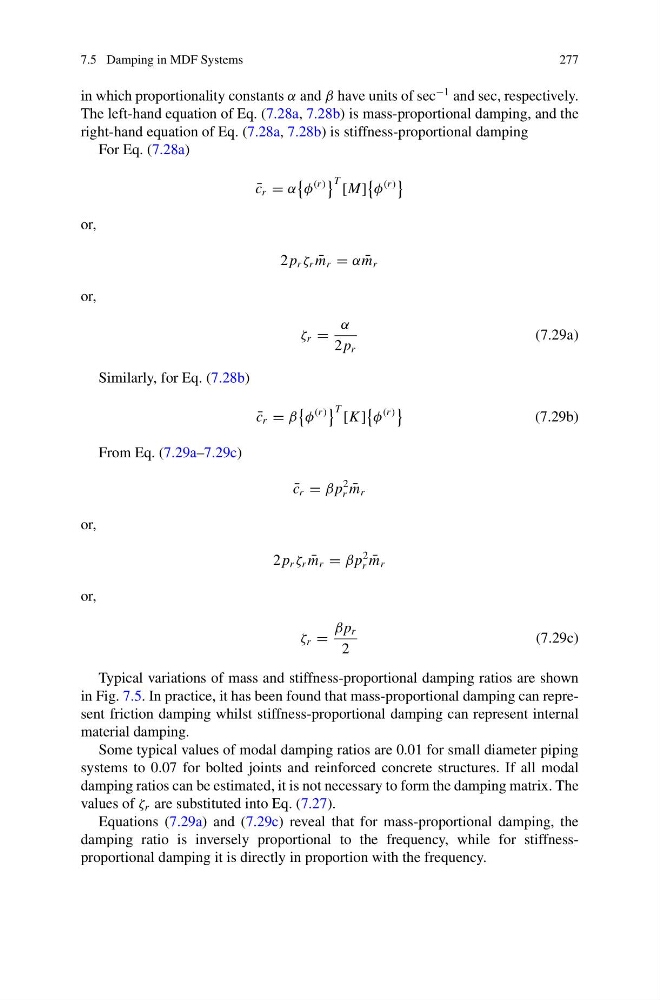
For Eq. (7.28a)
¯
c r = α
φ
(r )
T [M]
φ
(r )
or,
2 p r ζ r ¯
m r = α ¯
m r
or,
ζ r =
α
2 p r
(7.29a)
Similarly, for Eq. (7.28b)
¯
c r = β
φ
(r )
T [K ]
φ
(r )
(7.29b)
From Eq. (7.29a–7.29c)
¯
c r = βp
2
r ¯
m r
or,
2 p r ζ r ¯
m r = βp
2
r ¯
m r
or,
ζ r =
βp r
2
(7.29c)
Typical variations of mass and stiffness-proportional damping ratios are shown
in Fig. 7.5. In practice, it has been found that mass-proportional damping can represent friction damping whilst stiffness-proportional damping can represent internal
material damping.
Some typical values of modal damping ratios are 0.01 for small diameter piping
systems to 0.07 for bolted joints and reinforced concrete structures. If all modal
damping ratios can be estimated, it is not necessary to form the damping matrix. The
values of ζ r are substituted into Eq. (7.27).
Equations (7.29a) and (7.29c) reveal that for mass-proportional damping, the
damping ratio is inversely proportional to the frequency, while for stiffnessproportional damping it is directly in proportion with the frequency.
277
in which proportionality constants α and β have units of sec
−1 and sec, respectively.
The left-hand equation of Eq. (7.28a, 7.28b) is mass-proportional damping, and the
right-hand equation of Eq. (7.28a, 7.28b) is stiffness-proportional damping
For Eq. (7.28a)
¯
c r = α
φ
(r )
T [M]
φ
(r )
or,
2 p r ζ r ¯
m r = α ¯
m r
or,
ζ r =
α
2 p r
(7.29a)
Similarly, for Eq. (7.28b)
¯
c r = β
φ
(r )
T [K ]
φ
(r )
(7.29b)
From Eq. (7.29a–7.29c)
¯
c r = βp
2
r ¯
m r
or,
2 p r ζ r ¯
m r = βp
2
r ¯
m r
or,
ζ r =
βp r
2
(7.29c)
Typical variations of mass and stiffness-proportional damping ratios are shown
in Fig. 7.5. In practice, it has been found that mass-proportional damping can represent friction damping whilst stiffness-proportional damping can represent internal
material damping.
Some typical values of modal damping ratios are 0.01 for small diameter piping
systems to 0.07 for bolted joints and reinforced concrete structures. If all modal
damping ratios can be estimated, it is not necessary to form the damping matrix. The
values of ζ r are substituted into Eq. (7.27).
Equations (7.29a) and (7.29c) reveal that for mass-proportional damping, the
damping ratio is inversely proportional to the frequency, while for stiffnessproportional damping it is directly in proportion with the frequency.