

276
7 Forced Vibration Analysis of Multiple Degrees of Freedom System
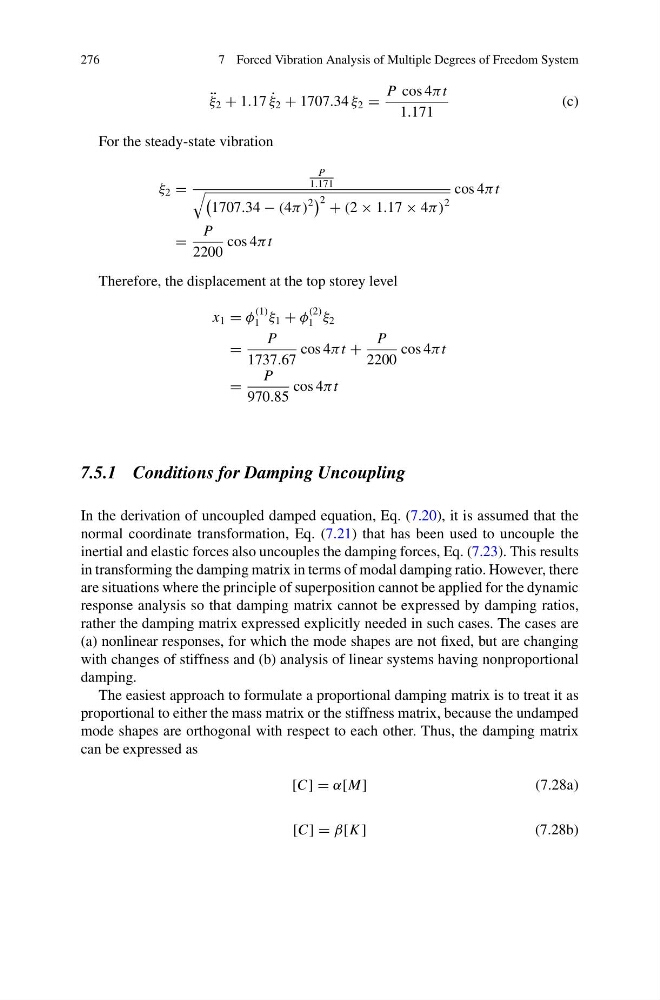
¨
ξ 2 + 1.17 ˙
ξ 2 + 1707.34 ξ 2 =
P cos 4π t
1.171
(c)
For the steady-state vibration
ξ 2 =
P
1.171
1707.34 − (4π )
2
2 + (2 × 1.17 × 4π )
2
cos 4π t
=
P
2200
cos 4π t
Therefore, the displacement at the top storey level
x 1 = φ
(1)
1 ξ 1 + φ
(2)
1 ξ 2
=
P
1737.67
cos 4π t +
P
2200
cos 4π t
=
P
970.85
cos 4π t
7.5.1 Conditions for Damping Uncoupling
In the derivation of uncoupled damped equation, Eq. (7.20), it is assumed that the
normal coordinate transformation, Eq. (7.21) that has been used to uncouple the
inertial and elastic forces also uncouples the damping forces, Eq. (7.23). This results
in transforming the damping matrix in terms of modal damping ratio. However, there
are situations where the principle of superposition cannot be applied for the dynamic
response analysis so that damping matrix cannot be expressed by damping ratios,
rather the damping matrix expressed explicitly needed in such cases. The cases are
(a) nonlinear responses, for which the mode shapes are not fixed, but are changing
with changes of stiffness and (b) analysis of linear systems having nonproportional
damping.
The easiest approach to formulate a proportional damping matrix is to treat it as
proportional to either the mass matrix or the stiffness matrix, because the undamped
mode shapes are orthogonal with respect to each other. Thus, the damping matrix
can be expressed as
[C] = α[M]
(7.28a)
[C] = β[K ]
(7.28b)
7 Forced Vibration Analysis of Multiple Degrees of Freedom System
¨
ξ 2 + 1.17 ˙
ξ 2 + 1707.34 ξ 2 =
P cos 4π t
1.171
(c)
For the steady-state vibration
ξ 2 =
P
1.171
1707.34 − (4π )
2
2 + (2 × 1.17 × 4π )
2
cos 4π t
=
P
2200
cos 4π t
Therefore, the displacement at the top storey level
x 1 = φ
(1)
1 ξ 1 + φ
(2)
1 ξ 2
=
P
1737.67
cos 4π t +
P
2200
cos 4π t
=
P
970.85
cos 4π t
7.5.1 Conditions for Damping Uncoupling
In the derivation of uncoupled damped equation, Eq. (7.20), it is assumed that the
normal coordinate transformation, Eq. (7.21) that has been used to uncouple the
inertial and elastic forces also uncouples the damping forces, Eq. (7.23). This results
in transforming the damping matrix in terms of modal damping ratio. However, there
are situations where the principle of superposition cannot be applied for the dynamic
response analysis so that damping matrix cannot be expressed by damping ratios,
rather the damping matrix expressed explicitly needed in such cases. The cases are
(a) nonlinear responses, for which the mode shapes are not fixed, but are changing
with changes of stiffness and (b) analysis of linear systems having nonproportional
damping.
The easiest approach to formulate a proportional damping matrix is to treat it as
proportional to either the mass matrix or the stiffness matrix, because the undamped
mode shapes are orthogonal with respect to each other. Thus, the damping matrix
can be expressed as
[C] = α[M]
(7.28a)
[C] = β[K ]
(7.28b)