

266
7 Forced Vibration Analysis of Multiple Degrees of Freedom System
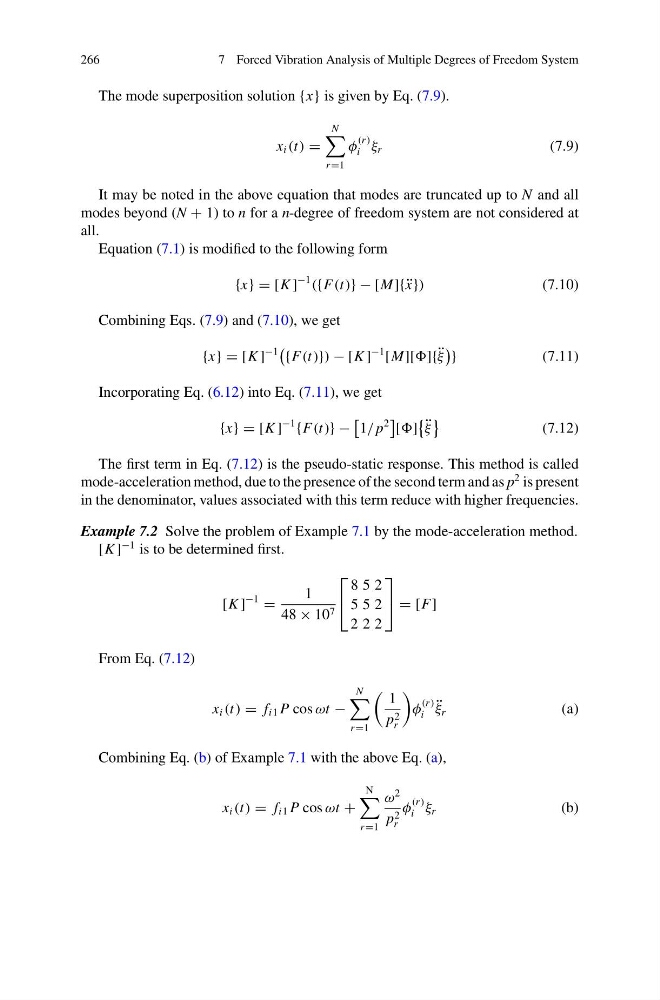
The mode superposition solution {x} is given by Eq. (7.9).
x i (t) =
N
r =1
φ
(r )
i ξ r
(7.9)
It may be noted in the above equation that modes are truncated up to N and all
modes beyond (N + 1) to n for a n-degree of freedom system are not considered at
all.
Equation (7.1) is modified to the following form
{x} = [K ]
−1
({F(t)} − [M]{ ¨
x})
(7.10)
Combining Eqs. (7.9) and (7.10), we get
{x} = [K ]
−1
{F(t)}) − [K ]
−1
[M][]{ ¨
ξ
}
(7.11)
Incorporating Eq. (6.12) into Eq. (7.11), we get
{x} = [K ]
−1
{F(t)} −
1/ p
2
[]
¨
ξ
(7.12)
The first term in Eq. (7.12) is the pseudo-static response. This method is called
mode-acceleration method, due to the presence of the second term and as p
2 is present
in the denominator, values associated with this term reduce with higher frequencies.
Example 7.2 Solve the problem of Example 7.1 by the mode-acceleration method.
[K ]
−1 is to be determined first.
[K ]
−1
=
1
48 × 10 7
⎡
⎣
8 5 2
5 5 2
2 2 2
⎤
⎦ = [F]
From Eq. (7.12)
x i (t) = f i1 P cos ωt −
N
r =1
1
p 2
r
φ
(r )
i
¨
ξ r
(a)
Combining Eq. (b) of Example 7.1 with the above Eq. (a),
x i (t) = f i1 P cos ωt +
N
r =1
ω
2
p 2
r
φ
(r )
i ξ r
(b)
7 Forced Vibration Analysis of Multiple Degrees of Freedom System
The mode superposition solution {x} is given by Eq. (7.9).
x i (t) =
N
r =1
φ
(r )
i ξ r
(7.9)
It may be noted in the above equation that modes are truncated up to N and all
modes beyond (N + 1) to n for a n-degree of freedom system are not considered at
all.
Equation (7.1) is modified to the following form
{x} = [K ]
−1
({F(t)} − [M]{ ¨
x})
(7.10)
Combining Eqs. (7.9) and (7.10), we get
{x} = [K ]
−1
{F(t)}) − [K ]
−1
[M][]{ ¨
ξ
}
(7.11)
Incorporating Eq. (6.12) into Eq. (7.11), we get
{x} = [K ]
−1
{F(t)} −
1/ p
2
[]
¨
ξ
(7.12)
The first term in Eq. (7.12) is the pseudo-static response. This method is called
mode-acceleration method, due to the presence of the second term and as p
2 is present
in the denominator, values associated with this term reduce with higher frequencies.
Example 7.2 Solve the problem of Example 7.1 by the mode-acceleration method.
[K ]
−1 is to be determined first.
[K ]
−1
=
1
48 × 10 7
⎡
⎣
8 5 2
5 5 2
2 2 2
⎤
⎦ = [F]
From Eq. (7.12)
x i (t) = f i1 P cos ωt −
N
r =1
1
p 2
r
φ
(r )
i
¨
ξ r
(a)
Combining Eq. (b) of Example 7.1 with the above Eq. (a),
x i (t) = f i1 P cos ωt +
N
r =1
ω
2
p 2
r
φ
(r )
i ξ r
(b)