

240
6 Free Vibration of Multiple Degrees of Freedom System
6.20.2 Guyan Reduction Method of Dynamic Analysis
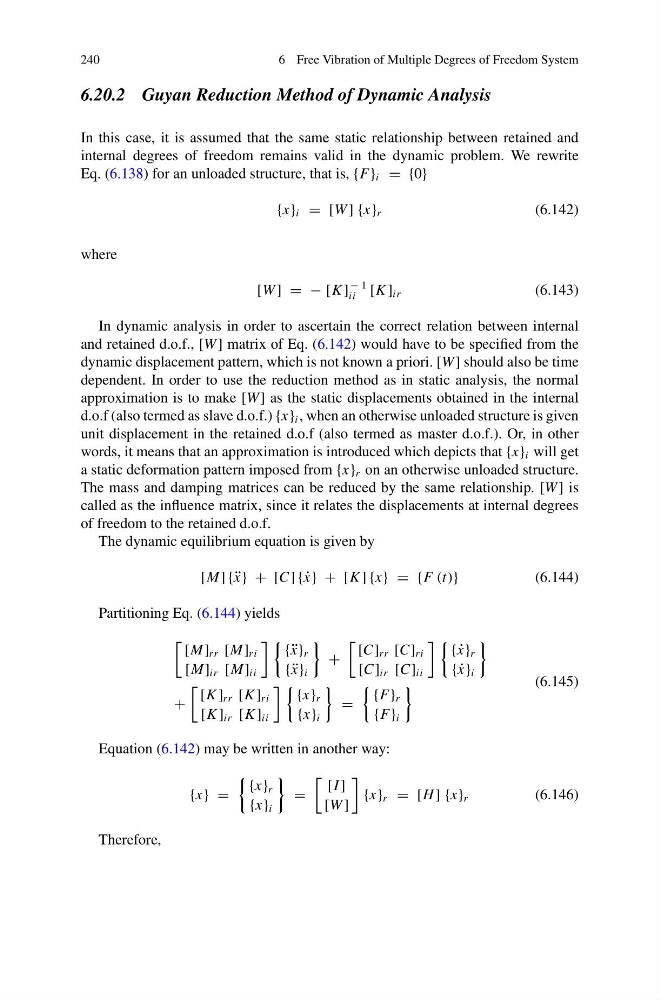
In this case, it is assumed that the same static relationship between retained and
internal degrees of freedom remains valid in the dynamic problem. We rewrite
Eq. (6.138) for an unloaded structure, that is, {F} i = {0}
{x} i = [W ] {x} r
(6.142)
where
[W ] = − [K ]
− 1
ii [K ] ir
(6.143)
In dynamic analysis in order to ascertain the correct relation between internal
and retained d.o.f., [W ] matrix of Eq. (6.142) would have to be specified from the
dynamic displacement pattern, which is not known a priori. [W ] should also be time
dependent. In order to use the reduction method as in static analysis, the normal
approximation is to make [W ] as the static displacements obtained in the internal
d.o.f (also termed as slave d.o.f.) {x} i , when an otherwise unloaded structure is given
unit displacement in the retained d.o.f (also termed as master d.o.f.). Or, in other
words, it means that an approximation is introduced which depicts that {x} i will get
a static deformation pattern imposed from {x} r on an otherwise unloaded structure.
The mass and damping matrices can be reduced by the same relationship. [W ] is
called as the influence matrix, since it relates the displacements at internal degrees
of freedom to the retained d.o.f.
The dynamic equilibrium equation is given by
[M] { ¨
x} + [C] { ˙
x} + [K ] {x} = {F (t)}
(6.144)
Partitioning Eq. (6.144) yields
[M] rr [M] ri
[M] ir [M] ii
{ ¨
x} r
{ ¨
x} i
+
[C] rr [C] ri
[C] ir [C] ii
{ ˙
x} r
{ ˙
x} i
+
[K ] rr [K ] ri
[K ] ir [K ] ii
{x} r
{x} i
=
{F} r
{F} i
(6.145)
Equation (6.142) may be written in another way:
{x} =
{x} r
{x} i
=
[I ]
[W ]
{x} r = [H ] {x} r
(6.146)
Therefore,
6 Free Vibration of Multiple Degrees of Freedom System
6.20.2 Guyan Reduction Method of Dynamic Analysis
In this case, it is assumed that the same static relationship between retained and
internal degrees of freedom remains valid in the dynamic problem. We rewrite
Eq. (6.138) for an unloaded structure, that is, {F} i = {0}
{x} i = [W ] {x} r
(6.142)
where
[W ] = − [K ]
− 1
ii [K ] ir
(6.143)
In dynamic analysis in order to ascertain the correct relation between internal
and retained d.o.f., [W ] matrix of Eq. (6.142) would have to be specified from the
dynamic displacement pattern, which is not known a priori. [W ] should also be time
dependent. In order to use the reduction method as in static analysis, the normal
approximation is to make [W ] as the static displacements obtained in the internal
d.o.f (also termed as slave d.o.f.) {x} i , when an otherwise unloaded structure is given
unit displacement in the retained d.o.f (also termed as master d.o.f.). Or, in other
words, it means that an approximation is introduced which depicts that {x} i will get
a static deformation pattern imposed from {x} r on an otherwise unloaded structure.
The mass and damping matrices can be reduced by the same relationship. [W ] is
called as the influence matrix, since it relates the displacements at internal degrees
of freedom to the retained d.o.f.
The dynamic equilibrium equation is given by
[M] { ¨
x} + [C] { ˙
x} + [K ] {x} = {F (t)}
(6.144)
Partitioning Eq. (6.144) yields
[M] rr [M] ri
[M] ir [M] ii
{ ¨
x} r
{ ¨
x} i
+
[C] rr [C] ri
[C] ir [C] ii
{ ˙
x} r
{ ˙
x} i
+
[K ] rr [K ] ri
[K ] ir [K ] ii
{x} r
{x} i
=
{F} r
{F} i
(6.145)
Equation (6.142) may be written in another way:
{x} =
{x} r
{x} i
=
[I ]
[W ]
{x} r = [H ] {x} r
(6.146)
Therefore,