

202
6 Free Vibration of Multiple Degrees of Freedom System
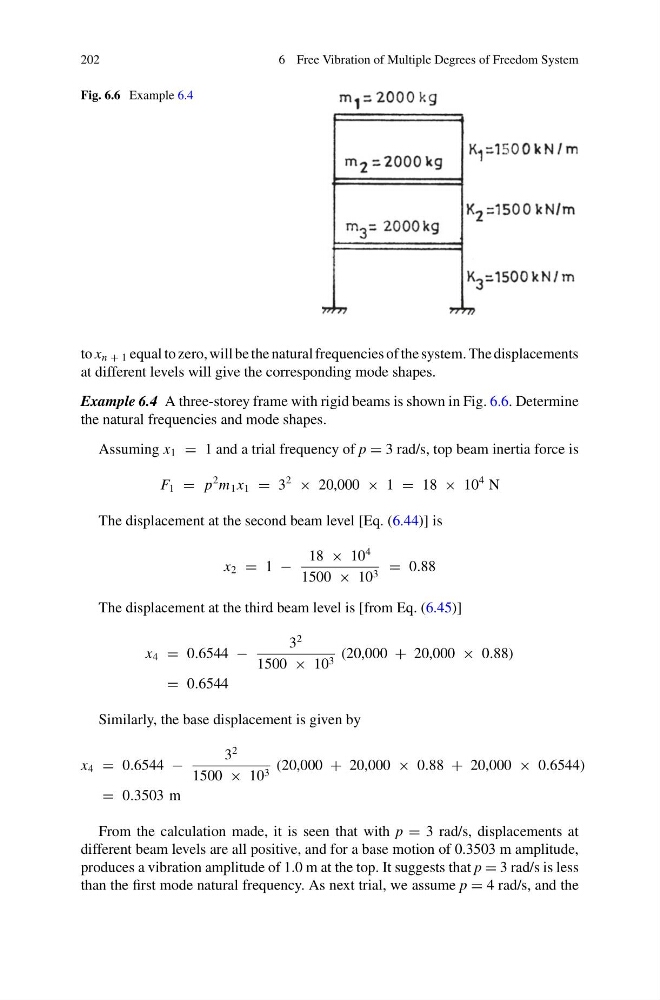
Fig. 6.6 Example 6.4
to x n + 1 equal to zero, will be the natural frequencies of the system. The displacements
at different levels will give the corresponding mode shapes.
Example 6.4 A three-storey frame with rigid beams is shown in Fig. 6.6. Determine
the natural frequencies and mode shapes.
Assuming x 1 = 1 and a trial frequency of p = 3 rad/s, top beam inertia force is
F 1 = p
2 m 1 x 1 = 3
2
× 20,000 × 1 = 18 × 10
4 N
The displacement at the second beam level [Eq. (6.44)] is
x 2 = 1 −
18 × 10
4
1500 × 10 3 = 0.88
The displacement at the third beam level is [from Eq. (6.45)]
x 4 = 0.6544 −
3
2
1500 × 10 3 (20,000 + 20,000 × 0.88)
= 0.6544
Similarly, the base displacement is given by
x 4 = 0.6544 −
3
2
1500 × 10 3 (20,000 + 20,000 × 0.88 + 20,000 × 0.6544)
= 0.3503 m
From the calculation made, it is seen that with p = 3 rad/s, displacements at
different beam levels are all positive, and for a base motion of 0.3503 m amplitude,
produces a vibration amplitude of 1.0 m at the top. It suggests that p = 3 rad/s is less
than the first mode natural frequency. As next trial, we assume p = 4 rad/s, and the
6 Free Vibration of Multiple Degrees of Freedom System
Fig. 6.6 Example 6.4
to x n + 1 equal to zero, will be the natural frequencies of the system. The displacements
at different levels will give the corresponding mode shapes.
Example 6.4 A three-storey frame with rigid beams is shown in Fig. 6.6. Determine
the natural frequencies and mode shapes.
Assuming x 1 = 1 and a trial frequency of p = 3 rad/s, top beam inertia force is
F 1 = p
2 m 1 x 1 = 3
2
× 20,000 × 1 = 18 × 10
4 N
The displacement at the second beam level [Eq. (6.44)] is
x 2 = 1 −
18 × 10
4
1500 × 10 3 = 0.88
The displacement at the third beam level is [from Eq. (6.45)]
x 4 = 0.6544 −
3
2
1500 × 10 3 (20,000 + 20,000 × 0.88)
= 0.6544
Similarly, the base displacement is given by
x 4 = 0.6544 −
3
2
1500 × 10 3 (20,000 + 20,000 × 0.88 + 20,000 × 0.6544)
= 0.3503 m
From the calculation made, it is seen that with p = 3 rad/s, displacements at
different beam levels are all positive, and for a base motion of 0.3503 m amplitude,
produces a vibration amplitude of 1.0 m at the top. It suggests that p = 3 rad/s is less
than the first mode natural frequency. As next trial, we assume p = 4 rad/s, and the