

192
6 Free Vibration of Multiple Degrees of Freedom System
p
2
1 [M] {φ
(1)
} = [K ] {φ
(1)
}
p
2
2 [M] {φ
(2)
} = [K ] {φ
(2)
}
. . .
. . .
p
2
n [M] {φ
(n)
} = [K ] {φ
(n)
}
⎫
⎪ ⎪ ⎪ ⎬
⎪ ⎪ ⎪ ⎭
(6.31)
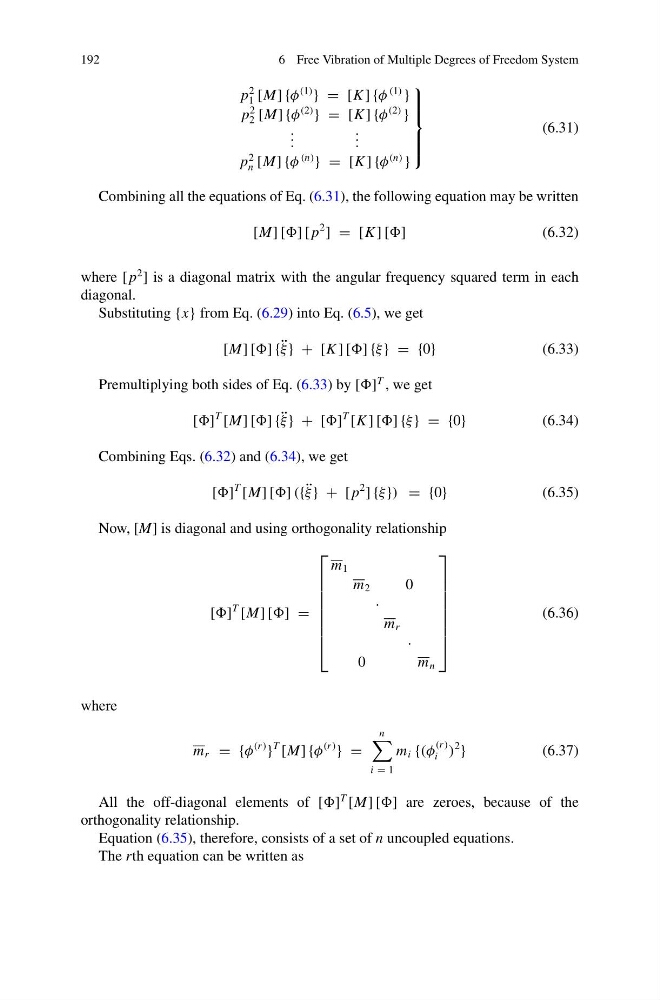
Combining all the equations of Eq. (6.31), the following equation may be written
[M] [] [p
2
] = [K ] []
(6.32)
where [ p
2
] is a diagonal matrix with the angular frequency squared term in each
diagonal.
Substituting {x} from Eq. (6.29) into Eq. (6.5), we get
[M] [] { ¨
ξ } + [K ] [] {ξ } = {0}
(6.33)
Premultiplying both sides of Eq. (6.33) by []
T , we get
[]
T
[M] [] { ¨
ξ } + []
T
[K ] [] {ξ } = {0}
(6.34)
Combining Eqs. (6.32) and (6.34), we get
[]
T
[M] [] ({ ¨
ξ } + [p
2
] {ξ }) = {0}
(6.35)
Now, [M] is diagonal and using orthogonality relationship
[]
T
[M] [] =
⎡
⎢
⎢
⎢
⎢
⎢
⎢
⎢
⎣
m 1
m 2
0
·
m r
·
0
m n
⎤
⎥
⎥
⎥
⎥
⎥
⎥
⎥
⎦
(6.36)
where
m r = {φ
(r )
}
T
[M] {φ
(r )
} =
n
i = 1
m i {(φ
(r )
i )
2
}
(6.37)
All the off-diagonal elements of []
T
[M] [] are zeroes, because of the
orthogonality relationship.
Equation (6.35), therefore, consists of a set of n uncoupled equations.
The rth equation can be written as
6 Free Vibration of Multiple Degrees of Freedom System
p
2
1 [M] {φ
(1)
} = [K ] {φ
(1)
}
p
2
2 [M] {φ
(2)
} = [K ] {φ
(2)
}
. . .
. . .
p
2
n [M] {φ
(n)
} = [K ] {φ
(n)
}
⎫
⎪ ⎪ ⎪ ⎬
⎪ ⎪ ⎪ ⎭
(6.31)
Combining all the equations of Eq. (6.31), the following equation may be written
[M] [] [p
2
] = [K ] []
(6.32)
where [ p
2
] is a diagonal matrix with the angular frequency squared term in each
diagonal.
Substituting {x} from Eq. (6.29) into Eq. (6.5), we get
[M] [] { ¨
ξ } + [K ] [] {ξ } = {0}
(6.33)
Premultiplying both sides of Eq. (6.33) by []
T , we get
[]
T
[M] [] { ¨
ξ } + []
T
[K ] [] {ξ } = {0}
(6.34)
Combining Eqs. (6.32) and (6.34), we get
[]
T
[M] [] ({ ¨
ξ } + [p
2
] {ξ }) = {0}
(6.35)
Now, [M] is diagonal and using orthogonality relationship
[]
T
[M] [] =
⎡
⎢
⎢
⎢
⎢
⎢
⎢
⎢
⎣
m 1
m 2
0
·
m r
·
0
m n
⎤
⎥
⎥
⎥
⎥
⎥
⎥
⎥
⎦
(6.36)
where
m r = {φ
(r )
}
T
[M] {φ
(r )
} =
n
i = 1
m i {(φ
(r )
i )
2
}
(6.37)
All the off-diagonal elements of []
T
[M] [] are zeroes, because of the
orthogonality relationship.
Equation (6.35), therefore, consists of a set of n uncoupled equations.
The rth equation can be written as