

6.6 Determination of Absolute Displacement of Free Vibration …
193
m r ( ¨
ξ r + p
2
r ξ r ) = 0
or
¨
ξ r + p
2
r ξ r = 0
(6.38)
The solution of Eq. (6.38) is
ξ r = A r sin p r t + B r cos p r t
(6.39)
Thus, a n degree of freedom system represented by Eq. (6.5) is reduced to n single
degree of freedom systems, represented by Eq. (6.38), with the full use transformed
coordinates instead of {x}. n uncoupled equations of the type of Eq. (6.38) can be
solved easily. The coordinate of {x} is obtained by
x i (t) =
n
r = 1
φ
(r )
i ξ r
(6.40)
Since the values of φ s are arbitrary, it is possible to choose φ s, such that m r is
unity for all values of r = 1, 2, 3, …, n. This is shown with the help of the following
example.
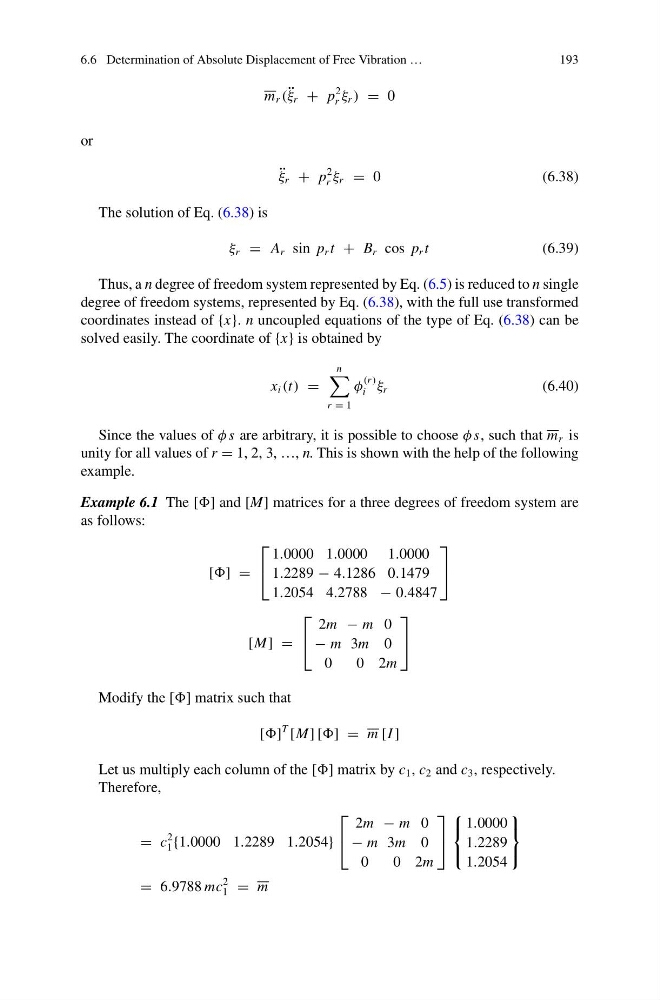
Example 6.1 The [] and [M] matrices for a three degrees of freedom system are
as follows:
[] =
⎡
⎣
1.0000 1.0000 1.0000
1.2289 − 4.1286 0.1479
1.2054 4.2788 − 0.4847
⎤
⎦
[M] =
⎡
⎣
2m − m 0
− m 3m 0
0
0 2m
⎤
⎦
Modify the [] matrix such that
[]
T
[M] [] = m [I ]
Let us multiply each column of the [] matrix by c 1 , c 2 and c 3 , respectively.
Therefore,
= c
2
1 {1.0000 1.2289 1.2054}
⎡
⎣
2m − m 0
− m 3m 0
0
0 2m
⎤
⎦
⎧
⎨
⎩
1.0000
1.2289
1.2054
⎫
⎬
⎭
= 6.9788 mc
2
1 = m
193
m r ( ¨
ξ r + p
2
r ξ r ) = 0
or
¨
ξ r + p
2
r ξ r = 0
(6.38)
The solution of Eq. (6.38) is
ξ r = A r sin p r t + B r cos p r t
(6.39)
Thus, a n degree of freedom system represented by Eq. (6.5) is reduced to n single
degree of freedom systems, represented by Eq. (6.38), with the full use transformed
coordinates instead of {x}. n uncoupled equations of the type of Eq. (6.38) can be
solved easily. The coordinate of {x} is obtained by
x i (t) =
n
r = 1
φ
(r )
i ξ r
(6.40)
Since the values of φ s are arbitrary, it is possible to choose φ s, such that m r is
unity for all values of r = 1, 2, 3, …, n. This is shown with the help of the following
example.
Example 6.1 The [] and [M] matrices for a three degrees of freedom system are
as follows:
[] =
⎡
⎣
1.0000 1.0000 1.0000
1.2289 − 4.1286 0.1479
1.2054 4.2788 − 0.4847
⎤
⎦
[M] =
⎡
⎣
2m − m 0
− m 3m 0
0
0 2m
⎤
⎦
Modify the [] matrix such that
[]
T
[M] [] = m [I ]
Let us multiply each column of the [] matrix by c 1 , c 2 and c 3 , respectively.
Therefore,
= c
2
1 {1.0000 1.2289 1.2054}
⎡
⎣
2m − m 0
− m 3m 0
0
0 2m
⎤
⎦
⎧
⎨
⎩
1.0000
1.2289
1.2054
⎫
⎬
⎭
= 6.9788 mc
2
1 = m