

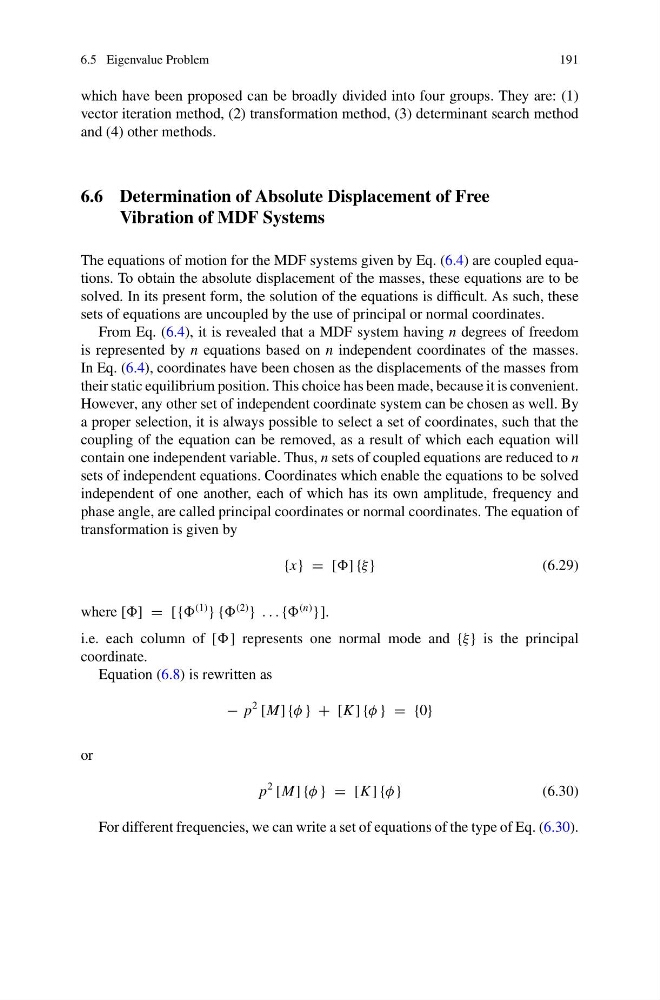
6.5 Eigenvalue Problem
191
which have been proposed can be broadly divided into four groups. They are: (1)
vector iteration method, (2) transformation method, (3) determinant search method
and (4) other methods.
6.6 Determination of Absolute Displacement of Free
Vibration of MDF Systems
The equations of motion for the MDF systems given by Eq. (6.4) are coupled equations. To obtain the absolute displacement of the masses, these equations are to be
solved. In its present form, the solution of the equations is difficult. As such, these
sets of equations are uncoupled by the use of principal or normal coordinates.
From Eq. (6.4), it is revealed that a MDF system having n degrees of freedom
is represented by n equations based on n independent coordinates of the masses.
In Eq. (6.4), coordinates have been chosen as the displacements of the masses from
their static equilibrium position. This choice has been made, because it is convenient.
However, any other set of independent coordinate system can be chosen as well. By
a proper selection, it is always possible to select a set of coordinates, such that the
coupling of the equation can be removed, as a result of which each equation will
contain one independent variable. Thus, n sets of coupled equations are reduced to n
sets of independent equations. Coordinates which enable the equations to be solved
independent of one another, each of which has its own amplitude, frequency and
phase angle, are called principal coordinates or normal coordinates. The equation of
transformation is given by
{x} = [] {ξ }
(6.29)
where [] = [{
(1)
} {
(2)
} . . . {
(n)
}].
i.e. each column of [ ] represents one normal mode and {ξ } is the principal
coordinate.
Equation (6.8) is rewritten as
− p
2
[M] {φ } + [K ] {φ } = {0}
or
p
2
[M] {φ } = [K ] {φ }
(6.30)
For different frequencies, we can write a set of equations of the type of Eq. (6.30).
191
which have been proposed can be broadly divided into four groups. They are: (1)
vector iteration method, (2) transformation method, (3) determinant search method
and (4) other methods.
6.6 Determination of Absolute Displacement of Free
Vibration of MDF Systems
The equations of motion for the MDF systems given by Eq. (6.4) are coupled equations. To obtain the absolute displacement of the masses, these equations are to be
solved. In its present form, the solution of the equations is difficult. As such, these
sets of equations are uncoupled by the use of principal or normal coordinates.
From Eq. (6.4), it is revealed that a MDF system having n degrees of freedom
is represented by n equations based on n independent coordinates of the masses.
In Eq. (6.4), coordinates have been chosen as the displacements of the masses from
their static equilibrium position. This choice has been made, because it is convenient.
However, any other set of independent coordinate system can be chosen as well. By
a proper selection, it is always possible to select a set of coordinates, such that the
coupling of the equation can be removed, as a result of which each equation will
contain one independent variable. Thus, n sets of coupled equations are reduced to n
sets of independent equations. Coordinates which enable the equations to be solved
independent of one another, each of which has its own amplitude, frequency and
phase angle, are called principal coordinates or normal coordinates. The equation of
transformation is given by
{x} = [] {ξ }
(6.29)
where [] = [{
(1)
} {
(2)
} . . . {
(n)
}].
i.e. each column of [ ] represents one normal mode and {ξ } is the principal
coordinate.
Equation (6.8) is rewritten as
− p
2
[M] {φ } + [K ] {φ } = {0}
or
p
2
[M] {φ } = [K ] {φ }
(6.30)
For different frequencies, we can write a set of equations of the type of Eq. (6.30).