

5.5 Vibration Absorber
163
ω
2
=
k 2
m 2
(5.26)
This is the principle of vibration absorber. This suggests that the mass, which
is subjected to a force, F 1 sin ω t will not vibrate at all, if there is a second spring
and a second mass, which is so designed that k 2 /m 2 is equal to square of the forcing
frequency.
Introducing
ω
2
1 =
k 1
m 1
and ω
2
2 =
k 2
m 2
and assuming the motion to be harmonic, the equation of the amplitude given by
Eq. (5.23) can be shown as
Ak 1
F 1
=
1 −
ω
ω 2
2
1 +
k 2
k 1
−
ω
ω 1
2
1 −
ω
ω 2
2
−
k 2
k 1
Bk 1
F 1
=
1
1 +
k 2
k 1
−
ω
ω 1
2
1 −
ω
ω 2
2
−
k 2
k 1
⎫
⎪ ⎪ ⎪ ⎪ ⎪ ⎪ ⎪ ⎪ ⎬
⎪ ⎪ ⎪ ⎪ ⎪ ⎪ ⎪ ⎪ ⎭
(5.27)
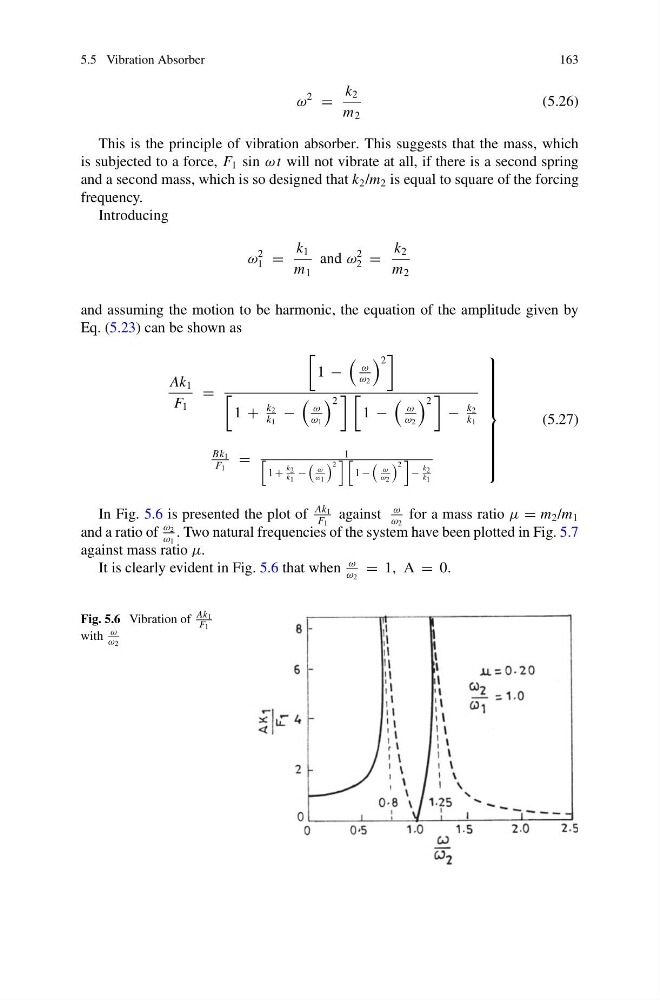
In Fig. 5.6 is presented the plot of
Ak 1
F 1
against
ω
ω 2
for a mass ratio μ = m 2 /m 1
and a ratio of
ω 2
ω 1
. Two natural frequencies of the system have been plotted in Fig. 5.7
against mass ratio μ.
It is clearly evident in Fig. 5.6 that when
ω
ω 2
= 1, A = 0.
Fig. 5.6 Vibration of
Ak1
F1
with
ω
ω2
163
ω
2
=
k 2
m 2
(5.26)
This is the principle of vibration absorber. This suggests that the mass, which
is subjected to a force, F 1 sin ω t will not vibrate at all, if there is a second spring
and a second mass, which is so designed that k 2 /m 2 is equal to square of the forcing
frequency.
Introducing
ω
2
1 =
k 1
m 1
and ω
2
2 =
k 2
m 2
and assuming the motion to be harmonic, the equation of the amplitude given by
Eq. (5.23) can be shown as
Ak 1
F 1
=
1 −
ω
ω 2
2
1 +
k 2
k 1
−
ω
ω 1
2
1 −
ω
ω 2
2
−
k 2
k 1
Bk 1
F 1
=
1
1 +
k 2
k 1
−
ω
ω 1
2
1 −
ω
ω 2
2
−
k 2
k 1
⎫
⎪ ⎪ ⎪ ⎪ ⎪ ⎪ ⎪ ⎪ ⎬
⎪ ⎪ ⎪ ⎪ ⎪ ⎪ ⎪ ⎪ ⎭
(5.27)
In Fig. 5.6 is presented the plot of
Ak 1
F 1
against
ω
ω 2
for a mass ratio μ = m 2 /m 1
and a ratio of
ω 2
ω 1
. Two natural frequencies of the system have been plotted in Fig. 5.7
against mass ratio μ.
It is clearly evident in Fig. 5.6 that when
ω
ω 2
= 1, A = 0.
Fig. 5.6 Vibration of
Ak1
F1
with
ω
ω2