

164
5 Vibration of Two Degrees of Freedom System
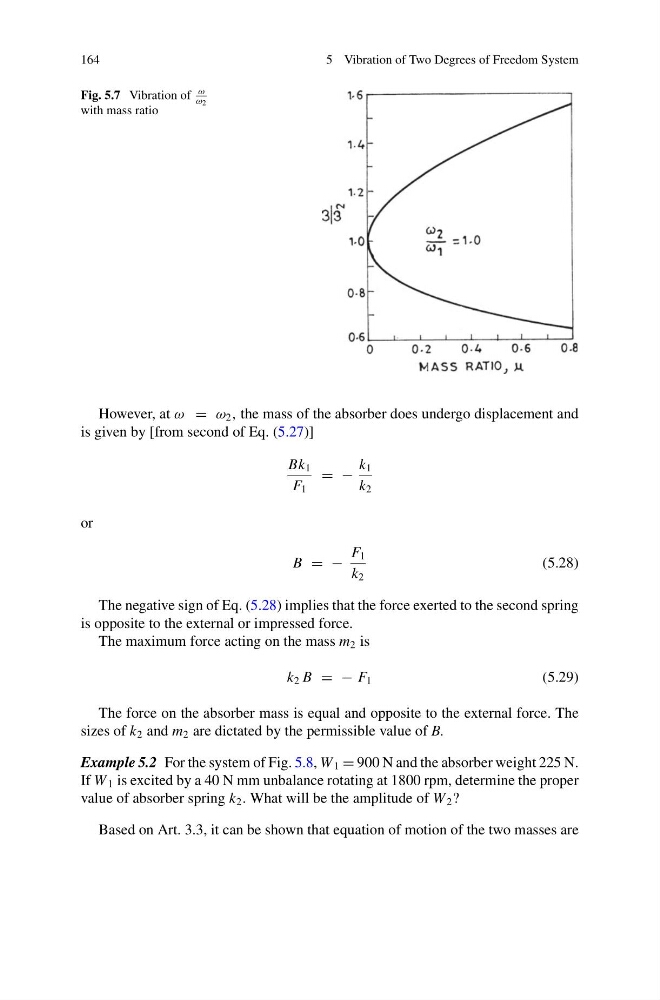
Fig. 5.7 Vibration of
ω
ω2
with mass ratio
However, at ω = ω 2 , the mass of the absorber does undergo displacement and
is given by [from second of Eq. (5.27)]
Bk 1
F 1
= −
k 1
k 2
or
B = −
F 1
k 2
(5.28)
The negative sign of Eq. (5.28) implies that the force exerted to the second spring
is opposite to the external or impressed force.
The maximum force acting on the mass m 2 is
k 2 B = − F 1
(5.29)
The force on the absorber mass is equal and opposite to the external force. The
sizes of k 2 and m 2 are dictated by the permissible value of B.
Example 5.2 For the system of Fig. 5.8, W 1 = 900 N and the absorber weight 225 N.
If W 1 is excited by a 40 N mm unbalance rotating at 1800 rpm, determine the proper
value of absorber spring k 2 . What will be the amplitude of W 2 ?
Based on Art. 3.3, it can be shown that equation of motion of the two masses are
5 Vibration of Two Degrees of Freedom System
Fig. 5.7 Vibration of
ω
ω2
with mass ratio
However, at ω = ω 2 , the mass of the absorber does undergo displacement and
is given by [from second of Eq. (5.27)]
Bk 1
F 1
= −
k 1
k 2
or
B = −
F 1
k 2
(5.28)
The negative sign of Eq. (5.28) implies that the force exerted to the second spring
is opposite to the external or impressed force.
The maximum force acting on the mass m 2 is
k 2 B = − F 1
(5.29)
The force on the absorber mass is equal and opposite to the external force. The
sizes of k 2 and m 2 are dictated by the permissible value of B.
Example 5.2 For the system of Fig. 5.8, W 1 = 900 N and the absorber weight 225 N.
If W 1 is excited by a 40 N mm unbalance rotating at 1800 rpm, determine the proper
value of absorber spring k 2 . What will be the amplitude of W 2 ?
Based on Art. 3.3, it can be shown that equation of motion of the two masses are