

162
5 Vibration of Two Degrees of Freedom System
A =
k 2 − m 2 ω
2
F 1
k 1 + k 2 − m 1 ω 2
k 2 − m 2 ω 2
− k
2
2
B =
k 2 F 1
k 1 + k 2 − m 1 ω 2
k 2 − m 2 ω 2
− k
2
2
⎫
⎪ ⎪ ⎪ ⎪ ⎪ ⎪ ⎬
⎪ ⎪ ⎪ ⎪ ⎪ ⎪ ⎭
(5.23)
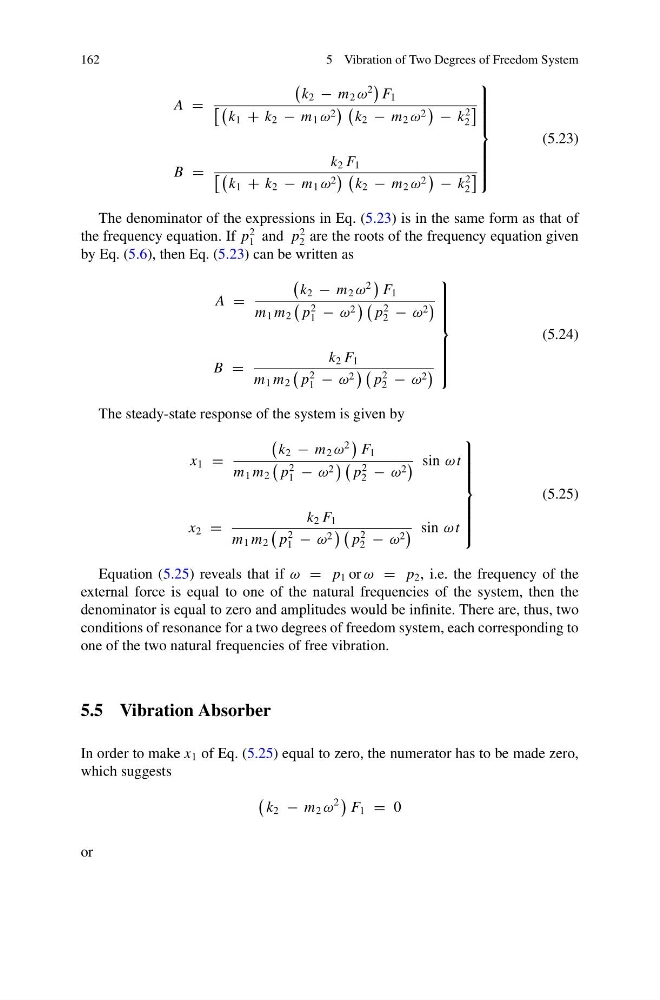
The denominator of the expressions in Eq. (5.23) is in the same form as that of
the frequency equation. If p
2
1 and p
2
2 are the roots of the frequency equation given
by Eq. (5.6), then Eq. (5.23) can be written as
A =
k 2 − m 2 ω
2
F 1
m 1 m 2
p
2
1 − ω 2
p
2
2 − ω 2
B =
k 2 F 1
m 1 m 2
p
2
1 − ω 2
p
2
2 − ω 2
⎫
⎪ ⎪ ⎪ ⎪ ⎪ ⎪ ⎬
⎪ ⎪ ⎪ ⎪ ⎪ ⎪ ⎭
(5.24)
The steady-state response of the system is given by
x 1 =
k 2 − m 2 ω
2
F 1
m 1 m 2
p
2
1 − ω 2
p
2
2 − ω 2
sin ω t
x 2 =
k 2 F 1
m 1 m 2
p
2
1 − ω 2
p
2
2 − ω 2
sin ω t
⎫
⎪ ⎪ ⎪ ⎪ ⎪ ⎪ ⎬
⎪ ⎪ ⎪ ⎪ ⎪ ⎪ ⎭
(5.25)
Equation (5.25) reveals that if ω = p 1 or ω = p 2 , i.e. the frequency of the
external force is equal to one of the natural frequencies of the system, then the
denominator is equal to zero and amplitudes would be infinite. There are, thus, two
conditions of resonance for a two degrees of freedom system, each corresponding to
one of the two natural frequencies of free vibration.
5.5 Vibration Absorber
In order to make x 1 of Eq. (5.25) equal to zero, the numerator has to be made zero,
which suggests
k 2 − m 2 ω
2
F 1 = 0
or
5 Vibration of Two Degrees of Freedom System
A =
k 2 − m 2 ω
2
F 1
k 1 + k 2 − m 1 ω 2
k 2 − m 2 ω 2
− k
2
2
B =
k 2 F 1
k 1 + k 2 − m 1 ω 2
k 2 − m 2 ω 2
− k
2
2
⎫
⎪ ⎪ ⎪ ⎪ ⎪ ⎪ ⎬
⎪ ⎪ ⎪ ⎪ ⎪ ⎪ ⎭
(5.23)
The denominator of the expressions in Eq. (5.23) is in the same form as that of
the frequency equation. If p
2
1 and p
2
2 are the roots of the frequency equation given
by Eq. (5.6), then Eq. (5.23) can be written as
A =
k 2 − m 2 ω
2
F 1
m 1 m 2
p
2
1 − ω 2
p
2
2 − ω 2
B =
k 2 F 1
m 1 m 2
p
2
1 − ω 2
p
2
2 − ω 2
⎫
⎪ ⎪ ⎪ ⎪ ⎪ ⎪ ⎬
⎪ ⎪ ⎪ ⎪ ⎪ ⎪ ⎭
(5.24)
The steady-state response of the system is given by
x 1 =
k 2 − m 2 ω
2
F 1
m 1 m 2
p
2
1 − ω 2
p
2
2 − ω 2
sin ω t
x 2 =
k 2 F 1
m 1 m 2
p
2
1 − ω 2
p
2
2 − ω 2
sin ω t
⎫
⎪ ⎪ ⎪ ⎪ ⎪ ⎪ ⎬
⎪ ⎪ ⎪ ⎪ ⎪ ⎪ ⎭
(5.25)
Equation (5.25) reveals that if ω = p 1 or ω = p 2 , i.e. the frequency of the
external force is equal to one of the natural frequencies of the system, then the
denominator is equal to zero and amplitudes would be infinite. There are, thus, two
conditions of resonance for a two degrees of freedom system, each corresponding to
one of the two natural frequencies of free vibration.
5.5 Vibration Absorber
In order to make x 1 of Eq. (5.25) equal to zero, the numerator has to be made zero,
which suggests
k 2 − m 2 ω
2
F 1 = 0
or