

5.3 Torsional Vibration of Two Degrees of Freedom System
161
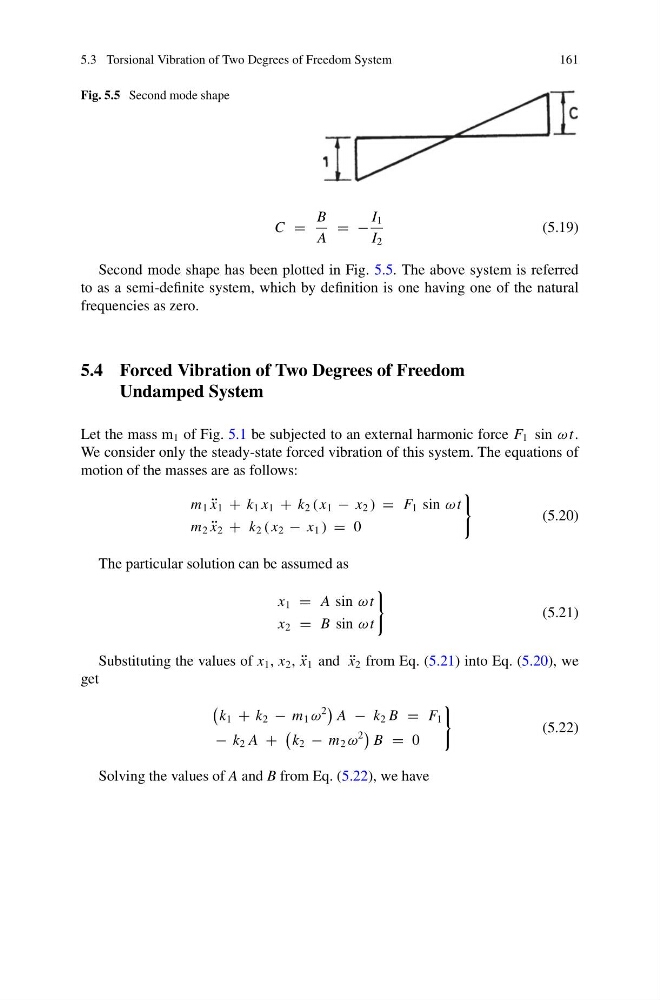
Fig. 5.5 Second mode shape
C =
B
A
= −
I 1
I 2
(5.19)
Second mode shape has been plotted in Fig. 5.5. The above system is referred
to as a semi-definite system, which by definition is one having one of the natural
frequencies as zero.
5.4 Forced Vibration of Two Degrees of Freedom
Undamped System
Let the mass m 1 of Fig. 5.1 be subjected to an external harmonic force F 1 sin ω t.
We consider only the steady-state forced vibration of this system. The equations of
motion of the masses are as follows:
m 1 ¨
x 1 + k 1 x 1 + k 2 ( x 1 − x 2 ) = F 1 sin ω t
m 2 ¨
x 2 + k 2 ( x 2 − x 1 ) = 0
(5.20)
The particular solution can be assumed as
x 1 = A sin ω t
x 2 = B sin ω t
(5.21)
Substituting the values of x 1 , x 2 , ¨
x 1 and ¨
x 2 from Eq. (5.21) into Eq. (5.20), we
get
k 1 + k 2 − m 1 ω
2
A − k 2 B = F 1
− k 2 A +
k 2 − m 2 ω
2
B = 0
(5.22)
Solving the values of A and B from Eq. (5.22), we have
161
Fig. 5.5 Second mode shape
C =
B
A
= −
I 1
I 2
(5.19)
Second mode shape has been plotted in Fig. 5.5. The above system is referred
to as a semi-definite system, which by definition is one having one of the natural
frequencies as zero.
5.4 Forced Vibration of Two Degrees of Freedom
Undamped System
Let the mass m 1 of Fig. 5.1 be subjected to an external harmonic force F 1 sin ω t.
We consider only the steady-state forced vibration of this system. The equations of
motion of the masses are as follows:
m 1 ¨
x 1 + k 1 x 1 + k 2 ( x 1 − x 2 ) = F 1 sin ω t
m 2 ¨
x 2 + k 2 ( x 2 − x 1 ) = 0
(5.20)
The particular solution can be assumed as
x 1 = A sin ω t
x 2 = B sin ω t
(5.21)
Substituting the values of x 1 , x 2 , ¨
x 1 and ¨
x 2 from Eq. (5.21) into Eq. (5.20), we
get
k 1 + k 2 − m 1 ω
2
A − k 2 B = F 1
− k 2 A +
k 2 − m 2 ω
2
B = 0
(5.22)
Solving the values of A and B from Eq. (5.22), we have