

160
5 Vibration of Two Degrees of Freedom System
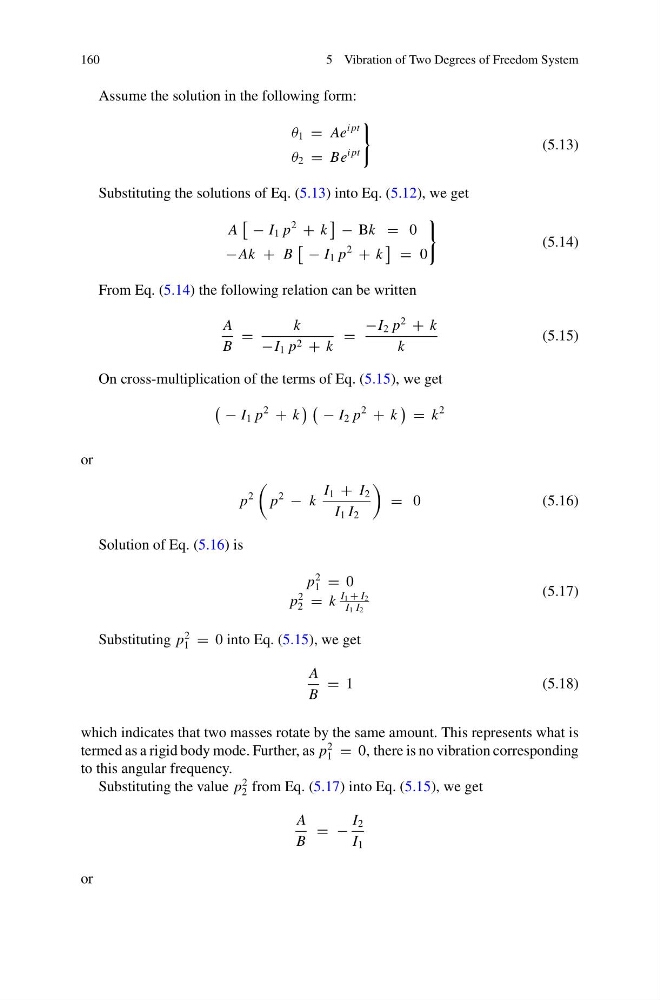
Assume the solution in the following form:
θ 1 = Ae
i pt
θ 2 = Be
i pt
(5.13)
Substituting the solutions of Eq. (5.13) into Eq. (5.12), we get
A
− I 1 p
2
+ k
− Bk = 0
−Ak + B
− I 1 p
2
+ k
= 0
(5.14)
From Eq. (5.14) the following relation can be written
A
B
=
k
−I 1 p 2 + k
=
−I 2 p
2
+ k
k
(5.15)
On cross-multiplication of the terms of Eq. (5.15), we get
− I 1 p
2
+ k
− I 2 p
2
+ k
= k
2
or
p
2
p
2
− k
I 1 + I 2
I 1 I 2
= 0
(5.16)
Solution of Eq. (5.16) is
p
2
1 = 0
p
2
2 = k
I 1 + I 2
I 1 I 2
(5.17)
Substituting p
2
1 = 0 into Eq. (5.15), we get
A
B
= 1
(5.18)
which indicates that two masses rotate by the same amount. This represents what is
termed as a rigid body mode. Further, as p
2
1 = 0, there is no vibration corresponding
to this angular frequency.
Substituting the value p
2
2 from Eq. (5.17) into Eq. (5.15), we get
A
B
= −
I 2
I 1
or
5 Vibration of Two Degrees of Freedom System
Assume the solution in the following form:
θ 1 = Ae
i pt
θ 2 = Be
i pt
(5.13)
Substituting the solutions of Eq. (5.13) into Eq. (5.12), we get
A
− I 1 p
2
+ k
− Bk = 0
−Ak + B
− I 1 p
2
+ k
= 0
(5.14)
From Eq. (5.14) the following relation can be written
A
B
=
k
−I 1 p 2 + k
=
−I 2 p
2
+ k
k
(5.15)
On cross-multiplication of the terms of Eq. (5.15), we get
− I 1 p
2
+ k
− I 2 p
2
+ k
= k
2
or
p
2
p
2
− k
I 1 + I 2
I 1 I 2
= 0
(5.16)
Solution of Eq. (5.16) is
p
2
1 = 0
p
2
2 = k
I 1 + I 2
I 1 I 2
(5.17)
Substituting p
2
1 = 0 into Eq. (5.15), we get
A
B
= 1
(5.18)
which indicates that two masses rotate by the same amount. This represents what is
termed as a rigid body mode. Further, as p
2
1 = 0, there is no vibration corresponding
to this angular frequency.
Substituting the value p
2
2 from Eq. (5.17) into Eq. (5.15), we get
A
B
= −
I 2
I 1
or