

5.2 Free Vibration of Undamped Two Degrees of Freedom Systems
157
p
4
−
k 2
m 2
+
k 1 + k 2
m 1
p
2
+
k 1 k 2
m 1 m 2
= 0
(5.6)
Equation (5.6) is a quadratic equation in p
2 . In this case, all the roots are real. Let
the four roots of Eq. (5.6) be p 1 , −p 1 , p 2 and − p 2 .
Therefore, according to Eq. (5.2)
x 1 = A 1 e
i p 1 t
+ A 2 e
− i p 1 t
+ A 3 e
i p 2 t
+ A 4 e
− i p 2 t
x 2 = B 1 e
i p 1 t
+ B 2 e
− i p 1 t
+ B 3 e
i p 2 t
+ B 4 e
− i p 2 t
(5.7)
Once the values of p
2
1 and p
2
2 are determined, B and A have known ratios, as
given by Eq. (5.4). Equation (5.4) can be written as
B =
k 2
− m 2 p 2 + k 2
A = C A
(5.8)
Equation (5.8) yields for each of the two values of p
2 , a corresponding value of
C, both of which are real numbers. Therefore, the second of Eq. (5.7) can be written
as
x 2 = C 1
A 1 e
i p 1 t
+ A 2 e
− i p 1 t
+ C 2
A 3 e
i p 2 t
+ A 4 e
− i p 2 t
(5.9)
Noting that e
± iθ
= cos θ ± i sin θ, Eq. (5.7) reduces, after modifying the
second equation as per Eq. (5.9) to
x 1 = D 1 cos p 1 t + D 2 sin p 1 t + D 3 cos p 2 t + D 4 sin p 2 t
x 2 = C 1 ( D 1 cos p 1 t + D 2 sin p 1 t) + C 2 ( D 3 cos p 2 t + D 4 sin p 2 t)
(5.10)
Equations (5.10) can also be written as
x 1 = E 1 sin ( p 1 t + ϕ 1 ) + E 2 sin ( p 2 t + ϕ 2 )
x 2 = C 1 E 1 sin ( p 1 t + ϕ 1 ) + C 2 E 2 sin ( p 2 t + ϕ 2 )
(5.11)
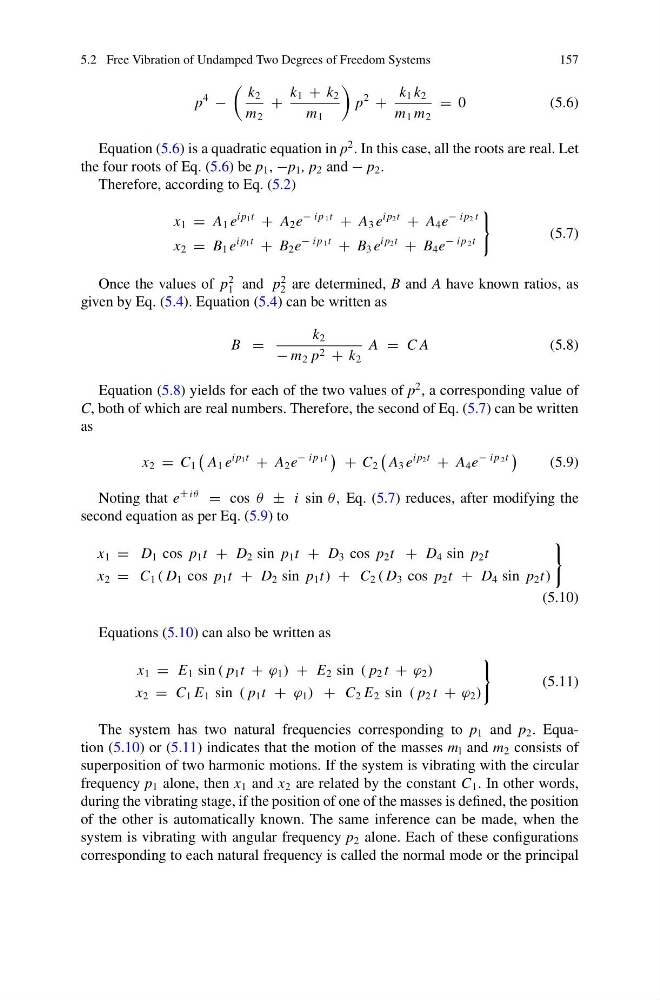
The system has two natural frequencies corresponding to p 1 and p 2 . Equation (5.10) or (5.11) indicates that the motion of the masses m l and m 2 consists of
superposition of two harmonic motions. If the system is vibrating with the circular
frequency p 1 alone, then x 1 and x 2 are related by the constant C 1 . In other words,
during the vibrating stage, if the position of one of the masses is defined, the position
of the other is automatically known. The same inference can be made, when the
system is vibrating with angular frequency p 2 alone. Each of these configurations
corresponding to each natural frequency is called the normal mode or the principal
157
p
4
−
k 2
m 2
+
k 1 + k 2
m 1
p
2
+
k 1 k 2
m 1 m 2
= 0
(5.6)
Equation (5.6) is a quadratic equation in p
2 . In this case, all the roots are real. Let
the four roots of Eq. (5.6) be p 1 , −p 1 , p 2 and − p 2 .
Therefore, according to Eq. (5.2)
x 1 = A 1 e
i p 1 t
+ A 2 e
− i p 1 t
+ A 3 e
i p 2 t
+ A 4 e
− i p 2 t
x 2 = B 1 e
i p 1 t
+ B 2 e
− i p 1 t
+ B 3 e
i p 2 t
+ B 4 e
− i p 2 t
(5.7)
Once the values of p
2
1 and p
2
2 are determined, B and A have known ratios, as
given by Eq. (5.4). Equation (5.4) can be written as
B =
k 2
− m 2 p 2 + k 2
A = C A
(5.8)
Equation (5.8) yields for each of the two values of p
2 , a corresponding value of
C, both of which are real numbers. Therefore, the second of Eq. (5.7) can be written
as
x 2 = C 1
A 1 e
i p 1 t
+ A 2 e
− i p 1 t
+ C 2
A 3 e
i p 2 t
+ A 4 e
− i p 2 t
(5.9)
Noting that e
± iθ
= cos θ ± i sin θ, Eq. (5.7) reduces, after modifying the
second equation as per Eq. (5.9) to
x 1 = D 1 cos p 1 t + D 2 sin p 1 t + D 3 cos p 2 t + D 4 sin p 2 t
x 2 = C 1 ( D 1 cos p 1 t + D 2 sin p 1 t) + C 2 ( D 3 cos p 2 t + D 4 sin p 2 t)
(5.10)
Equations (5.10) can also be written as
x 1 = E 1 sin ( p 1 t + ϕ 1 ) + E 2 sin ( p 2 t + ϕ 2 )
x 2 = C 1 E 1 sin ( p 1 t + ϕ 1 ) + C 2 E 2 sin ( p 2 t + ϕ 2 )
(5.11)
The system has two natural frequencies corresponding to p 1 and p 2 . Equation (5.10) or (5.11) indicates that the motion of the masses m l and m 2 consists of
superposition of two harmonic motions. If the system is vibrating with the circular
frequency p 1 alone, then x 1 and x 2 are related by the constant C 1 . In other words,
during the vibrating stage, if the position of one of the masses is defined, the position
of the other is automatically known. The same inference can be made, when the
system is vibrating with angular frequency p 2 alone. Each of these configurations
corresponding to each natural frequency is called the normal mode or the principal