

158
5 Vibration of Two Degrees of Freedom System
mode. Four constants related to the equation of motion can be evaluated from the
initial conditions.
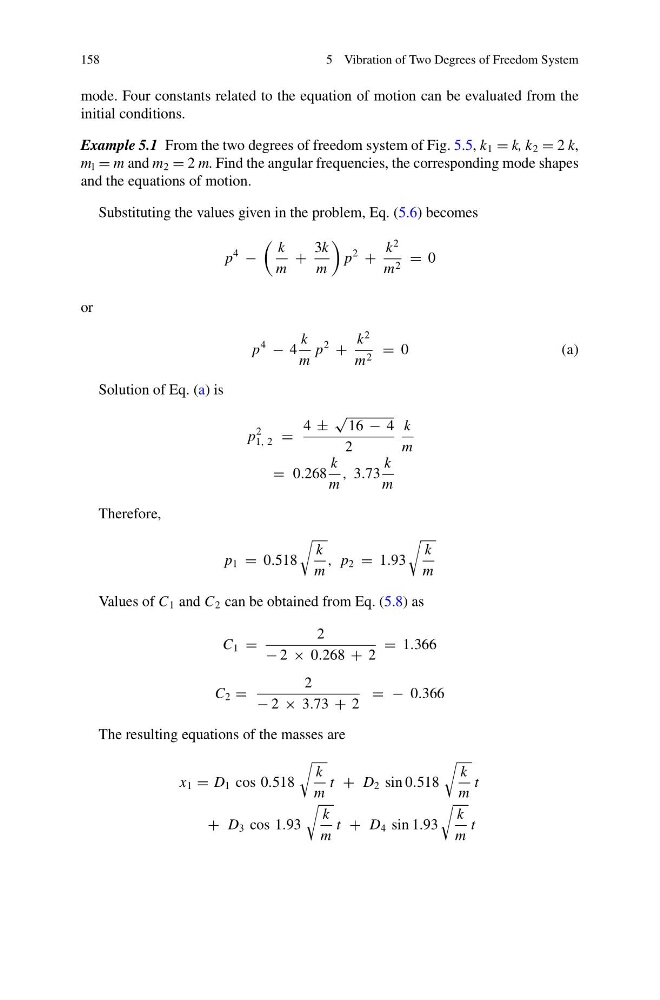
Example 5.1 From the two degrees of freedom system of Fig. 5.5, k 1 = k, k 2 = 2 k,
m l = m and m 2 = 2 m. Find the angular frequencies, the corresponding mode shapes
and the equations of motion.
Substituting the values given in the problem, Eq. (5.6) becomes
p
4
−
k
m
+
3k
m
p
2
+
k
2
m 2 = 0
or
p
4
− 4
k
m
p
2
+
k
2
m 2 = 0
( a )
Solution of Eq. (a) is
p
2
1, 2 =
4 ±
√
16 − 4
2
k
m
= 0.268
k
m
, 3.73
k
m
Therefore,
p 1 = 0.518
k
m
, p 2 = 1.93
k
m
Values of C 1 and C 2 can be obtained from Eq. (5.8) as
C 1 =
2
− 2 × 0.268 + 2
= 1.366
C 2 =
2
− 2 × 3.73 + 2
= − 0.366
The resulting equations of the masses are
x 1 = D 1 cos 0.518
k
m
t + D 2 sin 0.518
k
m
t
+ D 3 cos 1.93
k
m
t + D 4 sin 1.93
k
m
t
5 Vibration of Two Degrees of Freedom System
mode. Four constants related to the equation of motion can be evaluated from the
initial conditions.
Example 5.1 From the two degrees of freedom system of Fig. 5.5, k 1 = k, k 2 = 2 k,
m l = m and m 2 = 2 m. Find the angular frequencies, the corresponding mode shapes
and the equations of motion.
Substituting the values given in the problem, Eq. (5.6) becomes
p
4
−
k
m
+
3k
m
p
2
+
k
2
m 2 = 0
or
p
4
− 4
k
m
p
2
+
k
2
m 2 = 0
( a )
Solution of Eq. (a) is
p
2
1, 2 =
4 ±
√
16 − 4
2
k
m
= 0.268
k
m
, 3.73
k
m
Therefore,
p 1 = 0.518
k
m
, p 2 = 1.93
k
m
Values of C 1 and C 2 can be obtained from Eq. (5.8) as
C 1 =
2
− 2 × 0.268 + 2
= 1.366
C 2 =
2
− 2 × 3.73 + 2
= − 0.366
The resulting equations of the masses are
x 1 = D 1 cos 0.518
k
m
t + D 2 sin 0.518
k
m
t
+ D 3 cos 1.93
k
m
t + D 4 sin 1.93
k
m
t