

the fragmentation and artificial forces. One of the methods to overcome this problem
is the SC-AFIR method.
3.2 Exhaustive Reaction Path Search Using the SC-AFIR
Method
Next, we present a reaction path network constructed by the SC-AFIR algorithm. In
the SC-AFIR algorithm, many fragments are automatically assigned in a given
system to induce various geometrical deformations by pushing them together or
pulling them apart. In default setting, such fragments are defined around all atoms in
a system, and the artificial force is applied to all fragment pairs. Therefore, the total
cost increases in proportion with N
2 depending on the number of atoms N in the
system. Moreover, the procedure is applied to all obtained local minimum structures.
An SC-AFIR search with this default setting provides a global reaction path network
including all local minima and TSs accessible by the artificial force of a given γ.
However, the application of such an exhaustive search is limited to relatively simple
systems. In order to expand the applicability of SC-AFIR, various options are
available. An option which limits atoms to which fragments are assigned (target
atoms) and those which limit local minima to which the search procedure is applied
are frequently used for this purpose. Below, case studies on Co-catalyzed
hydroformylation and Rh-catalyzed asymmetric hydrogen shift reaction are
presented.
Hydroformylation The Co-catalyzed hydroformylation would be the most thoroughly studied organometallic system [77–82]. Several reports showing application
results of automated reaction path search methods have also been made [26, 36, 47,
83, 84]. We have presented a result of applications such as a preliminary version of
the SC-AFIR algorithm in which ligands are recognized as fragments and a semiautomatic search that applies the SC-AFIR method sequentially by limiting the
target structure with a bonding pattern. This time, we report the result of applying
the kinetic navigation, which determines the target structure based on the traffic
volume Λ i obtained by the RCMC method. In this search, the temperature T and
reaction time t MAX when applying the RCMC method were set to T ¼ 300,
400, 500 K and t MAX ¼ 3,600 s. The reaction system was assumed to include
HCo(CO) 3 , CO, H 2 , and C 2 H 4 , and random structures, in which their mutual
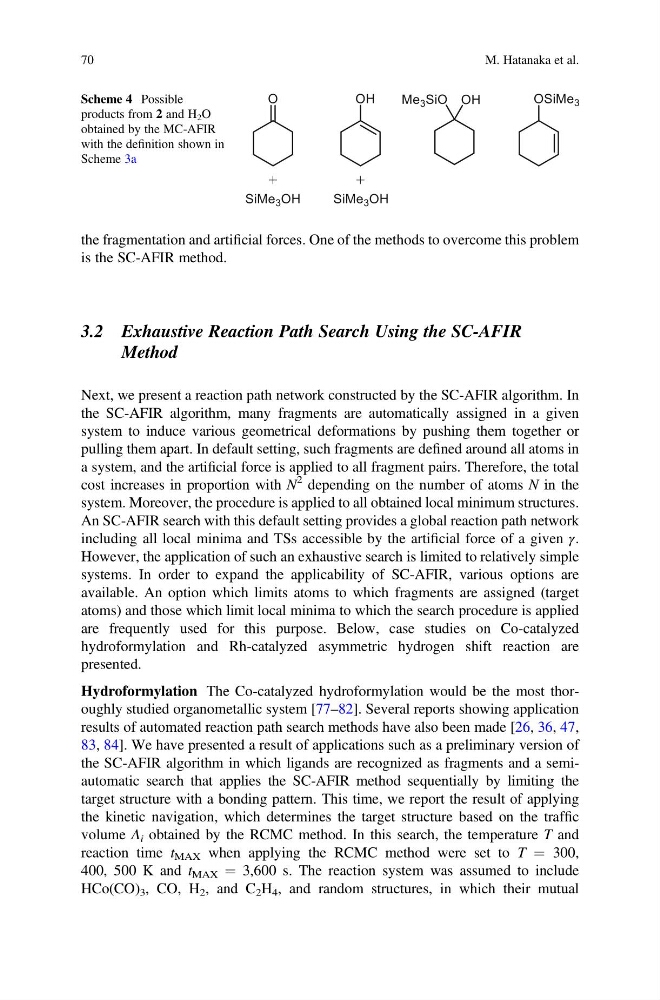
Scheme 4 Possible
products from 2 and H 2 O
obtained by the MC-AFIR
with the definition shown in
Scheme 3a
70
M. Hatanaka et al.
is the SC-AFIR method.
3.2 Exhaustive Reaction Path Search Using the SC-AFIR
Method
Next, we present a reaction path network constructed by the SC-AFIR algorithm. In
the SC-AFIR algorithm, many fragments are automatically assigned in a given
system to induce various geometrical deformations by pushing them together or
pulling them apart. In default setting, such fragments are defined around all atoms in
a system, and the artificial force is applied to all fragment pairs. Therefore, the total
cost increases in proportion with N
2 depending on the number of atoms N in the
system. Moreover, the procedure is applied to all obtained local minimum structures.
An SC-AFIR search with this default setting provides a global reaction path network
including all local minima and TSs accessible by the artificial force of a given γ.
However, the application of such an exhaustive search is limited to relatively simple
systems. In order to expand the applicability of SC-AFIR, various options are
available. An option which limits atoms to which fragments are assigned (target
atoms) and those which limit local minima to which the search procedure is applied
are frequently used for this purpose. Below, case studies on Co-catalyzed
hydroformylation and Rh-catalyzed asymmetric hydrogen shift reaction are
presented.
Hydroformylation The Co-catalyzed hydroformylation would be the most thoroughly studied organometallic system [77–82]. Several reports showing application
results of automated reaction path search methods have also been made [26, 36, 47,
83, 84]. We have presented a result of applications such as a preliminary version of
the SC-AFIR algorithm in which ligands are recognized as fragments and a semiautomatic search that applies the SC-AFIR method sequentially by limiting the
target structure with a bonding pattern. This time, we report the result of applying
the kinetic navigation, which determines the target structure based on the traffic
volume Λ i obtained by the RCMC method. In this search, the temperature T and
reaction time t MAX when applying the RCMC method were set to T ¼ 300,
400, 500 K and t MAX ¼ 3,600 s. The reaction system was assumed to include
HCo(CO) 3 , CO, H 2 , and C 2 H 4 , and random structures, in which their mutual
Scheme 4 Possible
products from 2 and H 2 O
obtained by the MC-AFIR
with the definition shown in
Scheme 3a
70
M. Hatanaka et al.