

improved by reducing the existing probability of conf. C itself. One way to change
the existing probability of each conformer is changing the Ln
3+ center. This idea was
consistent with the experimental results. As shown above, the exhaustive sampling
of the TSs of the stereo-determining step made it possible to reproduce the experimental product ratio quantitatively and to establish the strategy for improving the
selectivity.
It is worth noting that the definition of fragments and artificial forces for the
MC-AFIR method is flexible and left to the users. For instance, four definitions of
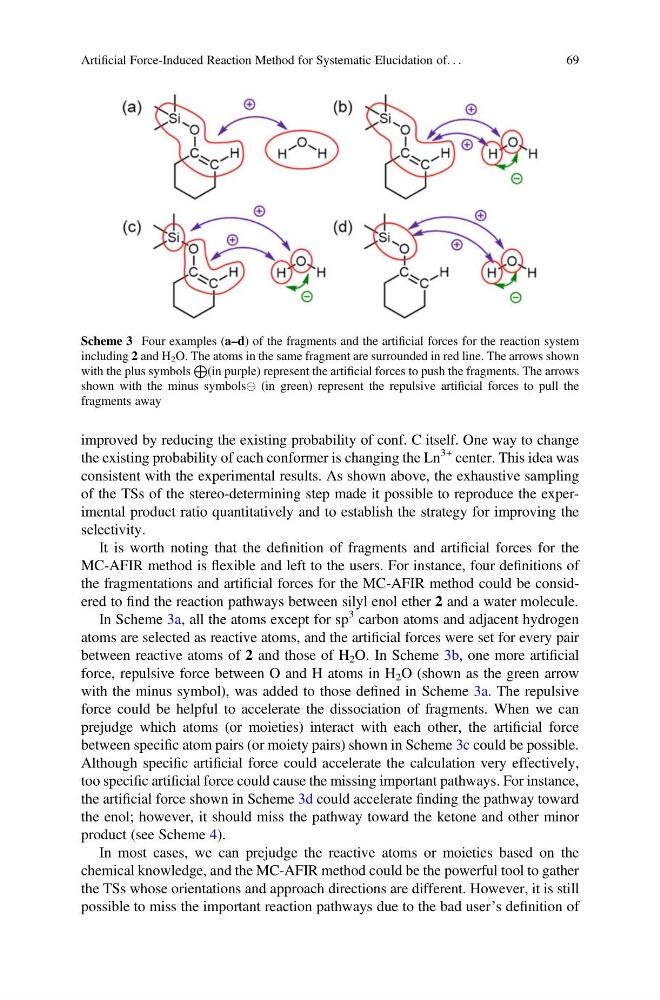
the fragmentations and artificial forces for the MC-AFIR method could be considered to find the reaction pathways between silyl enol ether 2 and a water molecule.
In Scheme 3a, all the atoms except for sp
3 carbon atoms and adjacent hydrogen
atoms are selected as reactive atoms, and the artificial forces were set for every pair
between reactive atoms of 2 and those of H 2 O. In Scheme 3b, one more artificial
force, repulsive force between O and H atoms in H 2 O (shown as the green arrow
with the minus symbol), was added to those defined in Scheme 3a. The repulsive
force could be helpful to accelerate the dissociation of fragments. When we can
prejudge which atoms (or moieties) interact with each other, the artificial force
between specific atom pairs (or moiety pairs) shown in Scheme 3c could be possible.
Although specific artificial force could accelerate the calculation very effectively,
too specific artificial force could cause the missing important pathways. For instance,
the artificial force shown in Scheme 3d could accelerate finding the pathway toward
the enol; however, it should miss the pathway toward the ketone and other minor
product (see Scheme 4).
In most cases, we can prejudge the reactive atoms or moieties based on the
chemical knowledge, and the MC-AFIR method could be the powerful tool to gather
the TSs whose orientations and approach directions are different. However, it is still
possible to miss the important reaction pathways due to the bad user’s definition of
Scheme 3 Four examples (a–d) of the fragments and the artificial forces for the reaction system
including 2 and H 2 O. The atoms in the same fragment are surrounded in red line. The arrows shown
with the plus symbols
L
(in purple) represent the artificial forces to push the fragments. The arrows
shown with the minus symbolsÉ (in green) represent the repulsive artificial forces to pull the
fragments away
Artificial Force-Induced Reaction Method for Systematic Elucidation of. . .
69
the existing probability of each conformer is changing the Ln
3+ center. This idea was
consistent with the experimental results. As shown above, the exhaustive sampling
of the TSs of the stereo-determining step made it possible to reproduce the experimental product ratio quantitatively and to establish the strategy for improving the
selectivity.
It is worth noting that the definition of fragments and artificial forces for the
MC-AFIR method is flexible and left to the users. For instance, four definitions of
the fragmentations and artificial forces for the MC-AFIR method could be considered to find the reaction pathways between silyl enol ether 2 and a water molecule.
In Scheme 3a, all the atoms except for sp
3 carbon atoms and adjacent hydrogen
atoms are selected as reactive atoms, and the artificial forces were set for every pair
between reactive atoms of 2 and those of H 2 O. In Scheme 3b, one more artificial
force, repulsive force between O and H atoms in H 2 O (shown as the green arrow
with the minus symbol), was added to those defined in Scheme 3a. The repulsive
force could be helpful to accelerate the dissociation of fragments. When we can
prejudge which atoms (or moieties) interact with each other, the artificial force
between specific atom pairs (or moiety pairs) shown in Scheme 3c could be possible.
Although specific artificial force could accelerate the calculation very effectively,
too specific artificial force could cause the missing important pathways. For instance,
the artificial force shown in Scheme 3d could accelerate finding the pathway toward
the enol; however, it should miss the pathway toward the ketone and other minor
product (see Scheme 4).
In most cases, we can prejudge the reactive atoms or moieties based on the
chemical knowledge, and the MC-AFIR method could be the powerful tool to gather
the TSs whose orientations and approach directions are different. However, it is still
possible to miss the important reaction pathways due to the bad user’s definition of
Scheme 3 Four examples (a–d) of the fragments and the artificial forces for the reaction system
including 2 and H 2 O. The atoms in the same fragment are surrounded in red line. The arrows shown
with the plus symbols
L
(in purple) represent the artificial forces to push the fragments. The arrows
shown with the minus symbolsÉ (in green) represent the repulsive artificial forces to pull the
fragments away
Artificial Force-Induced Reaction Method for Systematic Elucidation of. . .
69