

conformation search can be done by the SC-AFIR method with a low computational
cost.) The TSs of the stereo-determining step were gathered by the MC-AFIR
method with the artificial force between the reactive carbon atoms starting from
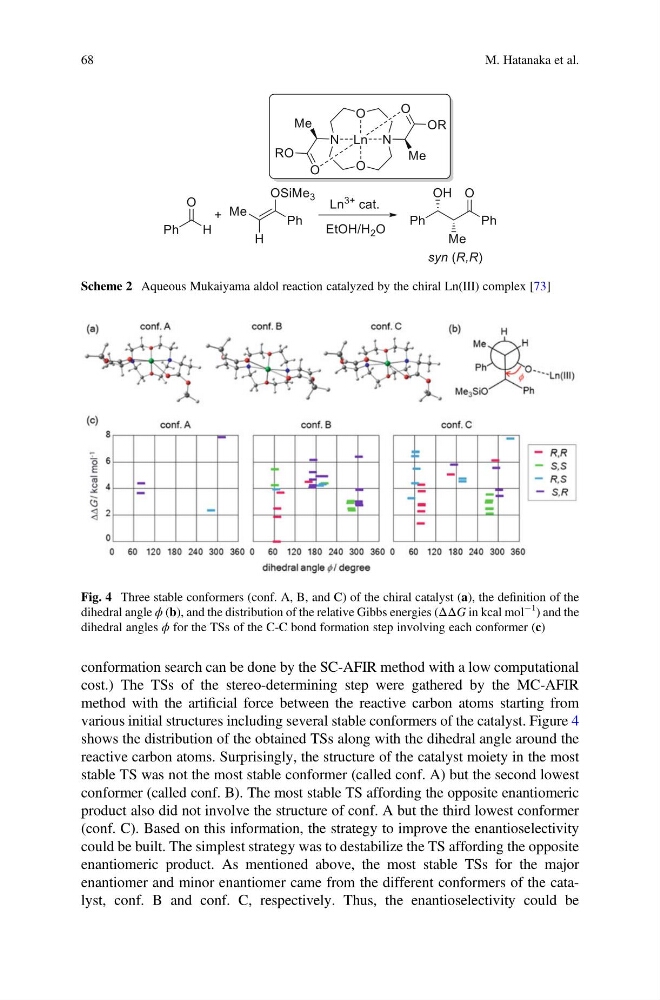
various initial structures including several stable conformers of the catalyst. Figure 4
shows the distribution of the obtained TSs along with the dihedral angle around the
reactive carbon atoms. Surprisingly, the structure of the catalyst moiety in the most
stable TS was not the most stable conformer (called conf. A) but the second lowest
conformer (called conf. B). The most stable TS affording the opposite enantiomeric
product also did not involve the structure of conf. A but the third lowest conformer
(conf. C). Based on this information, the strategy to improve the enantioselectivity
could be built. The simplest strategy was to destabilize the TS affording the opposite
enantiomeric product. As mentioned above, the most stable TSs for the major
enantiomer and minor enantiomer came from the different conformers of the catalyst, conf. B and conf. C, respectively. Thus, the enantioselectivity could be
Scheme 2 Aqueous Mukaiyama aldol reaction catalyzed by the chiral Ln(III) complex [73]
Fig. 4 Three stable conformers (conf. A, B, and C) of the chiral catalyst (a), the definition of the
dihedral angle ϕ (b), and the distribution of the relative Gibbs energies (ΔΔG in kcal mol
À1
) and the
dihedral angles ϕ for the TSs of the C-C bond formation step involving each conformer (c)
68
M. Hatanaka et al.
cost.) The TSs of the stereo-determining step were gathered by the MC-AFIR
method with the artificial force between the reactive carbon atoms starting from
various initial structures including several stable conformers of the catalyst. Figure 4
shows the distribution of the obtained TSs along with the dihedral angle around the
reactive carbon atoms. Surprisingly, the structure of the catalyst moiety in the most
stable TS was not the most stable conformer (called conf. A) but the second lowest
conformer (called conf. B). The most stable TS affording the opposite enantiomeric
product also did not involve the structure of conf. A but the third lowest conformer
(conf. C). Based on this information, the strategy to improve the enantioselectivity
could be built. The simplest strategy was to destabilize the TS affording the opposite
enantiomeric product. As mentioned above, the most stable TSs for the major
enantiomer and minor enantiomer came from the different conformers of the catalyst, conf. B and conf. C, respectively. Thus, the enantioselectivity could be
Scheme 2 Aqueous Mukaiyama aldol reaction catalyzed by the chiral Ln(III) complex [73]
Fig. 4 Three stable conformers (conf. A, B, and C) of the chiral catalyst (a), the definition of the
dihedral angle ϕ (b), and the distribution of the relative Gibbs energies (ΔΔG in kcal mol
À1
) and the
dihedral angles ϕ for the TSs of the C-C bond formation step involving each conformer (c)
68
M. Hatanaka et al.