

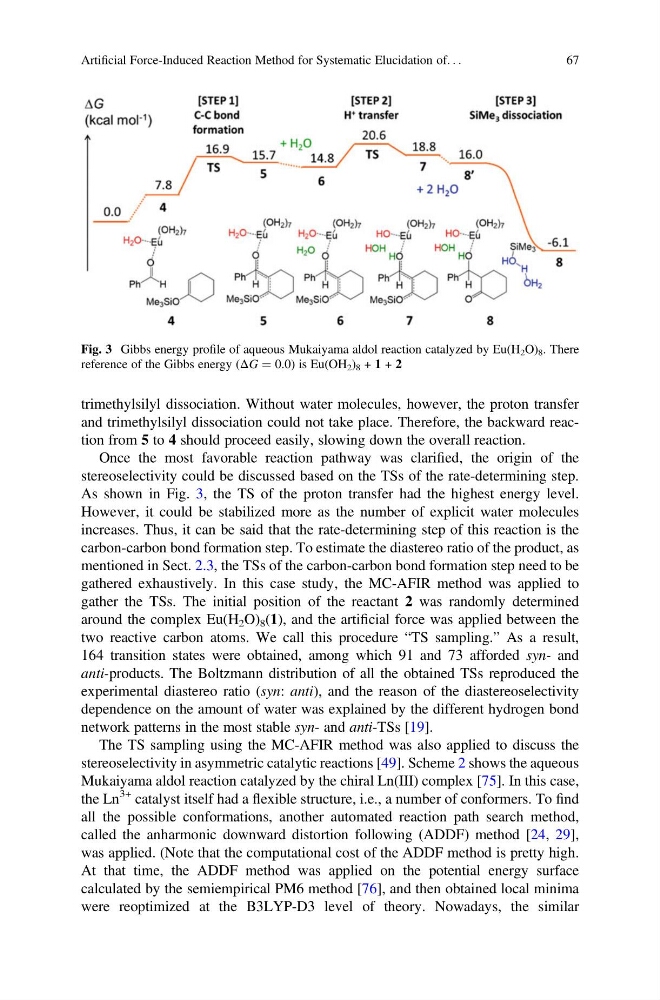
trimethylsilyl dissociation. Without water molecules, however, the proton transfer
and trimethylsilyl dissociation could not take place. Therefore, the backward reaction from 5 to 4 should proceed easily, slowing down the overall reaction.
Once the most favorable reaction pathway was clarified, the origin of the
stereoselectivity could be discussed based on the TSs of the rate-determining step.
As shown in Fig. 3, the TS of the proton transfer had the highest energy level.
However, it could be stabilized more as the number of explicit water molecules
increases. Thus, it can be said that the rate-determining step of this reaction is the
carbon-carbon bond formation step. To estimate the diastereo ratio of the product, as
mentioned in Sect. 2.3, the TSs of the carbon-carbon bond formation step need to be
gathered exhaustively. In this case study, the MC-AFIR method was applied to
gather the TSs. The initial position of the reactant 2 was randomly determined
around the complex Eu(H 2 O) 8 (1), and the artificial force was applied between the
two reactive carbon atoms. We call this procedure “TS sampling.” As a result,
164 transition states were obtained, among which 91 and 73 afforded syn- and
anti-products. The Boltzmann distribution of all the obtained TSs reproduced the
experimental diastereo ratio (syn: anti), and the reason of the diastereoselectivity
dependence on the amount of water was explained by the different hydrogen bond
network patterns in the most stable syn- and anti-TSs [19].
The TS sampling using the MC-AFIR method was also applied to discuss the
stereoselectivity in asymmetric catalytic reactions [49]. Scheme 2 shows the aqueous
Mukaiyama aldol reaction catalyzed by the chiral Ln(III) complex [75]. In this case,
the Ln
3+ catalyst itself had a flexible structure, i.e., a number of conformers. To find
all the possible conformations, another automated reaction path search method,
called the anharmonic downward distortion following (ADDF) method [24, 29],
was applied. (Note that the computational cost of the ADDF method is pretty high.
At that time, the ADDF method was applied on the potential energy surface
calculated by the semiempirical PM6 method [76], and then obtained local minima
were reoptimized at the B3LYP-D3 level of theory. Nowadays, the similar
Fig. 3 Gibbs energy profile of aqueous Mukaiyama aldol reaction catalyzed by Eu(H 2 O) 8 . There
reference of the Gibbs energy (ΔG ¼ 0.0) is Eu(OH 2 ) 8 + 1 + 2
Artificial Force-Induced Reaction Method for Systematic Elucidation of. . .
67
and trimethylsilyl dissociation could not take place. Therefore, the backward reaction from 5 to 4 should proceed easily, slowing down the overall reaction.
Once the most favorable reaction pathway was clarified, the origin of the
stereoselectivity could be discussed based on the TSs of the rate-determining step.
As shown in Fig. 3, the TS of the proton transfer had the highest energy level.
However, it could be stabilized more as the number of explicit water molecules
increases. Thus, it can be said that the rate-determining step of this reaction is the
carbon-carbon bond formation step. To estimate the diastereo ratio of the product, as
mentioned in Sect. 2.3, the TSs of the carbon-carbon bond formation step need to be
gathered exhaustively. In this case study, the MC-AFIR method was applied to
gather the TSs. The initial position of the reactant 2 was randomly determined
around the complex Eu(H 2 O) 8 (1), and the artificial force was applied between the
two reactive carbon atoms. We call this procedure “TS sampling.” As a result,
164 transition states were obtained, among which 91 and 73 afforded syn- and
anti-products. The Boltzmann distribution of all the obtained TSs reproduced the
experimental diastereo ratio (syn: anti), and the reason of the diastereoselectivity
dependence on the amount of water was explained by the different hydrogen bond
network patterns in the most stable syn- and anti-TSs [19].
The TS sampling using the MC-AFIR method was also applied to discuss the
stereoselectivity in asymmetric catalytic reactions [49]. Scheme 2 shows the aqueous
Mukaiyama aldol reaction catalyzed by the chiral Ln(III) complex [75]. In this case,
the Ln
3+ catalyst itself had a flexible structure, i.e., a number of conformers. To find
all the possible conformations, another automated reaction path search method,
called the anharmonic downward distortion following (ADDF) method [24, 29],
was applied. (Note that the computational cost of the ADDF method is pretty high.
At that time, the ADDF method was applied on the potential energy surface
calculated by the semiempirical PM6 method [76], and then obtained local minima
were reoptimized at the B3LYP-D3 level of theory. Nowadays, the similar
Fig. 3 Gibbs energy profile of aqueous Mukaiyama aldol reaction catalyzed by Eu(H 2 O) 8 . There
reference of the Gibbs energy (ΔG ¼ 0.0) is Eu(OH 2 ) 8 + 1 + 2
Artificial Force-Induced Reaction Method for Systematic Elucidation of. . .
67