

Mukaiyama aldol reaction catalyzed by Ln(OTf) 3 in organic solvent dramatically
increased upon addition of water. Another is why the diastereoselectivity of this
aqueous reaction shows opposite diastereoselectivity to the same reaction with
anhydrous condition.
Both two questions were answered based on the information obtained by the
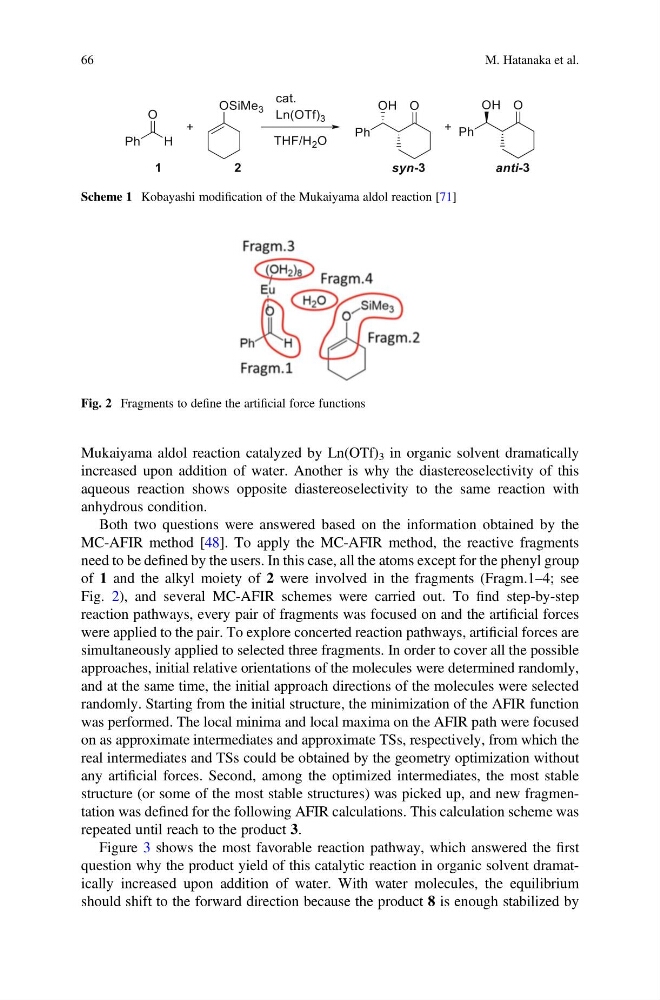
MC-AFIR method [48]. To apply the MC-AFIR method, the reactive fragments
need to be defined by the users. In this case, all the atoms except for the phenyl group
of 1 and the alkyl moiety of 2 were involved in the fragments (Fragm.1–4; see
Fig. 2), and several MC-AFIR schemes were carried out. To find step-by-step
reaction pathways, every pair of fragments was focused on and the artificial forces
were applied to the pair. To explore concerted reaction pathways, artificial forces are
simultaneously applied to selected three fragments. In order to cover all the possible
approaches, initial relative orientations of the molecules were determined randomly,
and at the same time, the initial approach directions of the molecules were selected
randomly. Starting from the initial structure, the minimization of the AFIR function
was performed. The local minima and local maxima on the AFIR path were focused
on as approximate intermediates and approximate TSs, respectively, from which the
real intermediates and TSs could be obtained by the geometry optimization without
any artificial forces. Second, among the optimized intermediates, the most stable
structure (or some of the most stable structures) was picked up, and new fragmentation was defined for the following AFIR calculations. This calculation scheme was
repeated until reach to the product 3.
Figure 3 shows the most favorable reaction pathway, which answered the first
question why the product yield of this catalytic reaction in organic solvent dramatically increased upon addition of water. With water molecules, the equilibrium
should shift to the forward direction because the product 8 is enough stabilized by
Scheme 1 Kobayashi modification of the Mukaiyama aldol reaction [71]
Fig. 2 Fragments to define the artificial force functions
66
M. Hatanaka et al.
increased upon addition of water. Another is why the diastereoselectivity of this
aqueous reaction shows opposite diastereoselectivity to the same reaction with
anhydrous condition.
Both two questions were answered based on the information obtained by the
MC-AFIR method [48]. To apply the MC-AFIR method, the reactive fragments
need to be defined by the users. In this case, all the atoms except for the phenyl group
of 1 and the alkyl moiety of 2 were involved in the fragments (Fragm.1–4; see
Fig. 2), and several MC-AFIR schemes were carried out. To find step-by-step
reaction pathways, every pair of fragments was focused on and the artificial forces
were applied to the pair. To explore concerted reaction pathways, artificial forces are
simultaneously applied to selected three fragments. In order to cover all the possible
approaches, initial relative orientations of the molecules were determined randomly,
and at the same time, the initial approach directions of the molecules were selected
randomly. Starting from the initial structure, the minimization of the AFIR function
was performed. The local minima and local maxima on the AFIR path were focused
on as approximate intermediates and approximate TSs, respectively, from which the
real intermediates and TSs could be obtained by the geometry optimization without
any artificial forces. Second, among the optimized intermediates, the most stable
structure (or some of the most stable structures) was picked up, and new fragmentation was defined for the following AFIR calculations. This calculation scheme was
repeated until reach to the product 3.
Figure 3 shows the most favorable reaction pathway, which answered the first
question why the product yield of this catalytic reaction in organic solvent dramatically increased upon addition of water. With water molecules, the equilibrium
should shift to the forward direction because the product 8 is enough stabilized by
Scheme 1 Kobayashi modification of the Mukaiyama aldol reaction [71]
Fig. 2 Fragments to define the artificial force functions
66
M. Hatanaka et al.