

of the imaginary frequency at the TS. The transmission coefficient Γ in the expression of Eq. (5) is used to take account of a part of the tunneling effect (see ref. [64]
for more advanced tunneling theories). Eq. 4 is the expression for unimolecular
reactions, and the factor (RT/p
0 )
nÀ1 is multiplied in the nth-order reactions, where p
0
corresponds to the standard atmosphere, i.e., 1 atm.
In many cases, the reactivity is discussed based on the rate constant at the ratedetermining elementary step. If the most stable structure in the reactant region (the
most stable local minimum prior to the TS of rate-determining step) is known, the
reactivity is discussed based on the rate constant calculated by the Gibbs energy
difference between the TS of the rate-determining step and the most stable local
minimum prior to the TS. If thermal equilibrium in the reactant region is assumed,
the generalized pre-equilibrium approximation model (or Shaffer’s model) can be
applied [65, 66]. In this model, the overall reaction profile is divided into the reactant
region R and the others. Then, the overall rate constant from R to the product region
is estimated by the following equation:
k
0
ij ¼
e
ÀΔG i =RT
P
p2R e ÀΔG p =RT Γ
k B T
h
e
À ΔG
{
ij ÀΔG i
ð
Þ =RT
ð6Þ
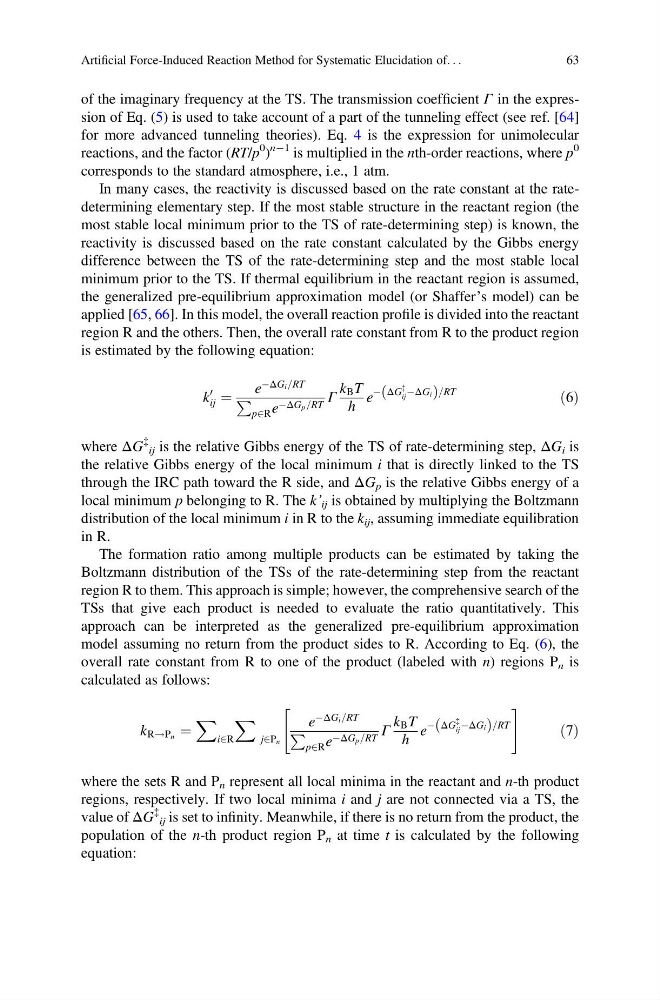
where ΔG
{
ij is the relative Gibbs energy of the TS of rate-determining step, ΔG i is
the relative Gibbs energy of the local minimum i that is directly linked to the TS
through the IRC path toward the R side, and ΔG p is the relative Gibbs energy of a
local minimum p belonging to R. The k’ ij is obtained by multiplying the Boltzmann
distribution of the local minimum i in R to the k ij , assuming immediate equilibration
in R.
The formation ratio among multiple products can be estimated by taking the
Boltzmann distribution of the TSs of the rate-determining step from the reactant
region R to them. This approach is simple; however, the comprehensive search of the
TSs that give each product is needed to evaluate the ratio quantitatively. This
approach can be interpreted as the generalized pre-equilibrium approximation
model assuming no return from the product sides to R. According to Eq. (6), the
overall rate constant from R to one of the product (labeled with n) regions P n is
calculated as follows:
k R!P n ¼
X
i2R
X
j2P n
e
ÀΔG i =RT
P
p2R e ÀΔG p =RT Γ
k B T
h
e
À ΔG
{
ij ÀΔG i
ð
Þ =RT
"
#
ð7Þ
where the sets R and P n represent all local minima in the reactant and n-th product
regions, respectively. If two local minima i and j are not connected via a TS, the
value of ΔG
{
ij is set to infinity. Meanwhile, if there is no return from the product, the
population of the n-th product region P n at time t is calculated by the following
equation:
Artificial Force-Induced Reaction Method for Systematic Elucidation of. . .
63
for more advanced tunneling theories). Eq. 4 is the expression for unimolecular
reactions, and the factor (RT/p
0 )
nÀ1 is multiplied in the nth-order reactions, where p
0
corresponds to the standard atmosphere, i.e., 1 atm.
In many cases, the reactivity is discussed based on the rate constant at the ratedetermining elementary step. If the most stable structure in the reactant region (the
most stable local minimum prior to the TS of rate-determining step) is known, the
reactivity is discussed based on the rate constant calculated by the Gibbs energy
difference between the TS of the rate-determining step and the most stable local
minimum prior to the TS. If thermal equilibrium in the reactant region is assumed,
the generalized pre-equilibrium approximation model (or Shaffer’s model) can be
applied [65, 66]. In this model, the overall reaction profile is divided into the reactant
region R and the others. Then, the overall rate constant from R to the product region
is estimated by the following equation:
k
0
ij ¼
e
ÀΔG i =RT
P
p2R e ÀΔG p =RT Γ
k B T
h
e
À ΔG
{
ij ÀΔG i
ð
Þ =RT
ð6Þ
where ΔG
{
ij is the relative Gibbs energy of the TS of rate-determining step, ΔG i is
the relative Gibbs energy of the local minimum i that is directly linked to the TS
through the IRC path toward the R side, and ΔG p is the relative Gibbs energy of a
local minimum p belonging to R. The k’ ij is obtained by multiplying the Boltzmann
distribution of the local minimum i in R to the k ij , assuming immediate equilibration
in R.
The formation ratio among multiple products can be estimated by taking the
Boltzmann distribution of the TSs of the rate-determining step from the reactant
region R to them. This approach is simple; however, the comprehensive search of the
TSs that give each product is needed to evaluate the ratio quantitatively. This
approach can be interpreted as the generalized pre-equilibrium approximation
model assuming no return from the product sides to R. According to Eq. (6), the
overall rate constant from R to one of the product (labeled with n) regions P n is
calculated as follows:
k R!P n ¼
X
i2R
X
j2P n
e
ÀΔG i =RT
P
p2R e ÀΔG p =RT Γ
k B T
h
e
À ΔG
{
ij ÀΔG i
ð
Þ =RT
"
#
ð7Þ
where the sets R and P n represent all local minima in the reactant and n-th product
regions, respectively. If two local minima i and j are not connected via a TS, the
value of ΔG
{
ij is set to infinity. Meanwhile, if there is no return from the product, the
population of the n-th product region P n at time t is calculated by the following
equation:
Artificial Force-Induced Reaction Method for Systematic Elucidation of. . .
63