

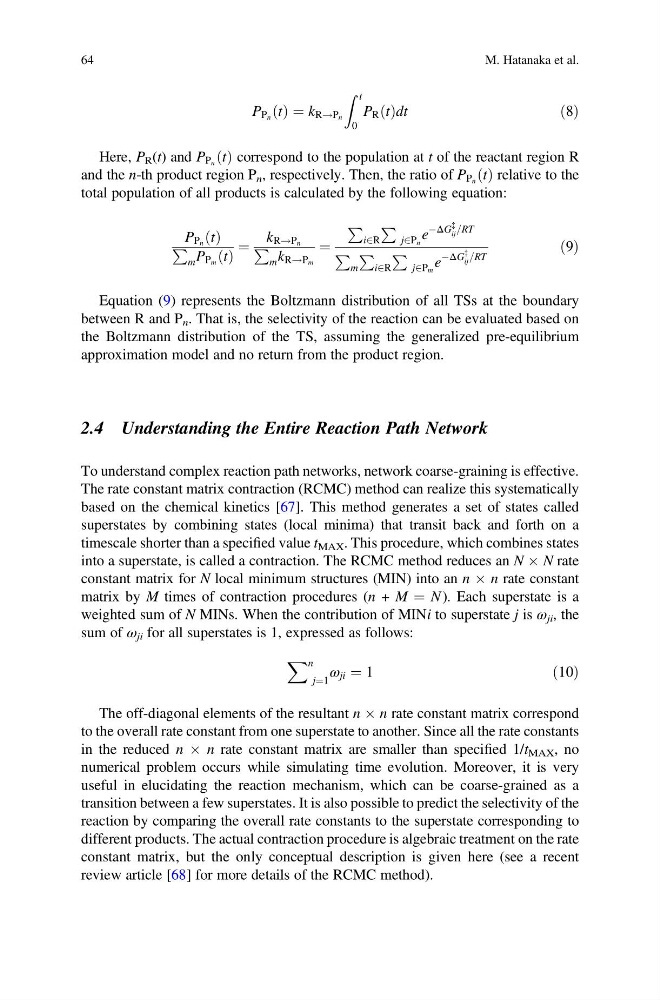
P P n t
ð Þ ¼ k R!P n
Z t
0
P R t
ð Þdt
ð8Þ
Here, P R (t) and P P n t
ð Þ correspond to the population at t of the reactant region R
and the n-th product region P n , respectively. Then, the ratio of P P n t
ð Þ relative to the
total population of all products is calculated by the following equation:
P P n t
ð Þ
P
m P P m t
ð Þ
¼
k R!P n
P
m k R!P m
¼
P
i2R
P
j2P n
e
ÀΔG
{
ij =RT
P
m
P
i2R
P
j2P m
e
ÀΔG
{
ij =RT
ð9Þ
Equation (9) represents the Boltzmann distribution of all TSs at the boundary
between R and P n . That is, the selectivity of the reaction can be evaluated based on
the Boltzmann distribution of the TS, assuming the generalized pre-equilibrium
approximation model and no return from the product region.
2.4 Understanding the Entire Reaction Path Network
To understand complex reaction path networks, network coarse-graining is effective.
The rate constant matrix contraction (RCMC) method can realize this systematically
based on the chemical kinetics [67]. This method generates a set of states called
superstates by combining states (local minima) that transit back and forth on a
timescale shorter than a specified value t MAX . This procedure, which combines states
into a superstate, is called a contraction. The RCMC method reduces an N Â N rate
constant matrix for N local minimum structures (MIN) into an n  n rate constant
matrix by M times of contraction procedures (n + M ¼ N). Each superstate is a
weighted sum of N MINs. When the contribution of MINi to superstate j is ω ji , the
sum of ω ji for all superstates is 1, expressed as follows:
X n
j¼1
ω ji ¼ 1
ð10Þ
The off-diagonal elements of the resultant n  n rate constant matrix correspond
to the overall rate constant from one superstate to another. Since all the rate constants
in the reduced n  n rate constant matrix are smaller than specified 1/t MAX , no
numerical problem occurs while simulating time evolution. Moreover, it is very
useful in elucidating the reaction mechanism, which can be coarse-grained as a
transition between a few superstates. It is also possible to predict the selectivity of the
reaction by comparing the overall rate constants to the superstate corresponding to
different products. The actual contraction procedure is algebraic treatment on the rate
constant matrix, but the only conceptual description is given here (see a recent
review article [68] for more details of the RCMC method).
64
M. Hatanaka et al.
ð Þ ¼ k R!P n
Z t
0
P R t
ð Þdt
ð8Þ
Here, P R (t) and P P n t
ð Þ correspond to the population at t of the reactant region R
and the n-th product region P n , respectively. Then, the ratio of P P n t
ð Þ relative to the
total population of all products is calculated by the following equation:
P P n t
ð Þ
P
m P P m t
ð Þ
¼
k R!P n
P
m k R!P m
¼
P
i2R
P
j2P n
e
ÀΔG
{
ij =RT
P
m
P
i2R
P
j2P m
e
ÀΔG
{
ij =RT
ð9Þ
Equation (9) represents the Boltzmann distribution of all TSs at the boundary
between R and P n . That is, the selectivity of the reaction can be evaluated based on
the Boltzmann distribution of the TS, assuming the generalized pre-equilibrium
approximation model and no return from the product region.
2.4 Understanding the Entire Reaction Path Network
To understand complex reaction path networks, network coarse-graining is effective.
The rate constant matrix contraction (RCMC) method can realize this systematically
based on the chemical kinetics [67]. This method generates a set of states called
superstates by combining states (local minima) that transit back and forth on a
timescale shorter than a specified value t MAX . This procedure, which combines states
into a superstate, is called a contraction. The RCMC method reduces an N Â N rate
constant matrix for N local minimum structures (MIN) into an n  n rate constant
matrix by M times of contraction procedures (n + M ¼ N). Each superstate is a
weighted sum of N MINs. When the contribution of MINi to superstate j is ω ji , the
sum of ω ji for all superstates is 1, expressed as follows:
X n
j¼1
ω ji ¼ 1
ð10Þ
The off-diagonal elements of the resultant n  n rate constant matrix correspond
to the overall rate constant from one superstate to another. Since all the rate constants
in the reduced n  n rate constant matrix are smaller than specified 1/t MAX , no
numerical problem occurs while simulating time evolution. Moreover, it is very
useful in elucidating the reaction mechanism, which can be coarse-grained as a
transition between a few superstates. It is also possible to predict the selectivity of the
reaction by comparing the overall rate constants to the superstate corresponding to
different products. The actual contraction procedure is algebraic treatment on the rate
constant matrix, but the only conceptual description is given here (see a recent
review article [68] for more details of the RCMC method).
64
M. Hatanaka et al.