

which fragments are defined. When the reaction mechanism is known to a certain
extent, the computational effort can be dramatically reduced by specifying the only
atoms involved in the mechanism as target atoms. The SC-AFIR algorithm finds
many local minimum structures along AFIR paths starting from the initial structure.
By default, the SC-AFIR algorithm is applied to all local minimum structures
obtained, resulting in a global reaction route map. Even in a small system, a huge
number of local minimum structures are obtained, which makes it difficult to apply
the AFIR method to all local minimum structures. Therefore, the limited search
options are available, which apply the AFIR method only to (1) the input structure,
(2) the local minimum structures having the same covalent bond patterns as the input
structure, (3) the relatively stable local minimum structures, or (4) the local minimum structures that are kinetically accessible from the input structure.
The third is the double-sphere AFIR (DS-AFIR) algorithm that searches for only
one path connecting two given structures. This method is named because the path
obtained by this method at the zero-force limit is similar to the path obtained by the
sphere optimization method [61] and that by the saddle method [62], respectively, in
low- and high-energy regions, where the former method traces energy minima on the
hypersphere while expanding the sphere radius while the latter method traces them
with contracting the sphere radius. The DS-AFIR algorithm tends to obtain the
shortest distance path, like other double-end methods when multiple paths exist
between two given structures. In general, the shortest distance path tends to be the
kinetically most favorable path in one-step processes. It should be noted, however,
that in multistep processes, the shortest distance path is not necessarily the kinetically most favorable one.
2.3 Reactivity and Selectivity Based on Chemical Kinetics
The calculated energy levels of local minima and TSs are useful to discuss the
reactivity and selectivity. According to the transition state theory, the rate constant
can be evaluated by the Gibbs energies of local minima and TSs. When an intrinsic
reaction coordinate (IRC) path [63] connects two local minima i and j via one TS, the
rate constant k ij of the elementary step of thermal reaction from i to j can be estimated
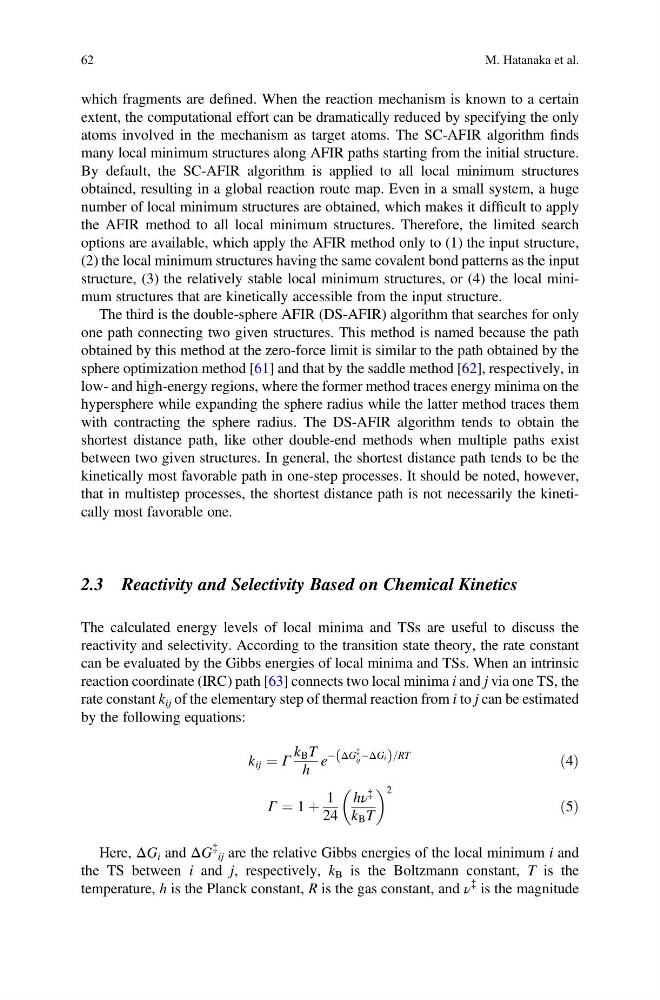
by the following equations:
k ij ¼ Γ
k B T
h
e
À ΔG
{
ij ÀΔG i
ð
Þ =RT
ð4Þ
Γ ¼ 1 þ
1
24
hν
{
k B T
2
ð5Þ
Here, ΔG i and ΔG
{
ij are the relative Gibbs energies of the local minimum i and
the TS between i and j, respectively, k B is the Boltzmann constant, T is the
temperature, h is the Planck constant, R is the gas constant, and ν
{ is the magnitude
62
M. Hatanaka et al.
extent, the computational effort can be dramatically reduced by specifying the only
atoms involved in the mechanism as target atoms. The SC-AFIR algorithm finds
many local minimum structures along AFIR paths starting from the initial structure.
By default, the SC-AFIR algorithm is applied to all local minimum structures
obtained, resulting in a global reaction route map. Even in a small system, a huge
number of local minimum structures are obtained, which makes it difficult to apply
the AFIR method to all local minimum structures. Therefore, the limited search
options are available, which apply the AFIR method only to (1) the input structure,
(2) the local minimum structures having the same covalent bond patterns as the input
structure, (3) the relatively stable local minimum structures, or (4) the local minimum structures that are kinetically accessible from the input structure.
The third is the double-sphere AFIR (DS-AFIR) algorithm that searches for only
one path connecting two given structures. This method is named because the path
obtained by this method at the zero-force limit is similar to the path obtained by the
sphere optimization method [61] and that by the saddle method [62], respectively, in
low- and high-energy regions, where the former method traces energy minima on the
hypersphere while expanding the sphere radius while the latter method traces them
with contracting the sphere radius. The DS-AFIR algorithm tends to obtain the
shortest distance path, like other double-end methods when multiple paths exist
between two given structures. In general, the shortest distance path tends to be the
kinetically most favorable path in one-step processes. It should be noted, however,
that in multistep processes, the shortest distance path is not necessarily the kinetically most favorable one.
2.3 Reactivity and Selectivity Based on Chemical Kinetics
The calculated energy levels of local minima and TSs are useful to discuss the
reactivity and selectivity. According to the transition state theory, the rate constant
can be evaluated by the Gibbs energies of local minima and TSs. When an intrinsic
reaction coordinate (IRC) path [63] connects two local minima i and j via one TS, the
rate constant k ij of the elementary step of thermal reaction from i to j can be estimated
by the following equations:
k ij ¼ Γ
k B T
h
e
À ΔG
{
ij ÀΔG i
ð
Þ =RT
ð4Þ
Γ ¼ 1 þ
1
24
hν
{
k B T
2
ð5Þ
Here, ΔG i and ΔG
{
ij are the relative Gibbs energies of the local minimum i and
the TS between i and j, respectively, k B is the Boltzmann constant, T is the
temperature, h is the Planck constant, R is the gas constant, and ν
{ is the magnitude
62
M. Hatanaka et al.