

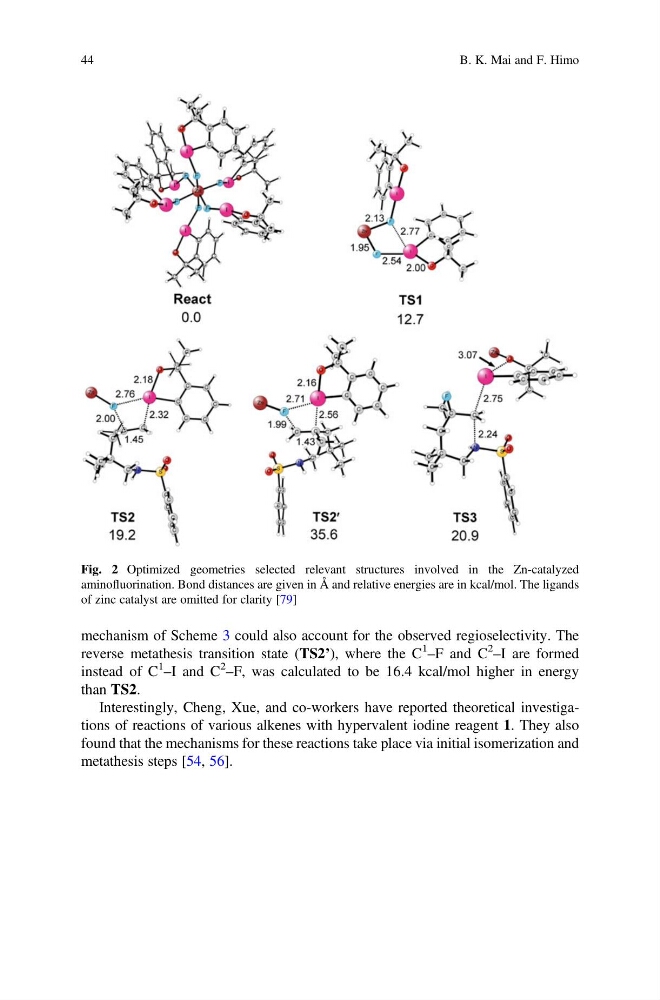
mechanism of Scheme 3 could also account for the observed regioselectivity. The
reverse metathesis transition state (TS2’), where the C
1
–F and C
2
–I are formed
instead of C
1
–I and C
2
–F, was calculated to be 16.4 kcal/mol higher in energy
than TS2.
Interestingly, Cheng, Xue, and co-workers have reported theoretical investigations of reactions of various alkenes with hypervalent iodine reagent 1. They also
found that the mechanisms for these reactions take place via initial isomerization and
metathesis steps [54, 56].
Fig. 2 Optimized geometries selected relevant structures involved in the Zn-catalyzed
aminofluorination. Bond distances are given in Å and relative energies are in kcal/mol. The ligands
of zinc catalyst are omitted for clarity [79]
44
B. K. Mai and F. Himo
reverse metathesis transition state (TS2’), where the C
1
–F and C
2
–I are formed
instead of C
1
–I and C
2
–F, was calculated to be 16.4 kcal/mol higher in energy
than TS2.
Interestingly, Cheng, Xue, and co-workers have reported theoretical investigations of reactions of various alkenes with hypervalent iodine reagent 1. They also
found that the mechanisms for these reactions take place via initial isomerization and
metathesis steps [54, 56].
Fig. 2 Optimized geometries selected relevant structures involved in the Zn-catalyzed
aminofluorination. Bond distances are given in Å and relative energies are in kcal/mol. The ligands
of zinc catalyst are omitted for clarity [79]
44
B. K. Mai and F. Himo