

calculations showed next that an isomerization of the fluoro-benziodoxole is a
necessary first step to activate the reagent by making the fluorine substituent trans
to the phenyl group instead of the oxygen (Scheme 3). Subsequently, an unexpected
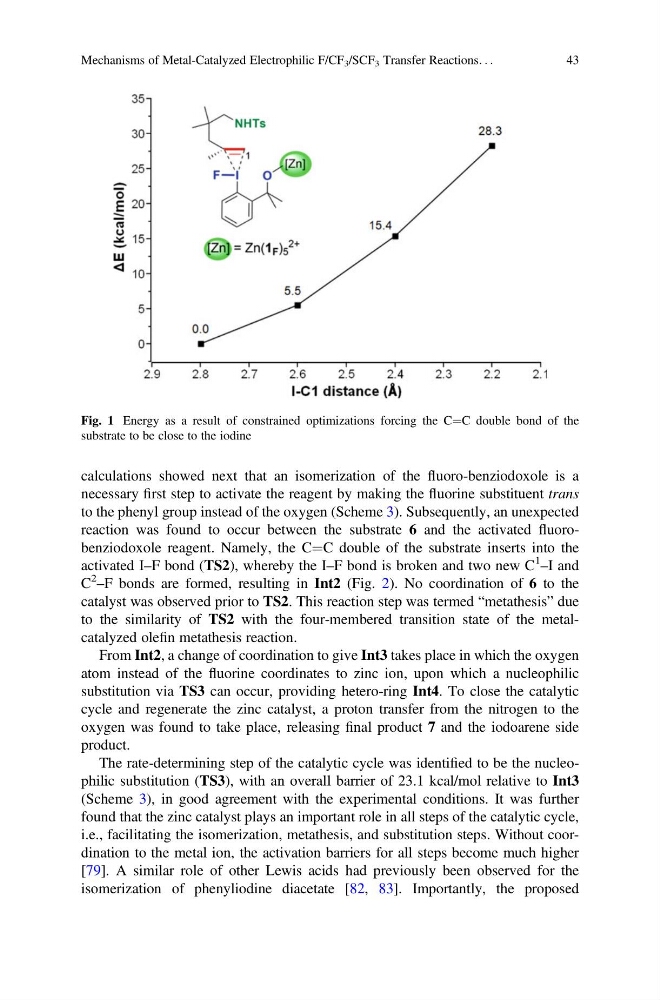
reaction was found to occur between the substrate 6 and the activated fluorobenziodoxole reagent. Namely, the C¼C double of the substrate inserts into the
activated I–F bond (TS2), whereby the I–F bond is broken and two new C
1
–I and
C
2
–F bonds are formed, resulting in Int2 (Fig. 2). No coordination of 6 to the
catalyst was observed prior to TS2. This reaction step was termed “metathesis” due
to the similarity of TS2 with the four-membered transition state of the metalcatalyzed olefin metathesis reaction.
From Int2, a change of coordination to give Int3 takes place in which the oxygen
atom instead of the fluorine coordinates to zinc ion, upon which a nucleophilic
substitution via TS3 can occur, providing hetero-ring Int4. To close the catalytic
cycle and regenerate the zinc catalyst, a proton transfer from the nitrogen to the
oxygen was found to take place, releasing final product 7 and the iodoarene side
product.
The rate-determining step of the catalytic cycle was identified to be the nucleophilic substitution (TS3), with an overall barrier of 23.1 kcal/mol relative to Int3
(Scheme 3), in good agreement with the experimental conditions. It was further
found that the zinc catalyst plays an important role in all steps of the catalytic cycle,
i.e., facilitating the isomerization, metathesis, and substitution steps. Without coordination to the metal ion, the activation barriers for all steps become much higher
[79]. A similar role of other Lewis acids had previously been observed for the
isomerization of phenyliodine diacetate [82, 83]. Importantly, the proposed
Fig. 1 Energy as a result of constrained optimizations forcing the C¼C double bond of the
substrate to be close to the iodine
Mechanisms of Metal-Catalyzed Electrophilic F/CF 3 /SCF 3 Transfer Reactions. . .
43
necessary first step to activate the reagent by making the fluorine substituent trans
to the phenyl group instead of the oxygen (Scheme 3). Subsequently, an unexpected
reaction was found to occur between the substrate 6 and the activated fluorobenziodoxole reagent. Namely, the C¼C double of the substrate inserts into the
activated I–F bond (TS2), whereby the I–F bond is broken and two new C
1
–I and
C
2
–F bonds are formed, resulting in Int2 (Fig. 2). No coordination of 6 to the
catalyst was observed prior to TS2. This reaction step was termed “metathesis” due
to the similarity of TS2 with the four-membered transition state of the metalcatalyzed olefin metathesis reaction.
From Int2, a change of coordination to give Int3 takes place in which the oxygen
atom instead of the fluorine coordinates to zinc ion, upon which a nucleophilic
substitution via TS3 can occur, providing hetero-ring Int4. To close the catalytic
cycle and regenerate the zinc catalyst, a proton transfer from the nitrogen to the
oxygen was found to take place, releasing final product 7 and the iodoarene side
product.
The rate-determining step of the catalytic cycle was identified to be the nucleophilic substitution (TS3), with an overall barrier of 23.1 kcal/mol relative to Int3
(Scheme 3), in good agreement with the experimental conditions. It was further
found that the zinc catalyst plays an important role in all steps of the catalytic cycle,
i.e., facilitating the isomerization, metathesis, and substitution steps. Without coordination to the metal ion, the activation barriers for all steps become much higher
[79]. A similar role of other Lewis acids had previously been observed for the
isomerization of phenyliodine diacetate [82, 83]. Importantly, the proposed
Fig. 1 Energy as a result of constrained optimizations forcing the C¼C double bond of the
substrate to be close to the iodine
Mechanisms of Metal-Catalyzed Electrophilic F/CF 3 /SCF 3 Transfer Reactions. . .
43