

considering various possible rotamers of the molecules and also different relative
binding modes of the reactants.
In addition, before any mechanistic investigation, a so-called computational
speciation study should be carefully carried out in order to identify the most stable
complex that could be formed in the mixture of all starting materials, including metal
catalysts, reactants, additive reagents, and solvents [79–81]. The most stable complex obtained from this study is used as a starting structure for further mechanistic
investigation. Failure to identify the lowest-energy starting complex can lead to large
errors in the following energy barriers and might thus result in wrong conclusions
about the chemistry. In the case of the zinc-catalyzed aminofluorination reaction
discussed below, for example, a careful computational speciation investigation
showed that the most stable zinc the complex was a dicationic octahedral structure,
in which all six ligands positions were occupied by reagent 1, coordinated by its
fluorine atom (see React below). This surprising finding gave a hint as to how the
zinc can catalyze the reaction by activating the reagent.
3 Zinc-Catalyzed Aminofluorination of Alkenes
The first example of computational mechanistic studies discussed here concerns the
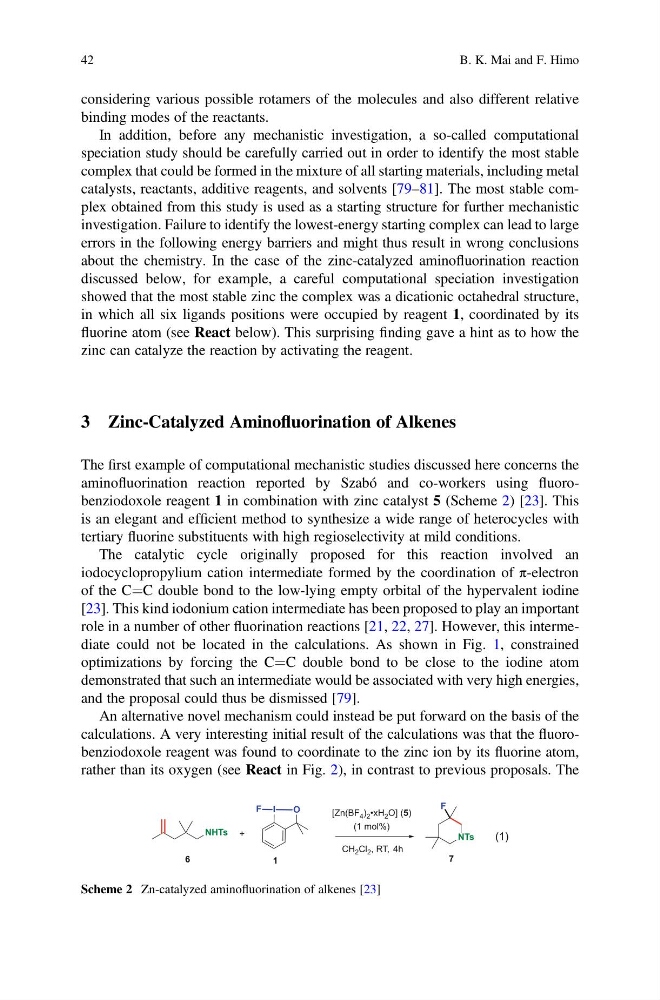
aminofluorination reaction reported by Szabó and co-workers using fluorobenziodoxole reagent 1 in combination with zinc catalyst 5 (Scheme 2) [23]. This
is an elegant and efficient method to synthesize a wide range of heterocycles with
tertiary fluorine substituents with high regioselectivity at mild conditions.
The catalytic cycle originally proposed for this reaction involved an
iodocyclopropylium cation intermediate formed by the coordination of π-electron
of the C¼C double bond to the low-lying empty orbital of the hypervalent iodine
[23]. This kind iodonium cation intermediate has been proposed to play an important
role in a number of other fluorination reactions [21, 22, 27]. However, this intermediate could not be located in the calculations. As shown in Fig. 1, constrained
optimizations by forcing the C¼C double bond to be close to the iodine atom
demonstrated that such an intermediate would be associated with very high energies,
and the proposal could thus be dismissed [79].
An alternative novel mechanism could instead be put forward on the basis of the
calculations. A very interesting initial result of the calculations was that the fluorobenziodoxole reagent was found to coordinate to the zinc ion by its fluorine atom,
rather than its oxygen (see React in Fig. 2), in contrast to previous proposals. The
NHTs
NTs
F
6
CH 2 Cl 2 , RT, 4h
7
O
I
F
+
1
[Zn(BF 4 ) 2 •xH 2 O] (5)
(1 mol%)
(1)
Scheme 2 Zn-catalyzed aminofluorination of alkenes [23]
42
B. K. Mai and F. Himo
binding modes of the reactants.
In addition, before any mechanistic investigation, a so-called computational
speciation study should be carefully carried out in order to identify the most stable
complex that could be formed in the mixture of all starting materials, including metal
catalysts, reactants, additive reagents, and solvents [79–81]. The most stable complex obtained from this study is used as a starting structure for further mechanistic
investigation. Failure to identify the lowest-energy starting complex can lead to large
errors in the following energy barriers and might thus result in wrong conclusions
about the chemistry. In the case of the zinc-catalyzed aminofluorination reaction
discussed below, for example, a careful computational speciation investigation
showed that the most stable zinc the complex was a dicationic octahedral structure,
in which all six ligands positions were occupied by reagent 1, coordinated by its
fluorine atom (see React below). This surprising finding gave a hint as to how the
zinc can catalyze the reaction by activating the reagent.
3 Zinc-Catalyzed Aminofluorination of Alkenes
The first example of computational mechanistic studies discussed here concerns the
aminofluorination reaction reported by Szabó and co-workers using fluorobenziodoxole reagent 1 in combination with zinc catalyst 5 (Scheme 2) [23]. This
is an elegant and efficient method to synthesize a wide range of heterocycles with
tertiary fluorine substituents with high regioselectivity at mild conditions.
The catalytic cycle originally proposed for this reaction involved an
iodocyclopropylium cation intermediate formed by the coordination of π-electron
of the C¼C double bond to the low-lying empty orbital of the hypervalent iodine
[23]. This kind iodonium cation intermediate has been proposed to play an important
role in a number of other fluorination reactions [21, 22, 27]. However, this intermediate could not be located in the calculations. As shown in Fig. 1, constrained
optimizations by forcing the C¼C double bond to be close to the iodine atom
demonstrated that such an intermediate would be associated with very high energies,
and the proposal could thus be dismissed [79].
An alternative novel mechanism could instead be put forward on the basis of the
calculations. A very interesting initial result of the calculations was that the fluorobenziodoxole reagent was found to coordinate to the zinc ion by its fluorine atom,
rather than its oxygen (see React in Fig. 2), in contrast to previous proposals. The
NHTs
NTs
F
6
CH 2 Cl 2 , RT, 4h
7
O
I
F
+
1
[Zn(BF 4 ) 2 •xH 2 O] (5)
(1 mol%)
(1)
Scheme 2 Zn-catalyzed aminofluorination of alkenes [23]
42
B. K. Mai and F. Himo