

approximation have been obtained with DFT calculations with the PBE-D3 functional, which includes dispersion effects and by means of optimizations in solvent
(toluene, SMD model).
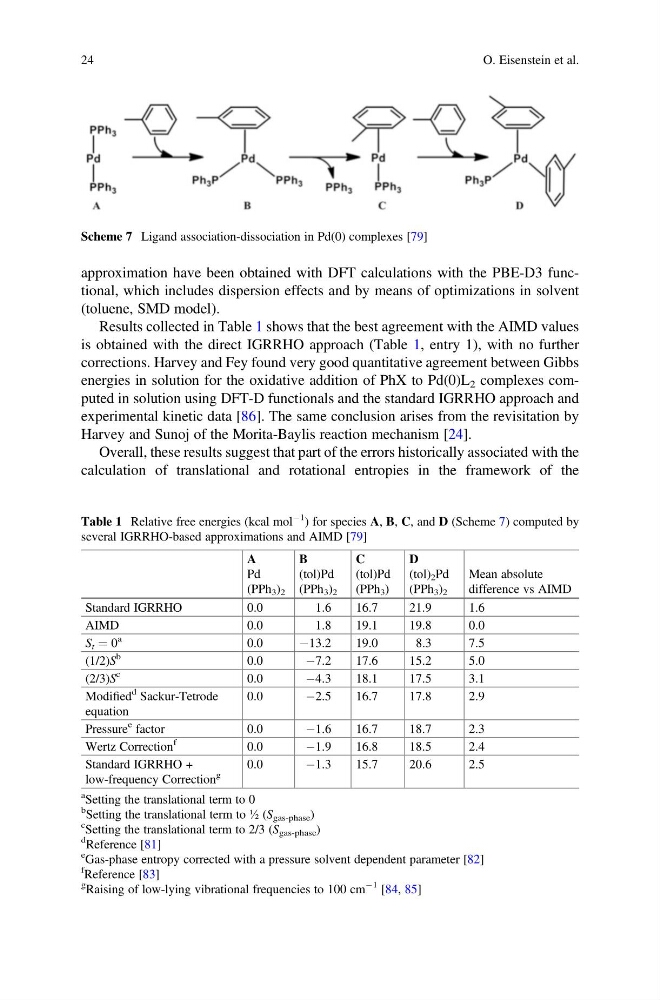
Results collected in Table 1 shows that the best agreement with the AIMD values
is obtained with the direct IGRRHO approach (Table 1, entry 1), with no further
corrections. Harvey and Fey found very good quantitative agreement between Gibbs
energies in solution for the oxidative addition of PhX to Pd(0)L 2 complexes computed in solution using DFT-D functionals and the standard IGRRHO approach and
experimental kinetic data [86]. The same conclusion arises from the revisitation by
Harvey and Sunoj of the Morita-Baylis reaction mechanism [24].
Overall, these results suggest that part of the errors historically associated with the
calculation of translational and rotational entropies in the framework of the
Scheme 7 Ligand association-dissociation in Pd(0) complexes [79]
Table 1 Relative free energies (kcal mol
À1
) for species A, B, C, and D (Scheme 7) computed by
several IGRRHO-based approximations and AIMD [79]
A
Pd
(PPh 3 ) 2
B
(tol)Pd
(PPh 3 ) 2
C
(tol)Pd
(PPh 3 )
D
(tol) 2 Pd
(PPh 3 ) 2
Mean absolute
difference vs AIMD
Standard IGRRHO
0.0
1.6
16.7
21.9
1.6
AIMD
0.0
1.8
19.1
19.8
0.0
S t ¼ 0
a
0.0
À13.2
19.0
8.3
7.5
(1/2)S
b
0.0
À7.2
17.6
15.2
5.0
(2/3)S
c
0.0
À4.3
18.1
17.5
3.1
Modified
d Sackur-Tetrode
equation
0.0
À2.5
16.7
17.8
2.9
Pressure
e factor
0.0
À1.6
16.7
18.7
2.3
Wertz Correction
f
0.0
À1.9
16.8
18.5
2.4
Standard IGRRHO +
low-frequency Correction
g
0.0
À1.3
15.7
20.6
2.5
a Setting the translational term to 0
b
Setting the translational term to ½ (S gas-phase )
c Setting the translational term to 2/3 (S gas-phase )
d
Reference [81]
e Gas-phase entropy corrected with a pressure solvent dependent parameter [82]
f
Reference [83]
g
Raising of low-lying vibrational frequencies to 100 cm
À1 [84, 85]
24
O. Eisenstein et al.
(toluene, SMD model).
Results collected in Table 1 shows that the best agreement with the AIMD values
is obtained with the direct IGRRHO approach (Table 1, entry 1), with no further
corrections. Harvey and Fey found very good quantitative agreement between Gibbs
energies in solution for the oxidative addition of PhX to Pd(0)L 2 complexes computed in solution using DFT-D functionals and the standard IGRRHO approach and
experimental kinetic data [86]. The same conclusion arises from the revisitation by
Harvey and Sunoj of the Morita-Baylis reaction mechanism [24].
Overall, these results suggest that part of the errors historically associated with the
calculation of translational and rotational entropies in the framework of the
Scheme 7 Ligand association-dissociation in Pd(0) complexes [79]
Table 1 Relative free energies (kcal mol
À1
) for species A, B, C, and D (Scheme 7) computed by
several IGRRHO-based approximations and AIMD [79]
A
Pd
(PPh 3 ) 2
B
(tol)Pd
(PPh 3 ) 2
C
(tol)Pd
(PPh 3 )
D
(tol) 2 Pd
(PPh 3 ) 2
Mean absolute
difference vs AIMD
Standard IGRRHO
0.0
1.6
16.7
21.9
1.6
AIMD
0.0
1.8
19.1
19.8
0.0
S t ¼ 0
a
0.0
À13.2
19.0
8.3
7.5
(1/2)S
b
0.0
À7.2
17.6
15.2
5.0
(2/3)S
c
0.0
À4.3
18.1
17.5
3.1
Modified
d Sackur-Tetrode
equation
0.0
À2.5
16.7
17.8
2.9
Pressure
e factor
0.0
À1.6
16.7
18.7
2.3
Wertz Correction
f
0.0
À1.9
16.8
18.5
2.4
Standard IGRRHO +
low-frequency Correction
g
0.0
À1.3
15.7
20.6
2.5
a Setting the translational term to 0
b
Setting the translational term to ½ (S gas-phase )
c Setting the translational term to 2/3 (S gas-phase )
d
Reference [81]
e Gas-phase entropy corrected with a pressure solvent dependent parameter [82]
f
Reference [83]
g
Raising of low-lying vibrational frequencies to 100 cm
À1 [84, 85]
24
O. Eisenstein et al.