

calculate this term has been a matter of numerous discussions in the past decades.
The calculation of the translational entropy in solution has been the most controversial and a summary of this controversy can be found in reference [25]. In the ideal
gas approach, it is introduced via particle in a box model by the Sackur-Tetrode
equation, and the validity of this equation in solution-phase situations has been
questioned [77]. A number of corrections to IGRRHO have been proposed, including the complete neglect of the translational terms of the entropy, considering only
one-half or two-thirds of it, modifying the Sackur-Tetrode equation or adding a
pressure effect.
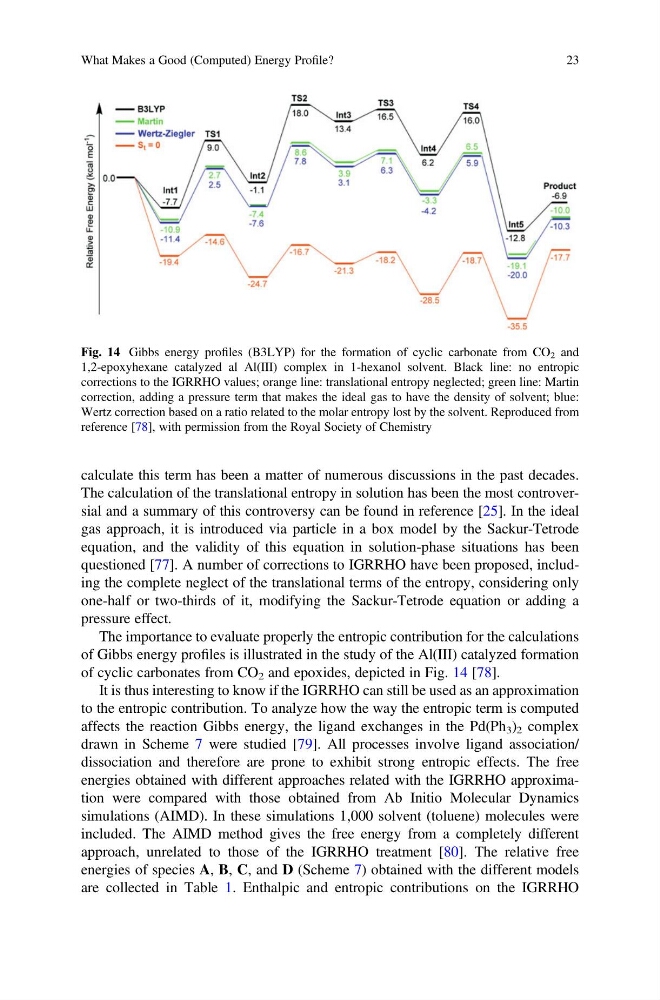
The importance to evaluate properly the entropic contribution for the calculations
of Gibbs energy profiles is illustrated in the study of the Al(III) catalyzed formation
of cyclic carbonates from CO 2 and epoxides, depicted in Fig. 14 [78].
It is thus interesting to know if the IGRRHO can still be used as an approximation
to the entropic contribution. To analyze how the way the entropic term is computed
affects the reaction Gibbs energy, the ligand exchanges in the Pd(Ph 3 ) 2 complex
drawn in Scheme 7 were studied [79]. All processes involve ligand association/
dissociation and therefore are prone to exhibit strong entropic effects. The free
energies obtained with different approaches related with the IGRRHO approximation were compared with those obtained from Ab Initio Molecular Dynamics
simulations (AIMD). In these simulations 1,000 solvent (toluene) molecules were
included. The AIMD method gives the free energy from a completely different
approach, unrelated to those of the IGRRHO treatment [80]. The relative free
energies of species A, B, C, and D (Scheme 7) obtained with the different models
are collected in Table 1. Enthalpic and entropic contributions on the IGRRHO
Fig. 14 Gibbs energy profiles (B3LYP) for the formation of cyclic carbonate from CO 2 and
1,2-epoxyhexane catalyzed al Al(III) complex in 1-hexanol solvent. Black line: no entropic
corrections to the IGRRHO values; orange line: translational entropy neglected; green line: Martin
correction, adding a pressure term that makes the ideal gas to have the density of solvent; blue:
Wertz correction based on a ratio related to the molar entropy lost by the solvent. Reproduced from
reference [78], with permission from the Royal Society of Chemistry
What Makes a Good (Computed) Energy Profile?
23
The calculation of the translational entropy in solution has been the most controversial and a summary of this controversy can be found in reference [25]. In the ideal
gas approach, it is introduced via particle in a box model by the Sackur-Tetrode
equation, and the validity of this equation in solution-phase situations has been
questioned [77]. A number of corrections to IGRRHO have been proposed, including the complete neglect of the translational terms of the entropy, considering only
one-half or two-thirds of it, modifying the Sackur-Tetrode equation or adding a
pressure effect.
The importance to evaluate properly the entropic contribution for the calculations
of Gibbs energy profiles is illustrated in the study of the Al(III) catalyzed formation
of cyclic carbonates from CO 2 and epoxides, depicted in Fig. 14 [78].
It is thus interesting to know if the IGRRHO can still be used as an approximation
to the entropic contribution. To analyze how the way the entropic term is computed
affects the reaction Gibbs energy, the ligand exchanges in the Pd(Ph 3 ) 2 complex
drawn in Scheme 7 were studied [79]. All processes involve ligand association/
dissociation and therefore are prone to exhibit strong entropic effects. The free
energies obtained with different approaches related with the IGRRHO approximation were compared with those obtained from Ab Initio Molecular Dynamics
simulations (AIMD). In these simulations 1,000 solvent (toluene) molecules were
included. The AIMD method gives the free energy from a completely different
approach, unrelated to those of the IGRRHO treatment [80]. The relative free
energies of species A, B, C, and D (Scheme 7) obtained with the different models
are collected in Table 1. Enthalpic and entropic contributions on the IGRRHO
Fig. 14 Gibbs energy profiles (B3LYP) for the formation of cyclic carbonate from CO 2 and
1,2-epoxyhexane catalyzed al Al(III) complex in 1-hexanol solvent. Black line: no entropic
corrections to the IGRRHO values; orange line: translational entropy neglected; green line: Martin
correction, adding a pressure term that makes the ideal gas to have the density of solvent; blue:
Wertz correction based on a ratio related to the molar entropy lost by the solvent. Reproduced from
reference [78], with permission from the Royal Society of Chemistry
What Makes a Good (Computed) Energy Profile?
23