

method dependent but the quartet state remains the preferred state regardless of the
computational method employed [60].
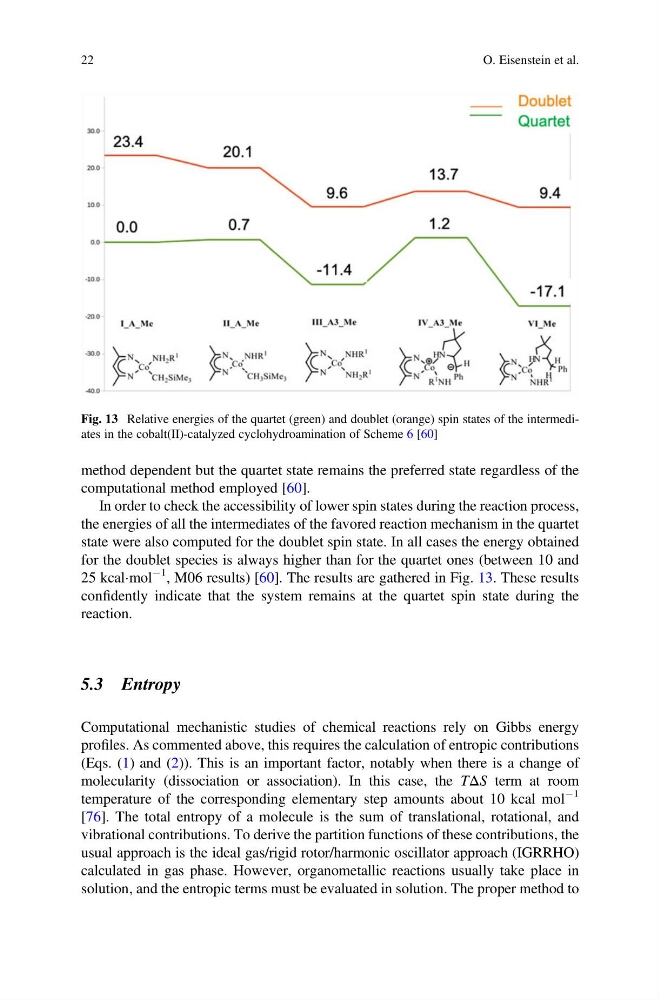
In order to check the accessibility of lower spin states during the reaction process,
the energies of all the intermediates of the favored reaction mechanism in the quartet
state were also computed for the doublet spin state. In all cases the energy obtained
for the doublet species is always higher than for the quartet ones (between 10 and
25 kcalÁmol
À1 , M06 results) [60]. The results are gathered in Fig. 13. These results
confidently indicate that the system remains at the quartet spin state during the
reaction.
5.3 Entropy
Computational mechanistic studies of chemical reactions rely on Gibbs energy
profiles. As commented above, this requires the calculation of entropic contributions
(Eqs. (1) and (2)). This is an important factor, notably when there is a change of
molecularity (dissociation or association). In this case, the TΔS term at room
temperature of the corresponding elementary step amounts about 10 kcal mol
À1
[76]. The total entropy of a molecule is the sum of translational, rotational, and
vibrational contributions. To derive the partition functions of these contributions, the
usual approach is the ideal gas/rigid rotor/harmonic oscillator approach (IGRRHO)
calculated in gas phase. However, organometallic reactions usually take place in
solution, and the entropic terms must be evaluated in solution. The proper method to
Fig. 13 Relative energies of the quartet (green) and doublet (orange) spin states of the intermediates in the cobalt(II)-catalyzed cyclohydroamination of Scheme 6 [60]
22
O. Eisenstein et al.
computational method employed [60].
In order to check the accessibility of lower spin states during the reaction process,
the energies of all the intermediates of the favored reaction mechanism in the quartet
state were also computed for the doublet spin state. In all cases the energy obtained
for the doublet species is always higher than for the quartet ones (between 10 and
25 kcalÁmol
À1 , M06 results) [60]. The results are gathered in Fig. 13. These results
confidently indicate that the system remains at the quartet spin state during the
reaction.
5.3 Entropy
Computational mechanistic studies of chemical reactions rely on Gibbs energy
profiles. As commented above, this requires the calculation of entropic contributions
(Eqs. (1) and (2)). This is an important factor, notably when there is a change of
molecularity (dissociation or association). In this case, the TΔS term at room
temperature of the corresponding elementary step amounts about 10 kcal mol
À1
[76]. The total entropy of a molecule is the sum of translational, rotational, and
vibrational contributions. To derive the partition functions of these contributions, the
usual approach is the ideal gas/rigid rotor/harmonic oscillator approach (IGRRHO)
calculated in gas phase. However, organometallic reactions usually take place in
solution, and the entropic terms must be evaluated in solution. The proper method to
Fig. 13 Relative energies of the quartet (green) and doublet (orange) spin states of the intermediates in the cobalt(II)-catalyzed cyclohydroamination of Scheme 6 [60]
22
O. Eisenstein et al.