

IGRRHO approach came from the lack of dispersion forces in the calculations
[79]. It appears that the best currently available way to handle entropic effects for
species in solution is through the usual IGRRHO expressions, combined with a
continuum solvent treatment of solvation (see next section) and using a dispersioncorrected functional. It is also recommended to compute the partition functions using
the calculations obtained with the continuum solvent model, rather than in vacuum.
This means that the stationary points have to be located and optimized “in solvent”
and the frequencies calculated in the same conditions. When gas-phase and solutionphase geometries and frequencies are similar, the use of gas-phase geometries and
frequencies can be a useful approximation. However, for cases where liquid and
gas-phase solute structures differ appreciably or when stationary points present in
liquid solution do not exist in the gas phase, using partition functions computed for
molecules optimized in solution becomes necessary [84].
6 The Solvent: Chemical and Theoretical Model
Most of organometallic chemistry is carried out in solvent even though if important
developments have been achieved for organometallic on solid supports [87–89]. In
parallel, gas phase organometallic reactions has been a topic of interest [90–94]. Several studies were devoted to a better understanding of the difference between
gas-phase and solution chemistry (an interesting contrast to reaction in condensed
phases) [95–99]. In this chapter, we focus on the reactions occurring in solution. As
it should be apparent from what was described before, a good description of solvent
effects is essential to a good description of the reaction. Implementing the solvent
impacts on both the chemical and computational parts of the computations. Indeed,
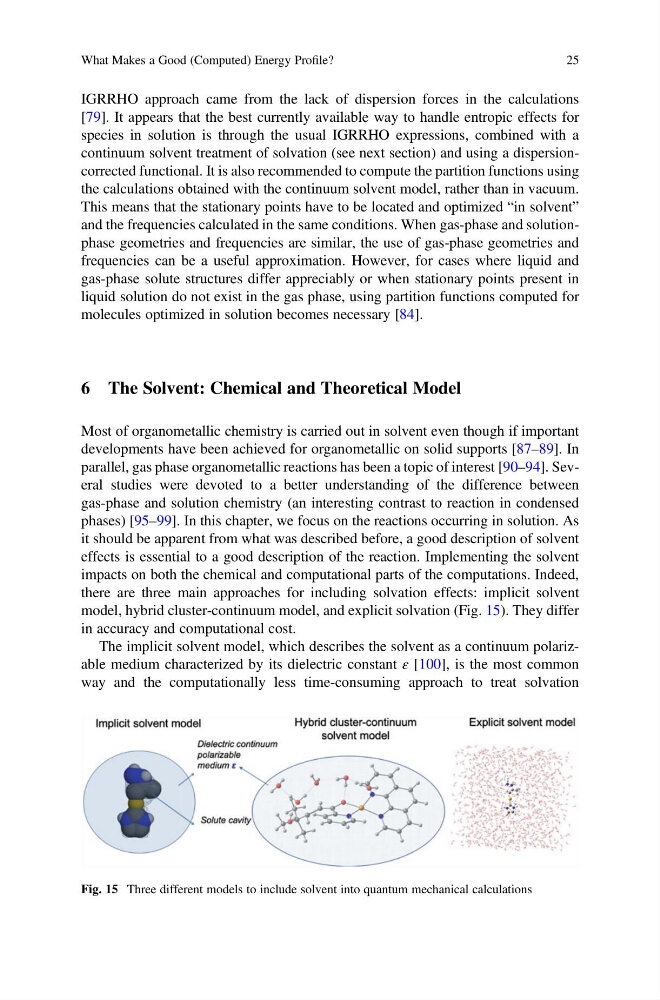
there are three main approaches for including solvation effects: implicit solvent
model, hybrid cluster-continuum model, and explicit solvation (Fig. 15). They differ
in accuracy and computational cost.
The implicit solvent model, which describes the solvent as a continuum polarizable medium characterized by its dielectric constant ε [100], is the most common
way and the computationally less time-consuming approach to treat solvation
Fig. 15 Three different models to include solvent into quantum mechanical calculations
What Makes a Good (Computed) Energy Profile?
25
[79]. It appears that the best currently available way to handle entropic effects for
species in solution is through the usual IGRRHO expressions, combined with a
continuum solvent treatment of solvation (see next section) and using a dispersioncorrected functional. It is also recommended to compute the partition functions using
the calculations obtained with the continuum solvent model, rather than in vacuum.
This means that the stationary points have to be located and optimized “in solvent”
and the frequencies calculated in the same conditions. When gas-phase and solutionphase geometries and frequencies are similar, the use of gas-phase geometries and
frequencies can be a useful approximation. However, for cases where liquid and
gas-phase solute structures differ appreciably or when stationary points present in
liquid solution do not exist in the gas phase, using partition functions computed for
molecules optimized in solution becomes necessary [84].
6 The Solvent: Chemical and Theoretical Model
Most of organometallic chemistry is carried out in solvent even though if important
developments have been achieved for organometallic on solid supports [87–89]. In
parallel, gas phase organometallic reactions has been a topic of interest [90–94]. Several studies were devoted to a better understanding of the difference between
gas-phase and solution chemistry (an interesting contrast to reaction in condensed
phases) [95–99]. In this chapter, we focus on the reactions occurring in solution. As
it should be apparent from what was described before, a good description of solvent
effects is essential to a good description of the reaction. Implementing the solvent
impacts on both the chemical and computational parts of the computations. Indeed,
there are three main approaches for including solvation effects: implicit solvent
model, hybrid cluster-continuum model, and explicit solvation (Fig. 15). They differ
in accuracy and computational cost.
The implicit solvent model, which describes the solvent as a continuum polarizable medium characterized by its dielectric constant ε [100], is the most common
way and the computationally less time-consuming approach to treat solvation
Fig. 15 Three different models to include solvent into quantum mechanical calculations
What Makes a Good (Computed) Energy Profile?
25