

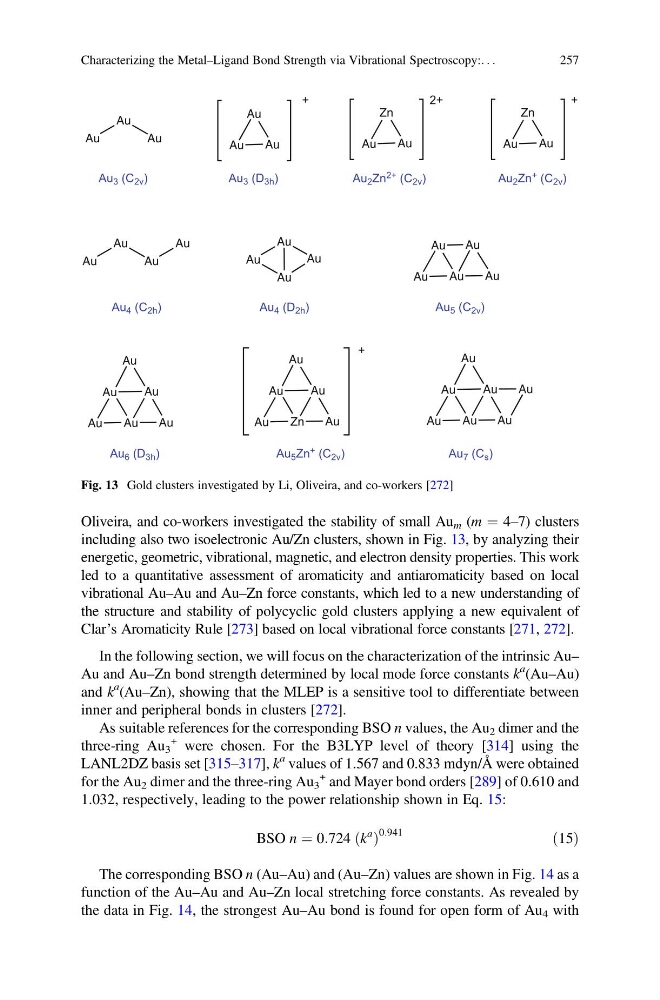
Oliveira, and co-workers investigated the stability of small Au m (m ¼ 4–7) clusters
including also two isoelectronic Au/Zn clusters, shown in Fig. 13, by analyzing their
energetic, geometric, vibrational, magnetic, and electron density properties. This work
led to a quantitative assessment of aromaticity and antiaromaticity based on local
vibrational Au–Au and Au–Zn force constants, which led to a new understanding of
the structure and stability of polycyclic gold clusters applying a new equivalent of
Clar’s Aromaticity Rule [273] based on local vibrational force constants [271, 272].
In the following section, we will focus on the characterization of the intrinsic Au–
Au and Au–Zn bond strength determined by local mode force constants k
a (Au–Au)
and k
a (Au–Zn), showing that the MLEP is a sensitive tool to differentiate between
inner and peripheral bonds in clusters [272].
As suitable references for the corresponding BSO n values, the Au 2 dimer and the
three-ring Au 3
+ were chosen. For the B3LYP level of theory [314] using the
LANL2DZ basis set [315–317], k
a values of 1.567 and 0.833 mdyn/Å were obtained
for the Au 2 dimer and the three-ring Au 3
+ and Mayer bond orders [289] of 0.610 and
1.032, respectively, leading to the power relationship shown in Eq. 15:
BSO n ¼ 0:724 k
a
ð Þ
0:941
ð15Þ
The corresponding BSO n (Au–Au) and (Au–Zn) values are shown in Fig. 14 as a
function of the Au–Au and Au–Zn local stretching force constants. As revealed by
the data in Fig. 14, the strongest Au–Au bond is found for open form of Au 4 with
Au
Au
Au
Au
Au
Au
Au
Au
Au
Au
Au 3 (C 2v )
A u 3 (D 3h )
Zn
Au
Au
Au 2 Zn 2+ (C 2v )
2+
Au 4 (C 2h )
Zn
Au
Au
Au 2 Zn + (C 2v )
+
Au
Au
Au
Au
Au 4 (D 2h )
Au
Au
Au
Au
Au 5 (C 2v )
Au
Au
Au
Au
Au
Au 6 (D 3h )
Au
Au
Au
Au
Zn
Au
Au 5 Zn + (C 2v )
Au
Au
+
Au
Au
Au
Au
Au 7 (C s )
Au
Au
Au
+
Fig. 13 Gold clusters investigated by Li, Oliveira, and co-workers [272]
Characterizing the Metal–Ligand Bond Strength via Vibrational Spectroscopy:. . .
257
including also two isoelectronic Au/Zn clusters, shown in Fig. 13, by analyzing their
energetic, geometric, vibrational, magnetic, and electron density properties. This work
led to a quantitative assessment of aromaticity and antiaromaticity based on local
vibrational Au–Au and Au–Zn force constants, which led to a new understanding of
the structure and stability of polycyclic gold clusters applying a new equivalent of
Clar’s Aromaticity Rule [273] based on local vibrational force constants [271, 272].
In the following section, we will focus on the characterization of the intrinsic Au–
Au and Au–Zn bond strength determined by local mode force constants k
a (Au–Au)
and k
a (Au–Zn), showing that the MLEP is a sensitive tool to differentiate between
inner and peripheral bonds in clusters [272].
As suitable references for the corresponding BSO n values, the Au 2 dimer and the
three-ring Au 3
+ were chosen. For the B3LYP level of theory [314] using the
LANL2DZ basis set [315–317], k
a values of 1.567 and 0.833 mdyn/Å were obtained
for the Au 2 dimer and the three-ring Au 3
+ and Mayer bond orders [289] of 0.610 and
1.032, respectively, leading to the power relationship shown in Eq. 15:
BSO n ¼ 0:724 k
a
ð Þ
0:941
ð15Þ
The corresponding BSO n (Au–Au) and (Au–Zn) values are shown in Fig. 14 as a
function of the Au–Au and Au–Zn local stretching force constants. As revealed by
the data in Fig. 14, the strongest Au–Au bond is found for open form of Au 4 with
Au
Au
Au
Au
Au
Au
Au
Au
Au
Au
Au 3 (C 2v )
A u 3 (D 3h )
Zn
Au
Au
Au 2 Zn 2+ (C 2v )
2+
Au 4 (C 2h )
Zn
Au
Au
Au 2 Zn + (C 2v )
+
Au
Au
Au
Au
Au 4 (D 2h )
Au
Au
Au
Au
Au 5 (C 2v )
Au
Au
Au
Au
Au
Au 6 (D 3h )
Au
Au
Au
Au
Zn
Au
Au 5 Zn + (C 2v )
Au
Au
+
Au
Au
Au
Au
Au 7 (C s )
Au
Au
Au
+
Fig. 13 Gold clusters investigated by Li, Oliveira, and co-workers [272]
Characterizing the Metal–Ligand Bond Strength via Vibrational Spectroscopy:. . .
257