

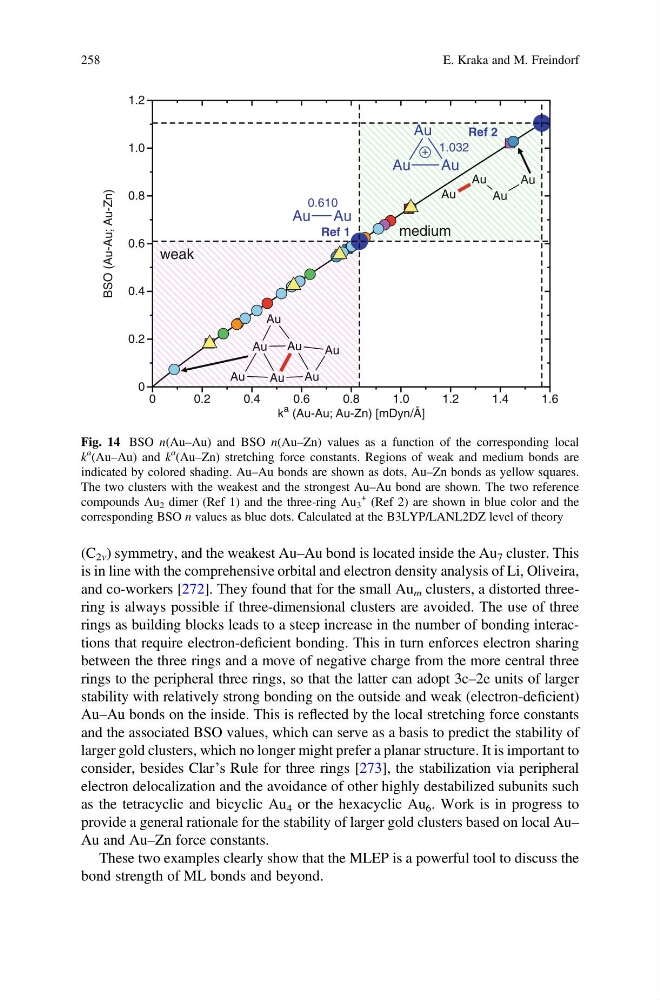
(C 2v ) symmetry, and the weakest Au–Au bond is located inside the Au 7 cluster. This
is in line with the comprehensive orbital and electron density analysis of Li, Oliveira,
and co-workers [272]. They found that for the small Au m clusters, a distorted threering is always possible if three-dimensional clusters are avoided. The use of three
rings as building blocks leads to a steep increase in the number of bonding interactions that require electron-deficient bonding. This in turn enforces electron sharing
between the three rings and a move of negative charge from the more central three
rings to the peripheral three rings, so that the latter can adopt 3c–2e units of larger
stability with relatively strong bonding on the outside and weak (electron-deficient)
Au–Au bonds on the inside. This is reflected by the local stretching force constants
and the associated BSO values, which can serve as a basis to predict the stability of
larger gold clusters, which no longer might prefer a planar structure. It is important to
consider, besides Clar’s Rule for three rings [273], the stabilization via peripheral
electron delocalization and the avoidance of other highly destabilized subunits such
as the tetracyclic and bicyclic Au 4 or the hexacyclic Au 6 . Work is in progress to
provide a general rationale for the stability of larger gold clusters based on local Au–
Au and Au–Zn force constants.
These two examples clearly show that the MLEP is a powerful tool to discuss the
bond strength of ML bonds and beyond.
weak
medium
Au
Au
Au
Au
Au
Ref 1
0.610
Ref 2
1.032
Au
Au
Au
Au
Au
Au
Au
Au
Au
Au
Au
BSO (Au-Au; Au-Zn)
0
0.2
0.4
0.6
0.8
1.0
1.2
k
a (Au-Au; Au-Zn) [mDyn/Å]
0
0.2
0.4
0.6
0.8
1.0
1.2
1.4
1.6
Fig. 14 BSO n(Au–Au) and BSO n(Au–Zn) values as a function of the corresponding local
k
a
(Au–Au) and k
a
(Au–Zn) stretching force constants. Regions of weak and medium bonds are
indicated by colored shading. Au–Au bonds are shown as dots, Au–Zn bonds as yellow squares.
The two clusters with the weakest and the strongest Au–Au bond are shown. The two reference
compounds Au 2 dimer (Ref 1) and the three-ring Au 3
+ (Ref 2) are shown in blue color and the
corresponding BSO n values as blue dots. Calculated at the B3LYP/LANL2DZ level of theory
258
E. Kraka and M. Freindorf
is in line with the comprehensive orbital and electron density analysis of Li, Oliveira,
and co-workers [272]. They found that for the small Au m clusters, a distorted threering is always possible if three-dimensional clusters are avoided. The use of three
rings as building blocks leads to a steep increase in the number of bonding interactions that require electron-deficient bonding. This in turn enforces electron sharing
between the three rings and a move of negative charge from the more central three
rings to the peripheral three rings, so that the latter can adopt 3c–2e units of larger
stability with relatively strong bonding on the outside and weak (electron-deficient)
Au–Au bonds on the inside. This is reflected by the local stretching force constants
and the associated BSO values, which can serve as a basis to predict the stability of
larger gold clusters, which no longer might prefer a planar structure. It is important to
consider, besides Clar’s Rule for three rings [273], the stabilization via peripheral
electron delocalization and the avoidance of other highly destabilized subunits such
as the tetracyclic and bicyclic Au 4 or the hexacyclic Au 6 . Work is in progress to
provide a general rationale for the stability of larger gold clusters based on local Au–
Au and Au–Zn force constants.
These two examples clearly show that the MLEP is a powerful tool to discuss the
bond strength of ML bonds and beyond.
weak
medium
Au
Au
Au
Au
Au
Ref 1
0.610
Ref 2
1.032
Au
Au
Au
Au
Au
Au
Au
Au
Au
Au
Au
BSO (Au-Au; Au-Zn)
0
0.2
0.4
0.6
0.8
1.0
1.2
k
a (Au-Au; Au-Zn) [mDyn/Å]
0
0.2
0.4
0.6
0.8
1.0
1.2
1.4
1.6
Fig. 14 BSO n(Au–Au) and BSO n(Au–Zn) values as a function of the corresponding local
k
a
(Au–Au) and k
a
(Au–Zn) stretching force constants. Regions of weak and medium bonds are
indicated by colored shading. Au–Au bonds are shown as dots, Au–Zn bonds as yellow squares.
The two clusters with the weakest and the strongest Au–Au bond are shown. The two reference
compounds Au 2 dimer (Ref 1) and the three-ring Au 3
+ (Ref 2) are shown in blue color and the
corresponding BSO n values as blue dots. Calculated at the B3LYP/LANL2DZ level of theory
258
E. Kraka and M. Freindorf