

5.5 Generalization of the MLEP
With a few exceptions, the TEP has been limited to the description of transition
metal–carbonyl complexes. In contrast, the MLEP can be determined for any ML
bond of any metal or transition metal complex, whether it contains CO ligands or
not. In this way, the MLEP provides a unique measure of the intrinsic strength of any
metal and/or transition metal bond including metal and transition metal atoms across
the periodic table. In the following section, we will present two recent examples.
MLEP for Fe–H Interactions Makoś and co-workers investigated the strength of
the H
À and H 2 interaction with the Fe atom of a [NiFe] hydrogenase mimic and how
this interaction can be modulated by changing the Fe ligand in trans position relative
to H
À and H 2 [262]. 17 different ligands were investigated at the BP86 level of
theory [304, 305] using the cc-pVTZ basis set [276, 306]. The investigation included
σ-donor ligands such as CH 3
À , C2H 5
À , NH 3 , and H 2 O, πÀdonor ligands such as
Cl
À , F
À , and OH
À
, and σ-donor/π–acceptor ligands such as CN
À and CO as shown
in Fig. 12a. According to the comprehensive local mode analysis performed in this
work, Fe–H interactions are strengthened by σ-donor or π-donor ligands and weakened by σ-donor/π-acceptor ligands. In contrast, the H–H bond of H 2 in complexes
B is weakened by σ-donor or π-donor ligands and strengthened by
σ-donor/π-acceptor ligands.
A new metal–ligand electronic parameter (MLEP) for Fe–H ligands was developed in this work, which can be generally applied to evaluate the Fe–H bond strength
in iron complexes and iron hydrides. For the underlying Fe–H power relationship,
the low-spin complex [Fe(CO) 5 ] was used, in which one axial CO ligand was
replaced by H 2 (reference 1) and by H
À (reference 2), respectively. The C 3v
symmetric [Fe(CO) 4 H] complex led to a k
a
(F–H) value of 1.954 mDyn/Å, and the
C s symmetric [Fe(CO) 4 H 2 ] complex led to a k
a (F–H) value of 1.024 mDyn/Å. As
BSO n values for these two references, the corresponding Mayer bond orders [289] n
(Mayer) 0.6454 and n(Mayer) 0.4775 were used, respectively. This led to the
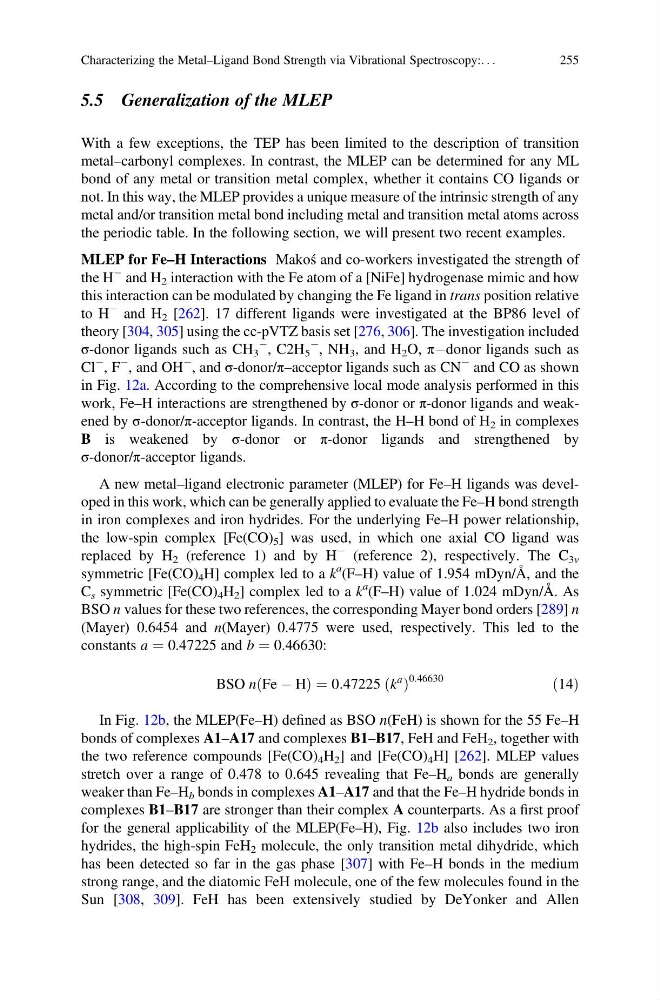
constants a ¼ 0.47225 and b ¼ 0.46630:
BSO n Fe À H
ð
Þ¼0:47225 k
a
ð Þ
0:46630
ð14Þ
In Fig. 12b, the MLEP(Fe–H) defined as BSO n(FeH) is shown for the 55 Fe–H
bonds of complexes A1–A17 and complexes B1–B17, FeH and FeH 2 , together with
the two reference compounds [Fe(CO) 4 H 2 ] and [Fe(CO) 4 H] [262]. MLEP values
stretch over a range of 0.478 to 0.645 revealing that Fe–H a bonds are generally
weaker than Fe–H b bonds in complexes A1–A17 and that the Fe–H hydride bonds in
complexes B1–B17 are stronger than their complex A counterparts. As a first proof
for the general applicability of the MLEP(Fe–H), Fig. 12b also includes two iron
hydrides, the high-spin FeH 2 molecule, the only transition metal dihydride, which
has been detected so far in the gas phase [307] with Fe–H bonds in the medium
strong range, and the diatomic FeH molecule, one of the few molecules found in the
Sun [308, 309]. FeH has been extensively studied by DeYonker and Allen
Characterizing the Metal–Ligand Bond Strength via Vibrational Spectroscopy:. . .
255
With a few exceptions, the TEP has been limited to the description of transition
metal–carbonyl complexes. In contrast, the MLEP can be determined for any ML
bond of any metal or transition metal complex, whether it contains CO ligands or
not. In this way, the MLEP provides a unique measure of the intrinsic strength of any
metal and/or transition metal bond including metal and transition metal atoms across
the periodic table. In the following section, we will present two recent examples.
MLEP for Fe–H Interactions Makoś and co-workers investigated the strength of
the H
À and H 2 interaction with the Fe atom of a [NiFe] hydrogenase mimic and how
this interaction can be modulated by changing the Fe ligand in trans position relative
to H
À and H 2 [262]. 17 different ligands were investigated at the BP86 level of
theory [304, 305] using the cc-pVTZ basis set [276, 306]. The investigation included
σ-donor ligands such as CH 3
À , C2H 5
À , NH 3 , and H 2 O, πÀdonor ligands such as
Cl
À , F
À , and OH
À
, and σ-donor/π–acceptor ligands such as CN
À and CO as shown
in Fig. 12a. According to the comprehensive local mode analysis performed in this
work, Fe–H interactions are strengthened by σ-donor or π-donor ligands and weakened by σ-donor/π-acceptor ligands. In contrast, the H–H bond of H 2 in complexes
B is weakened by σ-donor or π-donor ligands and strengthened by
σ-donor/π-acceptor ligands.
A new metal–ligand electronic parameter (MLEP) for Fe–H ligands was developed in this work, which can be generally applied to evaluate the Fe–H bond strength
in iron complexes and iron hydrides. For the underlying Fe–H power relationship,
the low-spin complex [Fe(CO) 5 ] was used, in which one axial CO ligand was
replaced by H 2 (reference 1) and by H
À (reference 2), respectively. The C 3v
symmetric [Fe(CO) 4 H] complex led to a k
a
(F–H) value of 1.954 mDyn/Å, and the
C s symmetric [Fe(CO) 4 H 2 ] complex led to a k
a (F–H) value of 1.024 mDyn/Å. As
BSO n values for these two references, the corresponding Mayer bond orders [289] n
(Mayer) 0.6454 and n(Mayer) 0.4775 were used, respectively. This led to the
constants a ¼ 0.47225 and b ¼ 0.46630:
BSO n Fe À H
ð
Þ¼0:47225 k
a
ð Þ
0:46630
ð14Þ
In Fig. 12b, the MLEP(Fe–H) defined as BSO n(FeH) is shown for the 55 Fe–H
bonds of complexes A1–A17 and complexes B1–B17, FeH and FeH 2 , together with
the two reference compounds [Fe(CO) 4 H 2 ] and [Fe(CO) 4 H] [262]. MLEP values
stretch over a range of 0.478 to 0.645 revealing that Fe–H a bonds are generally
weaker than Fe–H b bonds in complexes A1–A17 and that the Fe–H hydride bonds in
complexes B1–B17 are stronger than their complex A counterparts. As a first proof
for the general applicability of the MLEP(Fe–H), Fig. 12b also includes two iron
hydrides, the high-spin FeH 2 molecule, the only transition metal dihydride, which
has been detected so far in the gas phase [307] with Fe–H bonds in the medium
strong range, and the diatomic FeH molecule, one of the few molecules found in the
Sun [308, 309]. FeH has been extensively studied by DeYonker and Allen
Characterizing the Metal–Ligand Bond Strength via Vibrational Spectroscopy:. . .
255