

value is due to the missing σ-lone pair electrons whereas in the second case, the steric
bulk of the ligand hinders the acceptance of negative charge from Ni.
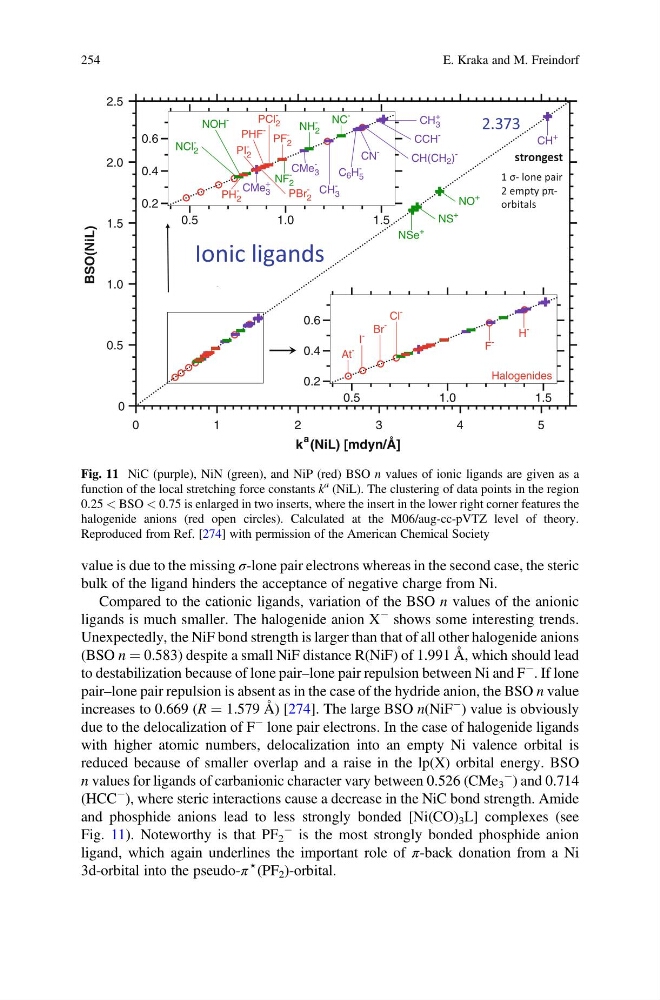
Compared to the cationic ligands, variation of the BSO n values of the anionic
ligands is much smaller. The halogenide anion X
À shows some interesting trends.
Unexpectedly, the NiF bond strength is larger than that of all other halogenide anions
(BSO n ¼ 0.583) despite a small NiF distance R(NiF) of 1.991 Å, which should lead
to destabilization because of lone pair–lone pair repulsion between Ni and F
À . If lone
pair–lone pair repulsion is absent as in the case of the hydride anion, the BSO n value
increases to 0.669 (R ¼ 1.579 Å) [274]. The large BSO n(NiF
À
) value is obviously
due to the delocalization of F
À lone pair electrons. In the case of halogenide ligands
with higher atomic numbers, delocalization into an empty Ni valence orbital is
reduced because of smaller overlap and a raise in the lp(X) orbital energy. BSO
n values for ligands of carbanionic character vary between 0.526 (CMe 3
À ) and 0.714
(HCC
À ), where steric interactions cause a decrease in the NiC bond strength. Amide
and phosphide anions lead to less strongly bonded [Ni(CO) 3 L] complexes (see
Fig. 11). Noteworthy is that PF 2
À is the most strongly bonded phosphide anion
ligand, which again underlines the important role of π-back donation from a Ni
3d-orbital into the pseudo-π
⋆
(PF 2 )-orbital.
0.2
0.4
0.6
0.5
1.0
1.5
PF
-
2
PI
-
2
PH
-
2
PBr
-
2
PCl
-
2
PHF
-
NC
-
NCl
-
2
NSe
+
NO
+
NS
+
NOH
-
NF
-
2
NH
-
2
CCH
-
CMe
-
3
CH
-
3
CN
-
CH(CH 2 )
-
CMe
+
3
CH
+
3
CH
+
C 6 H
-
5
H
-
Halogenides
F
-
Cl
-
Br
-
I
-
At
-
BSO(NiL)
0
0.5
1.0
1.5
2.0
2.5
k
a (NiL) [mdyn/Å]
0
1
2
3
4
5
0.2
0.4
0.6
0.5
1.0
1.5
Ionic ligands
strongest
1 σ- lone pair
2 empty pπorbitals
2.373
Fig. 11 NiC (purple), NiN (green), and NiP (red) BSO n values of ionic ligands are given as a
function of the local stretching force constants k
a (NiL). The clustering of data points in the region
0.25 < BSO < 0.75 is enlarged in two inserts, where the insert in the lower right corner features the
halogenide anions (red open circles). Calculated at the M06/aug-cc-pVTZ level of theory.
Reproduced from Ref. [274] with permission of the American Chemical Society
254
E. Kraka and M. Freindorf
bulk of the ligand hinders the acceptance of negative charge from Ni.
Compared to the cationic ligands, variation of the BSO n values of the anionic
ligands is much smaller. The halogenide anion X
À shows some interesting trends.
Unexpectedly, the NiF bond strength is larger than that of all other halogenide anions
(BSO n ¼ 0.583) despite a small NiF distance R(NiF) of 1.991 Å, which should lead
to destabilization because of lone pair–lone pair repulsion between Ni and F
À . If lone
pair–lone pair repulsion is absent as in the case of the hydride anion, the BSO n value
increases to 0.669 (R ¼ 1.579 Å) [274]. The large BSO n(NiF
À
) value is obviously
due to the delocalization of F
À lone pair electrons. In the case of halogenide ligands
with higher atomic numbers, delocalization into an empty Ni valence orbital is
reduced because of smaller overlap and a raise in the lp(X) orbital energy. BSO
n values for ligands of carbanionic character vary between 0.526 (CMe 3
À ) and 0.714
(HCC
À ), where steric interactions cause a decrease in the NiC bond strength. Amide
and phosphide anions lead to less strongly bonded [Ni(CO) 3 L] complexes (see
Fig. 11). Noteworthy is that PF 2
À is the most strongly bonded phosphide anion
ligand, which again underlines the important role of π-back donation from a Ni
3d-orbital into the pseudo-π
⋆
(PF 2 )-orbital.
0.2
0.4
0.6
0.5
1.0
1.5
PF
-
2
PI
-
2
PH
-
2
PBr
-
2
PCl
-
2
PHF
-
NC
-
NCl
-
2
NSe
+
NO
+
NS
+
NOH
-
NF
-
2
NH
-
2
CCH
-
CMe
-
3
CH
-
3
CN
-
CH(CH 2 )
-
CMe
+
3
CH
+
3
CH
+
C 6 H
-
5
H
-
Halogenides
F
-
Cl
-
Br
-
I
-
At
-
BSO(NiL)
0
0.5
1.0
1.5
2.0
2.5
k
a (NiL) [mdyn/Å]
0
1
2
3
4
5
0.2
0.4
0.6
0.5
1.0
1.5
Ionic ligands
strongest
1 σ- lone pair
2 empty pπorbitals
2.373
Fig. 11 NiC (purple), NiN (green), and NiP (red) BSO n values of ionic ligands are given as a
function of the local stretching force constants k
a (NiL). The clustering of data points in the region
0.25 < BSO < 0.75 is enlarged in two inserts, where the insert in the lower right corner features the
halogenide anions (red open circles). Calculated at the M06/aug-cc-pVTZ level of theory.
Reproduced from Ref. [274] with permission of the American Chemical Society
254
E. Kraka and M. Freindorf