

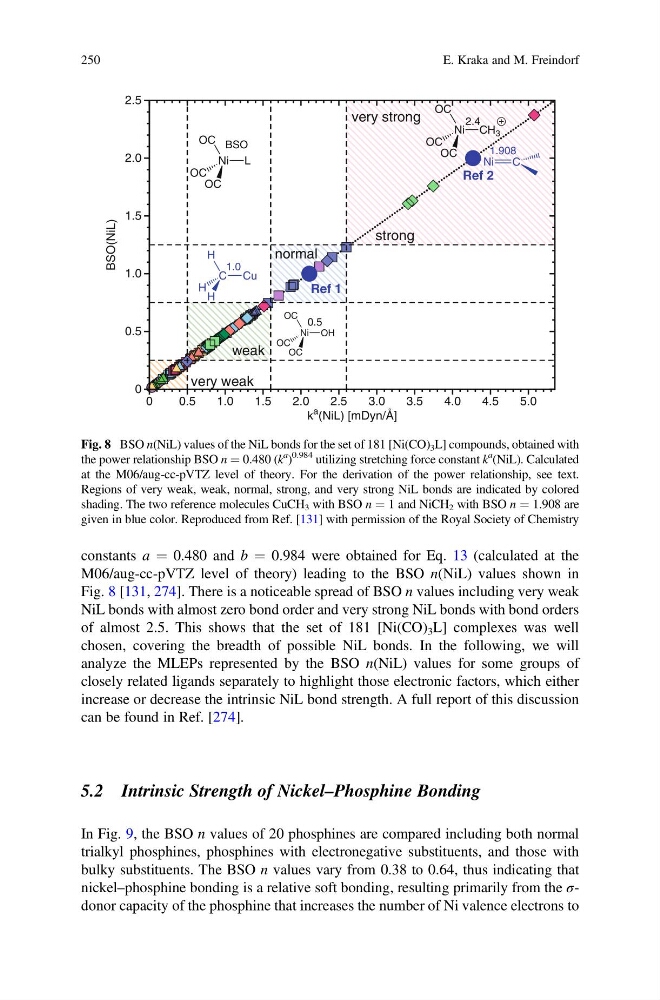
constants a ¼ 0.480 and b ¼ 0.984 were obtained for Eq. 13 (calculated at the
M06/aug-cc-pVTZ level of theory) leading to the BSO n(NiL) values shown in
Fig. 8 [131, 274]. There is a noticeable spread of BSO n values including very weak
NiL bonds with almost zero bond order and very strong NiL bonds with bond orders
of almost 2.5. This shows that the set of 181 [Ni(CO) 3 L] complexes was well
chosen, covering the breadth of possible NiL bonds. In the following, we will
analyze the MLEPs represented by the BSO n(NiL) values for some groups of
closely related ligands separately to highlight those electronic factors, which either
increase or decrease the intrinsic NiL bond strength. A full report of this discussion
can be found in Ref. [274].
5.2 Intrinsic Strength of Nickel–Phosphine Bonding
In Fig. 9, the BSO n values of 20 phosphines are compared including both normal
trialkyl phosphines, phosphines with electronegative substituents, and those with
bulky substituents. The BSO n values vary from 0.38 to 0.64, thus indicating that
nickel–phosphine bonding is a relative soft bonding, resulting primarily from the σdonor capacity of the phosphine that increases the number of Ni valence electrons to
2.4
very strong
normal
weak
very weak
strong
C Cu
H
H
H
Ni
C
BSO
1.908
1.0
Ni L
OC
OC
OC
Ni CH 3
OC
OC
OC
Ni OH
OC
OC
OC 0.5
Ref 2
Ref 1
BSO(NiL)
0
0.5
1.0
1.5
2.0
2.5
k
a (NiL) [mDyn/Å]
0
0.5
1.0
1.5
2.0
2.5
3.0
3.5
4.0
4.5
5.0
Fig. 8 BSO n(NiL) values of the NiL bonds for the set of 181 [Ni(CO) 3 L] compounds, obtained with
the power relationship BSO n ¼ 0.480 (k
a
)
0.984 utilizing stretching force constant k
a
(NiL). Calculated
at the M06/aug-cc-pVTZ level of theory. For the derivation of the power relationship, see text.
Regions of very weak, weak, normal, strong, and very strong NiL bonds are indicated by colored
shading. The two reference molecules CuCH 3 with BSO n ¼ 1 and NiCH 2 with BSO n ¼ 1.908 are
given in blue color. Reproduced from Ref. [131] with permission of the Royal Society of Chemistry
250
E. Kraka and M. Freindorf
M06/aug-cc-pVTZ level of theory) leading to the BSO n(NiL) values shown in
Fig. 8 [131, 274]. There is a noticeable spread of BSO n values including very weak
NiL bonds with almost zero bond order and very strong NiL bonds with bond orders
of almost 2.5. This shows that the set of 181 [Ni(CO) 3 L] complexes was well
chosen, covering the breadth of possible NiL bonds. In the following, we will
analyze the MLEPs represented by the BSO n(NiL) values for some groups of
closely related ligands separately to highlight those electronic factors, which either
increase or decrease the intrinsic NiL bond strength. A full report of this discussion
can be found in Ref. [274].
5.2 Intrinsic Strength of Nickel–Phosphine Bonding
In Fig. 9, the BSO n values of 20 phosphines are compared including both normal
trialkyl phosphines, phosphines with electronegative substituents, and those with
bulky substituents. The BSO n values vary from 0.38 to 0.64, thus indicating that
nickel–phosphine bonding is a relative soft bonding, resulting primarily from the σdonor capacity of the phosphine that increases the number of Ni valence electrons to
2.4
very strong
normal
weak
very weak
strong
C Cu
H
H
H
Ni
C
BSO
1.908
1.0
Ni L
OC
OC
OC
Ni CH 3
OC
OC
OC
Ni OH
OC
OC
OC 0.5
Ref 2
Ref 1
BSO(NiL)
0
0.5
1.0
1.5
2.0
2.5
k
a (NiL) [mDyn/Å]
0
0.5
1.0
1.5
2.0
2.5
3.0
3.5
4.0
4.5
5.0
Fig. 8 BSO n(NiL) values of the NiL bonds for the set of 181 [Ni(CO) 3 L] compounds, obtained with
the power relationship BSO n ¼ 0.480 (k
a
)
0.984 utilizing stretching force constant k
a
(NiL). Calculated
at the M06/aug-cc-pVTZ level of theory. For the derivation of the power relationship, see text.
Regions of very weak, weak, normal, strong, and very strong NiL bonds are indicated by colored
shading. The two reference molecules CuCH 3 with BSO n ¼ 1 and NiCH 2 with BSO n ¼ 1.908 are
given in blue color. Reproduced from Ref. [131] with permission of the Royal Society of Chemistry
250
E. Kraka and M. Freindorf