

hardware and advanced quantum chemical software [283–285]. This has opened the
avenue for assessing the ML bond strength directly from the analysis of the ML bond
without making a detour around the CO bonds. The local mode stretching force
constant k
a (ML) provides the perfect tool, which can be derived from experimental
and/or calculated normal vibrational frequencies.
5.1 Relative Bond Strength Order (BSO)
Once the local ML stretching force constants k
a (ML) have been determined, one can
simplify their comparison by translating the force constants into bond strength orders
(BSO) n; most chemists are more acquainted with [75, 246, 259, 286]. This can be
accomplished with Kraka, Larsson, and Cremer’s extension of the Badger rule
[246, 287], which states that the strength of a bond correlates with the frequency
of its vibrational mode and vice versa in a form of a power relationship. Badger’s
original rule was derived for diatomic molecules using the bond length as measure of
bond strength [287]. Kraka, Larsson, and Cremer showed that utilizing local
stretching force constants and replacing bond lengths by BSO n values, the Badger
rule can be generalized and in this way applied to the bonds of polyatomic molecules
including different bonds between atoms of the same period. This has led to the
power relationship shown in Eq. 13, transforming local mode stretching force
constants into BSO n values to be used as more convenient bond strength descriptors, i.e., instead of defining the MLEP as the local mode stretching force constant
k
a (ML), one can also define the MLEP as the BSO n(ML).
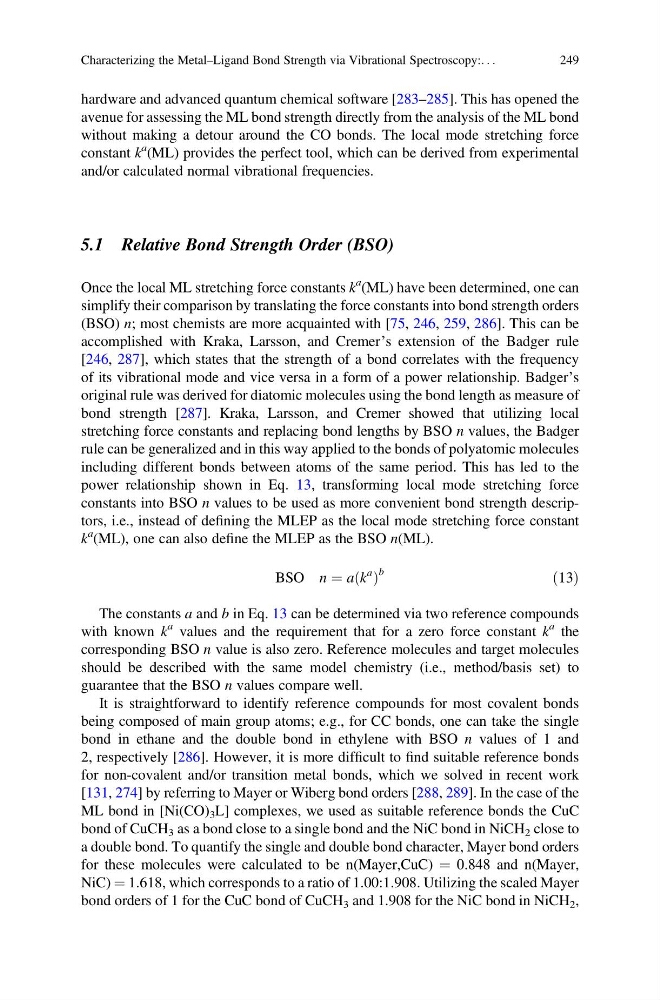
BSO n ¼ a k
a
ð Þ
b
ð13Þ
The constants a and b in Eq. 13 can be determined via two reference compounds
with known k
a values and the requirement that for a zero force constant k
a the
corresponding BSO n value is also zero. Reference molecules and target molecules
should be described with the same model chemistry (i.e., method/basis set) to
guarantee that the BSO n values compare well.
It is straightforward to identify reference compounds for most covalent bonds
being composed of main group atoms; e.g., for CC bonds, one can take the single
bond in ethane and the double bond in ethylene with BSO n values of 1 and
2, respectively [286]. However, it is more difficult to find suitable reference bonds
for non-covalent and/or transition metal bonds, which we solved in recent work
[131, 274] by referring to Mayer or Wiberg bond orders [288, 289]. In the case of the
ML bond in [Ni(CO) 3 L] complexes, we used as suitable reference bonds the CuC
bond of CuCH 3 as a bond close to a single bond and the NiC bond in NiCH 2 close to
a double bond. To quantify the single and double bond character, Mayer bond orders
for these molecules were calculated to be n(Mayer,CuC) ¼ 0.848 and n(Mayer,
NiC) ¼ 1.618, which corresponds to a ratio of 1.00:1.908. Utilizing the scaled Mayer
bond orders of 1 for the CuC bond of CuCH 3 and 1.908 for the NiC bond in NiCH 2 ,
Characterizing the Metal–Ligand Bond Strength via Vibrational Spectroscopy:. . .
249
avenue for assessing the ML bond strength directly from the analysis of the ML bond
without making a detour around the CO bonds. The local mode stretching force
constant k
a (ML) provides the perfect tool, which can be derived from experimental
and/or calculated normal vibrational frequencies.
5.1 Relative Bond Strength Order (BSO)
Once the local ML stretching force constants k
a (ML) have been determined, one can
simplify their comparison by translating the force constants into bond strength orders
(BSO) n; most chemists are more acquainted with [75, 246, 259, 286]. This can be
accomplished with Kraka, Larsson, and Cremer’s extension of the Badger rule
[246, 287], which states that the strength of a bond correlates with the frequency
of its vibrational mode and vice versa in a form of a power relationship. Badger’s
original rule was derived for diatomic molecules using the bond length as measure of
bond strength [287]. Kraka, Larsson, and Cremer showed that utilizing local
stretching force constants and replacing bond lengths by BSO n values, the Badger
rule can be generalized and in this way applied to the bonds of polyatomic molecules
including different bonds between atoms of the same period. This has led to the
power relationship shown in Eq. 13, transforming local mode stretching force
constants into BSO n values to be used as more convenient bond strength descriptors, i.e., instead of defining the MLEP as the local mode stretching force constant
k
a (ML), one can also define the MLEP as the BSO n(ML).
BSO n ¼ a k
a
ð Þ
b
ð13Þ
The constants a and b in Eq. 13 can be determined via two reference compounds
with known k
a values and the requirement that for a zero force constant k
a the
corresponding BSO n value is also zero. Reference molecules and target molecules
should be described with the same model chemistry (i.e., method/basis set) to
guarantee that the BSO n values compare well.
It is straightforward to identify reference compounds for most covalent bonds
being composed of main group atoms; e.g., for CC bonds, one can take the single
bond in ethane and the double bond in ethylene with BSO n values of 1 and
2, respectively [286]. However, it is more difficult to find suitable reference bonds
for non-covalent and/or transition metal bonds, which we solved in recent work
[131, 274] by referring to Mayer or Wiberg bond orders [288, 289]. In the case of the
ML bond in [Ni(CO) 3 L] complexes, we used as suitable reference bonds the CuC
bond of CuCH 3 as a bond close to a single bond and the NiC bond in NiCH 2 close to
a double bond. To quantify the single and double bond character, Mayer bond orders
for these molecules were calculated to be n(Mayer,CuC) ¼ 0.848 and n(Mayer,
NiC) ¼ 1.618, which corresponds to a ratio of 1.00:1.908. Utilizing the scaled Mayer
bond orders of 1 for the CuC bond of CuCH 3 and 1.908 for the NiC bond in NiCH 2 ,
Characterizing the Metal–Ligand Bond Strength via Vibrational Spectroscopy:. . .
249