

increasingly frequent, particularly with calculations of homogeneous gold-catalysis
[46–48].
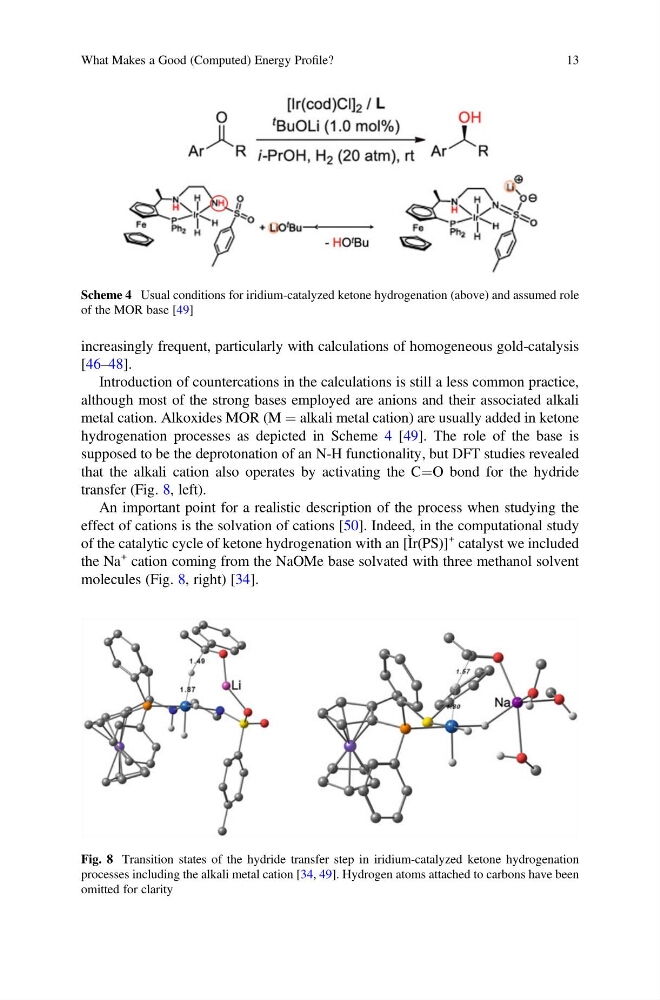
Introduction of countercations in the calculations is still a less common practice,
although most of the strong bases employed are anions and their associated alkali
metal cation. Alkoxides MOR (M ¼ alkali metal cation) are usually added in ketone
hydrogenation processes as depicted in Scheme 4 [49]. The role of the base is
supposed to be the deprotonation of an N-H functionality, but DFT studies revealed
that the alkali cation also operates by activating the C¼O bond for the hydride
transfer (Fig. 8, left).
An important point for a realistic description of the process when studying the
effect of cations is the solvation of cations [50]. Indeed, in the computational study
of the catalytic cycle of ketone hydrogenation with an [Ìr(PS)]
+ catalyst we included
the Na
+ cation coming from the NaOMe base solvated with three methanol solvent
molecules (Fig. 8, right) [34].
Scheme 4 Usual conditions for iridium-catalyzed ketone hydrogenation (above) and assumed role
of the MOR base [49]
Fig. 8 Transition states of the hydride transfer step in iridium-catalyzed ketone hydrogenation
processes including the alkali metal cation [34, 49]. Hydrogen atoms attached to carbons have been
omitted for clarity
What Makes a Good (Computed) Energy Profile?
13
[46–48].
Introduction of countercations in the calculations is still a less common practice,
although most of the strong bases employed are anions and their associated alkali
metal cation. Alkoxides MOR (M ¼ alkali metal cation) are usually added in ketone
hydrogenation processes as depicted in Scheme 4 [49]. The role of the base is
supposed to be the deprotonation of an N-H functionality, but DFT studies revealed
that the alkali cation also operates by activating the C¼O bond for the hydride
transfer (Fig. 8, left).
An important point for a realistic description of the process when studying the
effect of cations is the solvation of cations [50]. Indeed, in the computational study
of the catalytic cycle of ketone hydrogenation with an [Ìr(PS)]
+ catalyst we included
the Na
+ cation coming from the NaOMe base solvated with three methanol solvent
molecules (Fig. 8, right) [34].
Scheme 4 Usual conditions for iridium-catalyzed ketone hydrogenation (above) and assumed role
of the MOR base [49]
Fig. 8 Transition states of the hydride transfer step in iridium-catalyzed ketone hydrogenation
processes including the alkali metal cation [34, 49]. Hydrogen atoms attached to carbons have been
omitted for clarity
What Makes a Good (Computed) Energy Profile?
13