

The role of an alkali cation as a Lewis acid in the formate decarboxylation
catalyzed by an iron pincer complex was analyzed by DFT calculations modeling
the cation as [Na(H 2 O) 6 ]
+ [51]. More recently, the study of the effect of Li
+ cation on
the formic acid dehydrogenation catalyzed by a ruthenium PNP pincer complex
(RuPNP) was performed by means of density functional theory-based molecular
dynamics with an explicit description of methanol solvent [52]. Since the reactions
involve transfer of charged species and are performed in protic solvent mixtures
(MeOH/H 2 O), accounting for solvent interactions and thermal fluctuations is important for a realistic and accurate description of the reaction mechanism, as we will
discuss in Sect. 6. The simulations show that the cation interacts with up to four
solvent methanol molecules along the reaction, highlighting the importance of
considering adequate solvation of the cation.
The use of additives is very common in homogeneous catalysis. However, in
most cases its role is not well understood, and additives are often neglected in a
computational study. Several years ago, a thorough computational study on the role
of coupling additives in palladium-catalyzed reductive eliminations showcase that a
detailed computational modeling of the system allows to understand their role
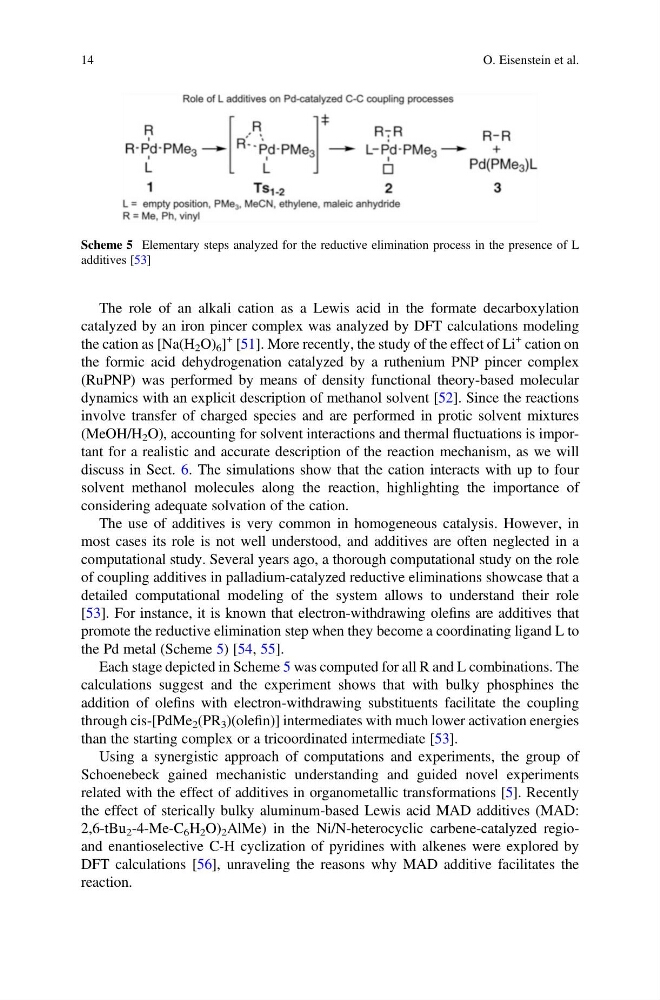
[53]. For instance, it is known that electron-withdrawing olefins are additives that
promote the reductive elimination step when they become a coordinating ligand L to
the Pd metal (Scheme 5) [54, 55].
Each stage depicted in Scheme 5 was computed for all R and L combinations. The
calculations suggest and the experiment shows that with bulky phosphines the
addition of olefins with electron-withdrawing substituents facilitate the coupling
through cis-[PdMe 2 (PR 3 )(olefin)] intermediates with much lower activation energies
than the starting complex or a tricoordinated intermediate [53].
Using a synergistic approach of computations and experiments, the group of
Schoenebeck gained mechanistic understanding and guided novel experiments
related with the effect of additives in organometallic transformations [5]. Recently
the effect of sterically bulky aluminum-based Lewis acid MAD additives (MAD:
2,6-tBu 2 -4-Me-C 6 H 2 O) 2 AlMe) in the Ni/N-heterocyclic carbene-catalyzed regioand enantioselective C-H cyclization of pyridines with alkenes were explored by
DFT calculations [56], unraveling the reasons why MAD additive facilitates the
reaction.
Scheme 5 Elementary steps analyzed for the reductive elimination process in the presence of L
additives [53]
14
O. Eisenstein et al.
catalyzed by an iron pincer complex was analyzed by DFT calculations modeling
the cation as [Na(H 2 O) 6 ]
+ [51]. More recently, the study of the effect of Li
+ cation on
the formic acid dehydrogenation catalyzed by a ruthenium PNP pincer complex
(RuPNP) was performed by means of density functional theory-based molecular
dynamics with an explicit description of methanol solvent [52]. Since the reactions
involve transfer of charged species and are performed in protic solvent mixtures
(MeOH/H 2 O), accounting for solvent interactions and thermal fluctuations is important for a realistic and accurate description of the reaction mechanism, as we will
discuss in Sect. 6. The simulations show that the cation interacts with up to four
solvent methanol molecules along the reaction, highlighting the importance of
considering adequate solvation of the cation.
The use of additives is very common in homogeneous catalysis. However, in
most cases its role is not well understood, and additives are often neglected in a
computational study. Several years ago, a thorough computational study on the role
of coupling additives in palladium-catalyzed reductive eliminations showcase that a
detailed computational modeling of the system allows to understand their role
[53]. For instance, it is known that electron-withdrawing olefins are additives that
promote the reductive elimination step when they become a coordinating ligand L to
the Pd metal (Scheme 5) [54, 55].
Each stage depicted in Scheme 5 was computed for all R and L combinations. The
calculations suggest and the experiment shows that with bulky phosphines the
addition of olefins with electron-withdrawing substituents facilitate the coupling
through cis-[PdMe 2 (PR 3 )(olefin)] intermediates with much lower activation energies
than the starting complex or a tricoordinated intermediate [53].
Using a synergistic approach of computations and experiments, the group of
Schoenebeck gained mechanistic understanding and guided novel experiments
related with the effect of additives in organometallic transformations [5]. Recently
the effect of sterically bulky aluminum-based Lewis acid MAD additives (MAD:
2,6-tBu 2 -4-Me-C 6 H 2 O) 2 AlMe) in the Ni/N-heterocyclic carbene-catalyzed regioand enantioselective C-H cyclization of pyridines with alkenes were explored by
DFT calculations [56], unraveling the reasons why MAD additive facilitates the
reaction.
Scheme 5 Elementary steps analyzed for the reductive elimination process in the presence of L
additives [53]
14
O. Eisenstein et al.