

accessible in this system, but a 1,3-hydrogen shift from the hydrido-alkynyl intermediate also exhibits rather high Gibbs energy barrier.
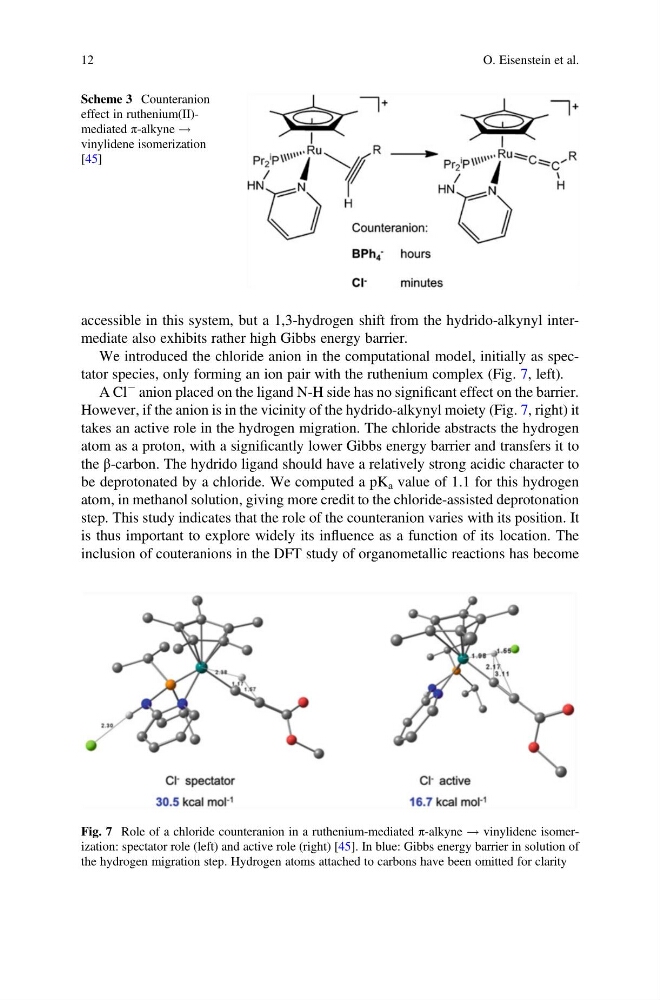
We introduced the chloride anion in the computational model, initially as spectator species, only forming an ion pair with the ruthenium complex (Fig. 7, left).
A Cl
À anion placed on the ligand N-H side has no significant effect on the barrier.
However, if the anion is in the vicinity of the hydrido-alkynyl moiety (Fig. 7, right) it
takes an active role in the hydrogen migration. The chloride abstracts the hydrogen
atom as a proton, with a significantly lower Gibbs energy barrier and transfers it to
the β-carbon. The hydrido ligand should have a relatively strong acidic character to
be deprotonated by a chloride. We computed a pK a value of 1.1 for this hydrogen
atom, in methanol solution, giving more credit to the chloride-assisted deprotonation
step. This study indicates that the role of the counteranion varies with its position. It
is thus important to explore widely its influence as a function of its location. The
inclusion of couteranions in the DFT study of organometallic reactions has become
Scheme 3 Counteranion
effect in ruthenium(II)mediated π-alkyne !
vinylidene isomerization
[45]
Fig. 7 Role of a chloride counteranion in a ruthenium-mediated π-alkyne ! vinylidene isomerization: spectator role (left) and active role (right) [45]. In blue: Gibbs energy barrier in solution of
the hydrogen migration step. Hydrogen atoms attached to carbons have been omitted for clarity
12
O. Eisenstein et al.
We introduced the chloride anion in the computational model, initially as spectator species, only forming an ion pair with the ruthenium complex (Fig. 7, left).
A Cl
À anion placed on the ligand N-H side has no significant effect on the barrier.
However, if the anion is in the vicinity of the hydrido-alkynyl moiety (Fig. 7, right) it
takes an active role in the hydrogen migration. The chloride abstracts the hydrogen
atom as a proton, with a significantly lower Gibbs energy barrier and transfers it to
the β-carbon. The hydrido ligand should have a relatively strong acidic character to
be deprotonated by a chloride. We computed a pK a value of 1.1 for this hydrogen
atom, in methanol solution, giving more credit to the chloride-assisted deprotonation
step. This study indicates that the role of the counteranion varies with its position. It
is thus important to explore widely its influence as a function of its location. The
inclusion of couteranions in the DFT study of organometallic reactions has become
Scheme 3 Counteranion
effect in ruthenium(II)mediated π-alkyne !
vinylidene isomerization
[45]
Fig. 7 Role of a chloride counteranion in a ruthenium-mediated π-alkyne ! vinylidene isomerization: spectator role (left) and active role (right) [45]. In blue: Gibbs energy barrier in solution of
the hydrogen migration step. Hydrogen atoms attached to carbons have been omitted for clarity
12
O. Eisenstein et al.