

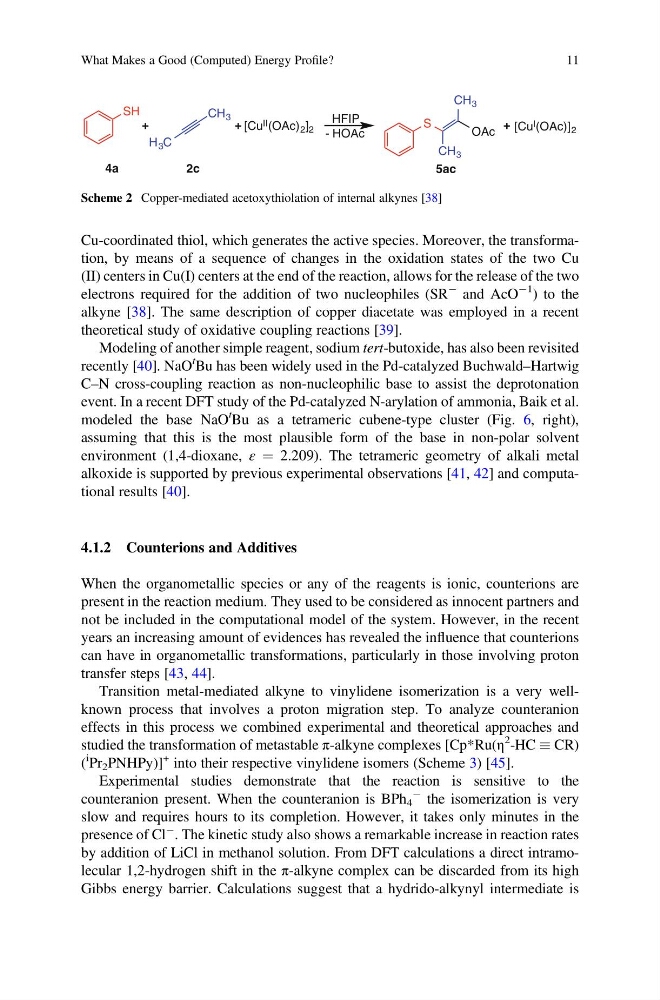
Cu-coordinated thiol, which generates the active species. Moreover, the transformation, by means of a sequence of changes in the oxidation states of the two Cu
(II) centers in Cu(I) centers at the end of the reaction, allows for the release of the two
electrons required for the addition of two nucleophiles (SR
À and AcO
À1 ) to the
alkyne [38]. The same description of copper diacetate was employed in a recent
theoretical study of oxidative coupling reactions [39].
Modeling of another simple reagent, sodium tert-butoxide, has also been revisited
recently [40]. NaO
t
Bu has been widely used in the Pd-catalyzed Buchwald–Hartwig
C–N cross-coupling reaction as non-nucleophilic base to assist the deprotonation
event. In a recent DFT study of the Pd-catalyzed N-arylation of ammonia, Baik et al.
modeled the base NaO
t Bu as a tetrameric cubene-type cluster (Fig. 6, right),
assuming that this is the most plausible form of the base in non-polar solvent
environment (1,4-dioxane, ε ¼ 2.209). The tetrameric geometry of alkali metal
alkoxide is supported by previous experimental observations [41, 42] and computational results [40].
4.1.2 Counterions and Additives
When the organometallic species or any of the reagents is ionic, counterions are
present in the reaction medium. They used to be considered as innocent partners and
not be included in the computational model of the system. However, in the recent
years an increasing amount of evidences has revealed the influence that counterions
can have in organometallic transformations, particularly in those involving proton
transfer steps [43, 44].
Transition metal-mediated alkyne to vinylidene isomerization is a very wellknown process that involves a proton migration step. To analyze counteranion
effects in this process we combined experimental and theoretical approaches and
studied the transformation of metastable π-alkyne complexes [Cp*Ru(η
2 -HC CR)
(
i Pr 2 PNHPy)]
+ into their respective vinylidene isomers (Scheme 3) [45].
Experimental studies demonstrate that the reaction is sensitive to the
counteranion present. When the counteranion is BPh 4
À the isomerization is very
slow and requires hours to its completion. However, it takes only minutes in the
presence of Cl
À . The kinetic study also shows a remarkable increase in reaction rates
by addition of LiCl in methanol solution. From DFT calculations a direct intramolecular 1,2-hydrogen shift in the π-alkyne complex can be discarded from its high
Gibbs energy barrier. Calculations suggest that a hydrido-alkynyl intermediate is
SH
CH 3
H 3 C
CH 3
CH 3
S
OAc
5ac
4a
2c
+
+
- HOAc
HFIP
+
[Cu II (OAc) 2 ] 2
[Cu I (OAc)] 2
Scheme 2 Copper-mediated acetoxythiolation of internal alkynes [38]
What Makes a Good (Computed) Energy Profile?
11
(II) centers in Cu(I) centers at the end of the reaction, allows for the release of the two
electrons required for the addition of two nucleophiles (SR
À and AcO
À1 ) to the
alkyne [38]. The same description of copper diacetate was employed in a recent
theoretical study of oxidative coupling reactions [39].
Modeling of another simple reagent, sodium tert-butoxide, has also been revisited
recently [40]. NaO
t
Bu has been widely used in the Pd-catalyzed Buchwald–Hartwig
C–N cross-coupling reaction as non-nucleophilic base to assist the deprotonation
event. In a recent DFT study of the Pd-catalyzed N-arylation of ammonia, Baik et al.
modeled the base NaO
t Bu as a tetrameric cubene-type cluster (Fig. 6, right),
assuming that this is the most plausible form of the base in non-polar solvent
environment (1,4-dioxane, ε ¼ 2.209). The tetrameric geometry of alkali metal
alkoxide is supported by previous experimental observations [41, 42] and computational results [40].
4.1.2 Counterions and Additives
When the organometallic species or any of the reagents is ionic, counterions are
present in the reaction medium. They used to be considered as innocent partners and
not be included in the computational model of the system. However, in the recent
years an increasing amount of evidences has revealed the influence that counterions
can have in organometallic transformations, particularly in those involving proton
transfer steps [43, 44].
Transition metal-mediated alkyne to vinylidene isomerization is a very wellknown process that involves a proton migration step. To analyze counteranion
effects in this process we combined experimental and theoretical approaches and
studied the transformation of metastable π-alkyne complexes [Cp*Ru(η
2 -HC CR)
(
i Pr 2 PNHPy)]
+ into their respective vinylidene isomers (Scheme 3) [45].
Experimental studies demonstrate that the reaction is sensitive to the
counteranion present. When the counteranion is BPh 4
À the isomerization is very
slow and requires hours to its completion. However, it takes only minutes in the
presence of Cl
À . The kinetic study also shows a remarkable increase in reaction rates
by addition of LiCl in methanol solution. From DFT calculations a direct intramolecular 1,2-hydrogen shift in the π-alkyne complex can be discarded from its high
Gibbs energy barrier. Calculations suggest that a hydrido-alkynyl intermediate is
SH
CH 3
H 3 C
CH 3
CH 3
S
OAc
5ac
4a
2c
+
+
- HOAc
HFIP
+
[Cu II (OAc) 2 ] 2
[Cu I (OAc)] 2
Scheme 2 Copper-mediated acetoxythiolation of internal alkynes [38]
What Makes a Good (Computed) Energy Profile?
11