

(1
R )]
+ , COD removal by hydrogenation, coupled to isopropanol coordination yields
cationic [Ir(iPrOH) 2 (1
R )]
+
. All complexes drawn in Fig. 5 are generated from this
complex by deprotonation, hydrogenation, and/or iPrOH reductive elimination. For
some complexes several isomers are possible. The conclusion from the speciation
study is that the anionic tetrahydrido complex [IrH 4 (PS)]
À (16) should be the most
abundant species resulting from the addition of 2
R to an alcohol solvent in the
presence of H 2 and a strong base. Exploration of the hydrogenation mechanisms
suggests an operating cycle via a [Na
+
(MeOH) 3 ÁÁÁIr À H 4 (PS)] contact ion pair [34].
Even for simple reagents speciation can be a major issue. Copper(II) acetate is the
most commonly used oxidant in oxidative coupling reactions, but full understanding
of its role in catalytic cycles is still missing [35]. The representation of copper acetate
in calculations is not trivial. The simplest description is Cu(OAc) 2 . However, in the
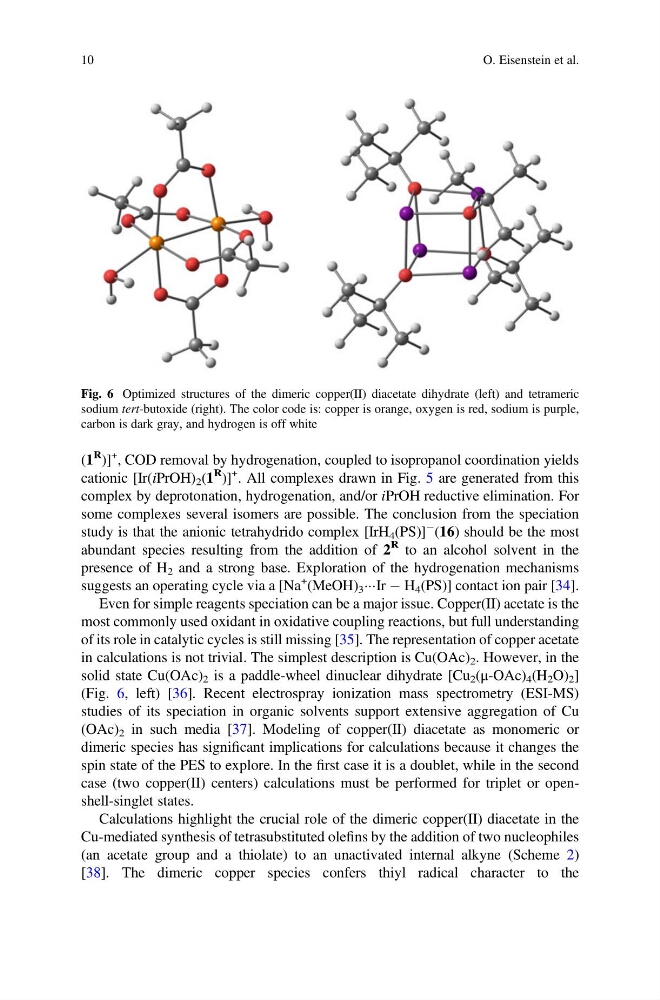
solid state Cu(OAc) 2 is a paddle-wheel dinuclear dihydrate [Cu 2 (μ-OAc) 4 (H 2 O) 2 ]
(Fig. 6, left) [36]. Recent electrospray ionization mass spectrometry (ESI-MS)
studies of its speciation in organic solvents support extensive aggregation of Cu
(OAc) 2 in such media [37]. Modeling of copper(II) diacetate as monomeric or
dimeric species has significant implications for calculations because it changes the
spin state of the PES to explore. In the first case it is a doublet, while in the second
case (two copper(II) centers) calculations must be performed for triplet or openshell-singlet states.
Calculations highlight the crucial role of the dimeric copper(II) diacetate in the
Cu-mediated synthesis of tetrasubstituted olefins by the addition of two nucleophiles
(an acetate group and a thiolate) to an unactivated internal alkyne (Scheme 2)
[38]. The dimeric copper species confers thiyl radical character to the
Fig. 6 Optimized structures of the dimeric copper(II) diacetate dihydrate (left) and tetrameric
sodium tert-butoxide (right). The color code is: copper is orange, oxygen is red, sodium is purple,
carbon is dark gray, and hydrogen is off white
10
O. Eisenstein et al.
R )]
+ , COD removal by hydrogenation, coupled to isopropanol coordination yields
cationic [Ir(iPrOH) 2 (1
R )]
+
. All complexes drawn in Fig. 5 are generated from this
complex by deprotonation, hydrogenation, and/or iPrOH reductive elimination. For
some complexes several isomers are possible. The conclusion from the speciation
study is that the anionic tetrahydrido complex [IrH 4 (PS)]
À (16) should be the most
abundant species resulting from the addition of 2
R to an alcohol solvent in the
presence of H 2 and a strong base. Exploration of the hydrogenation mechanisms
suggests an operating cycle via a [Na
+
(MeOH) 3 ÁÁÁIr À H 4 (PS)] contact ion pair [34].
Even for simple reagents speciation can be a major issue. Copper(II) acetate is the
most commonly used oxidant in oxidative coupling reactions, but full understanding
of its role in catalytic cycles is still missing [35]. The representation of copper acetate
in calculations is not trivial. The simplest description is Cu(OAc) 2 . However, in the
solid state Cu(OAc) 2 is a paddle-wheel dinuclear dihydrate [Cu 2 (μ-OAc) 4 (H 2 O) 2 ]
(Fig. 6, left) [36]. Recent electrospray ionization mass spectrometry (ESI-MS)
studies of its speciation in organic solvents support extensive aggregation of Cu
(OAc) 2 in such media [37]. Modeling of copper(II) diacetate as monomeric or
dimeric species has significant implications for calculations because it changes the
spin state of the PES to explore. In the first case it is a doublet, while in the second
case (two copper(II) centers) calculations must be performed for triplet or openshell-singlet states.
Calculations highlight the crucial role of the dimeric copper(II) diacetate in the
Cu-mediated synthesis of tetrasubstituted olefins by the addition of two nucleophiles
(an acetate group and a thiolate) to an unactivated internal alkyne (Scheme 2)
[38]. The dimeric copper species confers thiyl radical character to the
Fig. 6 Optimized structures of the dimeric copper(II) diacetate dihydrate (left) and tetrameric
sodium tert-butoxide (right). The color code is: copper is orange, oxygen is red, sodium is purple,
carbon is dark gray, and hydrogen is off white
10
O. Eisenstein et al.