

Exploratory investigations used a simpler model of 1
R ligand, where the ferrocene linker was replaced by a –CH¼CH– linker and the phenyl groups by H atoms.
Then, the most stable systems were calculated with the real ligands. Methanol was
used as a solvent, described as a continuum polarizable medium in the optimizations,
but also a cluster of six solvent molecules (MeOH) 6 was included in the
deprotonation reactions (the base was modeled by [MeO(MeOH) 5 ]
À , see Sect. 6).
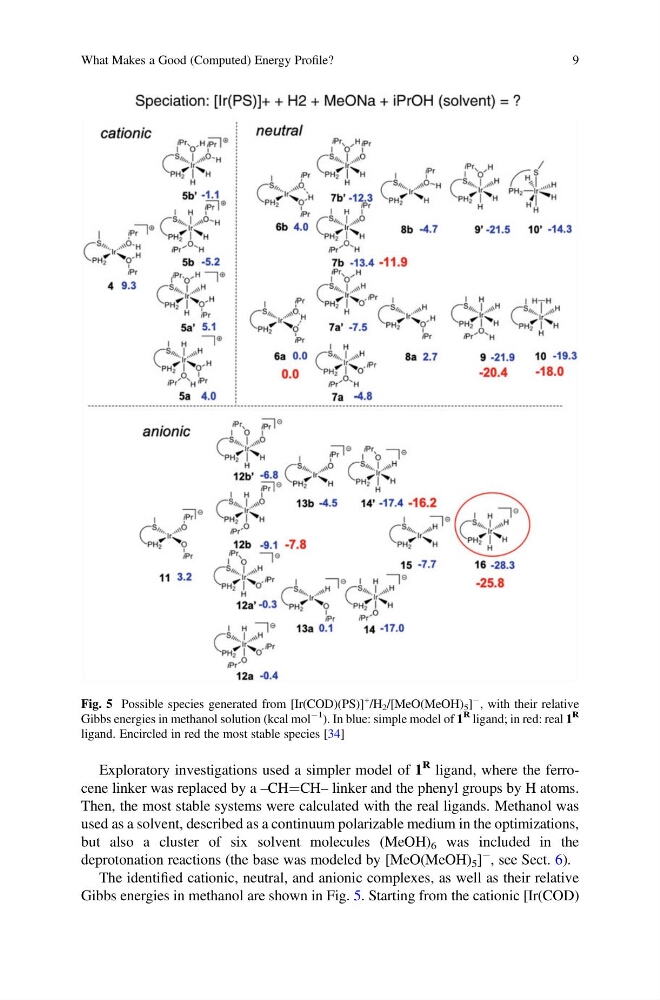
The identified cationic, neutral, and anionic complexes, as well as their relative
Gibbs energies in methanol are shown in Fig. 5. Starting from the cationic [Ir(COD)
Fig. 5 Possible species generated from [Ir(COD)(PS)]
+ /H 2 /[MeO(MeOH) 5 ]
À , with their relative
Gibbs energies in methanol solution (kcal mol
À1
). In blue: simple model of 1
R ligand; in red: real 1
R
ligand. Encircled in red the most stable species [34]
What Makes a Good (Computed) Energy Profile?
9
R ligand, where the ferrocene linker was replaced by a –CH¼CH– linker and the phenyl groups by H atoms.
Then, the most stable systems were calculated with the real ligands. Methanol was
used as a solvent, described as a continuum polarizable medium in the optimizations,
but also a cluster of six solvent molecules (MeOH) 6 was included in the
deprotonation reactions (the base was modeled by [MeO(MeOH) 5 ]
À , see Sect. 6).
The identified cationic, neutral, and anionic complexes, as well as their relative
Gibbs energies in methanol are shown in Fig. 5. Starting from the cationic [Ir(COD)
Fig. 5 Possible species generated from [Ir(COD)(PS)]
+ /H 2 /[MeO(MeOH) 5 ]
À , with their relative
Gibbs energies in methanol solution (kcal mol
À1
). In blue: simple model of 1
R ligand; in red: real 1
R
ligand. Encircled in red the most stable species [34]
What Makes a Good (Computed) Energy Profile?
9