

The way to deal with the questions commented above is crucial to obtain reliable
information on reaction mechanisms from calculations. In the next sections we
illustrate the aspects outlined in Fig. 4 using examples from our work.
4 The Chemical Model
The minimal model to compute an energy profile of a reaction between an organometallic and a substrate is to include the catalyst and one molecule for each reactant.
However, other species, like counterions and additives, can be present in the reaction
vessel. Moreover, in most of the cases the catalytically active species is not the initial
organometallic complex added into the flask, and a careful speciation analysis must
be performed. It is important to keep in mind that calculations cannot inform about
mechanisms involving species not considered in the chemical model of the system.
4.1 What’s Inside the Flask?
4.1.1 Speciation
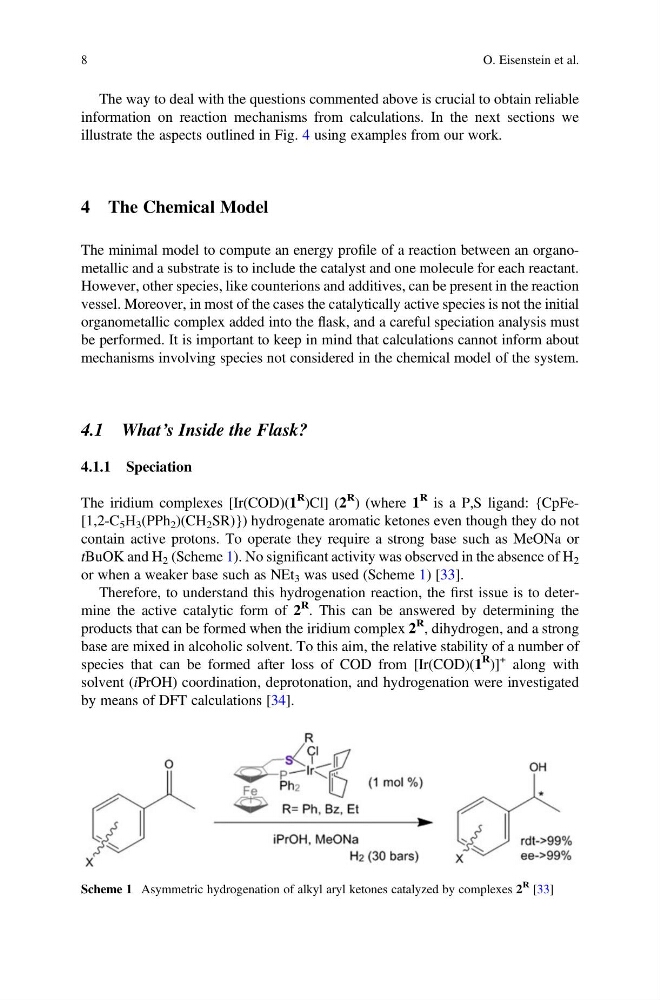
The iridium complexes [Ir(COD)(1
R
)Cl] (2
R ) (where 1
R is a P,S ligand: {CpFe[1,2-C 5 H 3 (PPh 2 )(CH 2 SR)}) hydrogenate aromatic ketones even though they do not
contain active protons. To operate they require a strong base such as MeONa or
tBuOK and H 2 (Scheme 1). No significant activity was observed in the absence of H 2
or when a weaker base such as NEt 3 was used (Scheme 1) [33].
Therefore, to understand this hydrogenation reaction, the first issue is to determine the active catalytic form of 2
R
. This can be answered by determining the
products that can be formed when the iridium complex 2
R , dihydrogen, and a strong
base are mixed in alcoholic solvent. To this aim, the relative stability of a number of
species that can be formed after loss of COD from [Ir(COD)(1
R )]
+ along with
solvent (iPrOH) coordination, deprotonation, and hydrogenation were investigated
by means of DFT calculations [34].
Scheme 1 Asymmetric hydrogenation of alkyl aryl ketones catalyzed by complexes 2
R [33]
8
O. Eisenstein et al.
information on reaction mechanisms from calculations. In the next sections we
illustrate the aspects outlined in Fig. 4 using examples from our work.
4 The Chemical Model
The minimal model to compute an energy profile of a reaction between an organometallic and a substrate is to include the catalyst and one molecule for each reactant.
However, other species, like counterions and additives, can be present in the reaction
vessel. Moreover, in most of the cases the catalytically active species is not the initial
organometallic complex added into the flask, and a careful speciation analysis must
be performed. It is important to keep in mind that calculations cannot inform about
mechanisms involving species not considered in the chemical model of the system.
4.1 What’s Inside the Flask?
4.1.1 Speciation
The iridium complexes [Ir(COD)(1
R
)Cl] (2
R ) (where 1
R is a P,S ligand: {CpFe[1,2-C 5 H 3 (PPh 2 )(CH 2 SR)}) hydrogenate aromatic ketones even though they do not
contain active protons. To operate they require a strong base such as MeONa or
tBuOK and H 2 (Scheme 1). No significant activity was observed in the absence of H 2
or when a weaker base such as NEt 3 was used (Scheme 1) [33].
Therefore, to understand this hydrogenation reaction, the first issue is to determine the active catalytic form of 2
R
. This can be answered by determining the
products that can be formed when the iridium complex 2
R , dihydrogen, and a strong
base are mixed in alcoholic solvent. To this aim, the relative stability of a number of
species that can be formed after loss of COD from [Ir(COD)(1
R )]
+ along with
solvent (iPrOH) coordination, deprotonation, and hydrogenation were investigated
by means of DFT calculations [34].
Scheme 1 Asymmetric hydrogenation of alkyl aryl ketones catalyzed by complexes 2
R [33]
8
O. Eisenstein et al.