

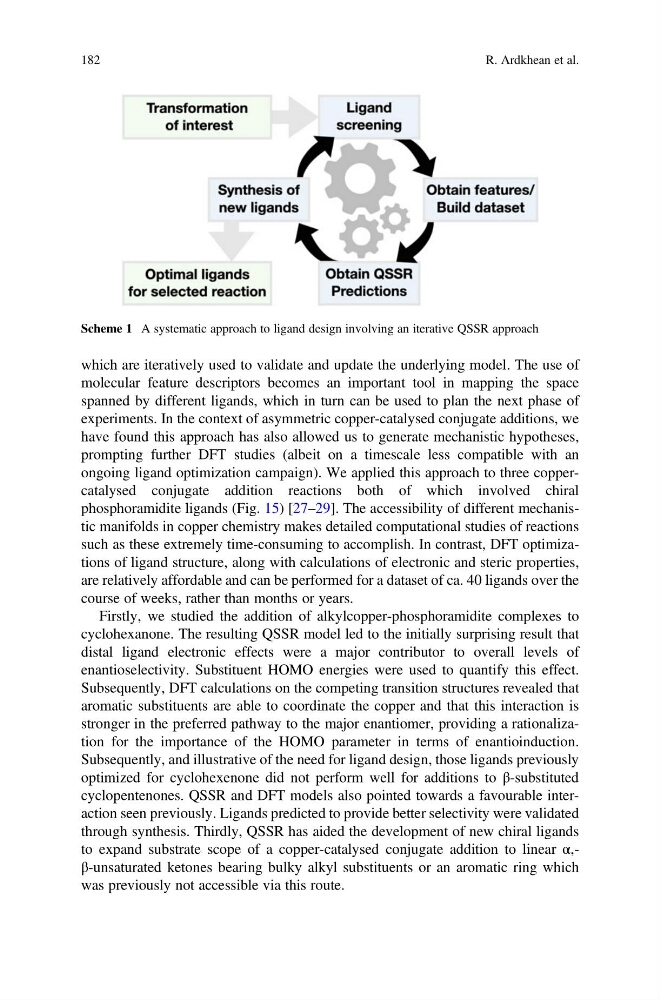
which are iteratively used to validate and update the underlying model. The use of
molecular feature descriptors becomes an important tool in mapping the space
spanned by different ligands, which in turn can be used to plan the next phase of
experiments. In the context of asymmetric copper-catalysed conjugate additions, we
have found this approach has also allowed us to generate mechanistic hypotheses,
prompting further DFT studies (albeit on a timescale less compatible with an
ongoing ligand optimization campaign). We applied this approach to three coppercatalysed conjugate addition reactions both of which involved chiral
phosphoramidite ligands (Fig. 15) [27–29]. The accessibility of different mechanistic manifolds in copper chemistry makes detailed computational studies of reactions
such as these extremely time-consuming to accomplish. In contrast, DFT optimizations of ligand structure, along with calculations of electronic and steric properties,
are relatively affordable and can be performed for a dataset of ca. 40 ligands over the
course of weeks, rather than months or years.
Firstly, we studied the addition of alkylcopper-phosphoramidite complexes to
cyclohexanone. The resulting QSSR model led to the initially surprising result that
distal ligand electronic effects were a major contributor to overall levels of
enantioselectivity. Substituent HOMO energies were used to quantify this effect.
Subsequently, DFT calculations on the competing transition structures revealed that
aromatic substituents are able to coordinate the copper and that this interaction is
stronger in the preferred pathway to the major enantiomer, providing a rationalization for the importance of the HOMO parameter in terms of enantioinduction.
Subsequently, and illustrative of the need for ligand design, those ligands previously
optimized for cyclohexenone did not perform well for additions to β-substituted
cyclopentenones. QSSR and DFT models also pointed towards a favourable interaction seen previously. Ligands predicted to provide better selectivity were validated
through synthesis. Thirdly, QSSR has aided the development of new chiral ligands
to expand substrate scope of a copper-catalysed conjugate addition to linear α,β-unsaturated ketones bearing bulky alkyl substituents or an aromatic ring which
was previously not accessible via this route.
Scheme 1 A systematic approach to ligand design involving an iterative QSSR approach
182
R. Ardkhean et al.
molecular feature descriptors becomes an important tool in mapping the space
spanned by different ligands, which in turn can be used to plan the next phase of
experiments. In the context of asymmetric copper-catalysed conjugate additions, we
have found this approach has also allowed us to generate mechanistic hypotheses,
prompting further DFT studies (albeit on a timescale less compatible with an
ongoing ligand optimization campaign). We applied this approach to three coppercatalysed conjugate addition reactions both of which involved chiral
phosphoramidite ligands (Fig. 15) [27–29]. The accessibility of different mechanistic manifolds in copper chemistry makes detailed computational studies of reactions
such as these extremely time-consuming to accomplish. In contrast, DFT optimizations of ligand structure, along with calculations of electronic and steric properties,
are relatively affordable and can be performed for a dataset of ca. 40 ligands over the
course of weeks, rather than months or years.
Firstly, we studied the addition of alkylcopper-phosphoramidite complexes to
cyclohexanone. The resulting QSSR model led to the initially surprising result that
distal ligand electronic effects were a major contributor to overall levels of
enantioselectivity. Substituent HOMO energies were used to quantify this effect.
Subsequently, DFT calculations on the competing transition structures revealed that
aromatic substituents are able to coordinate the copper and that this interaction is
stronger in the preferred pathway to the major enantiomer, providing a rationalization for the importance of the HOMO parameter in terms of enantioinduction.
Subsequently, and illustrative of the need for ligand design, those ligands previously
optimized for cyclohexenone did not perform well for additions to β-substituted
cyclopentenones. QSSR and DFT models also pointed towards a favourable interaction seen previously. Ligands predicted to provide better selectivity were validated
through synthesis. Thirdly, QSSR has aided the development of new chiral ligands
to expand substrate scope of a copper-catalysed conjugate addition to linear α,β-unsaturated ketones bearing bulky alkyl substituents or an aromatic ring which
was previously not accessible via this route.
Scheme 1 A systematic approach to ligand design involving an iterative QSSR approach
182
R. Ardkhean et al.