

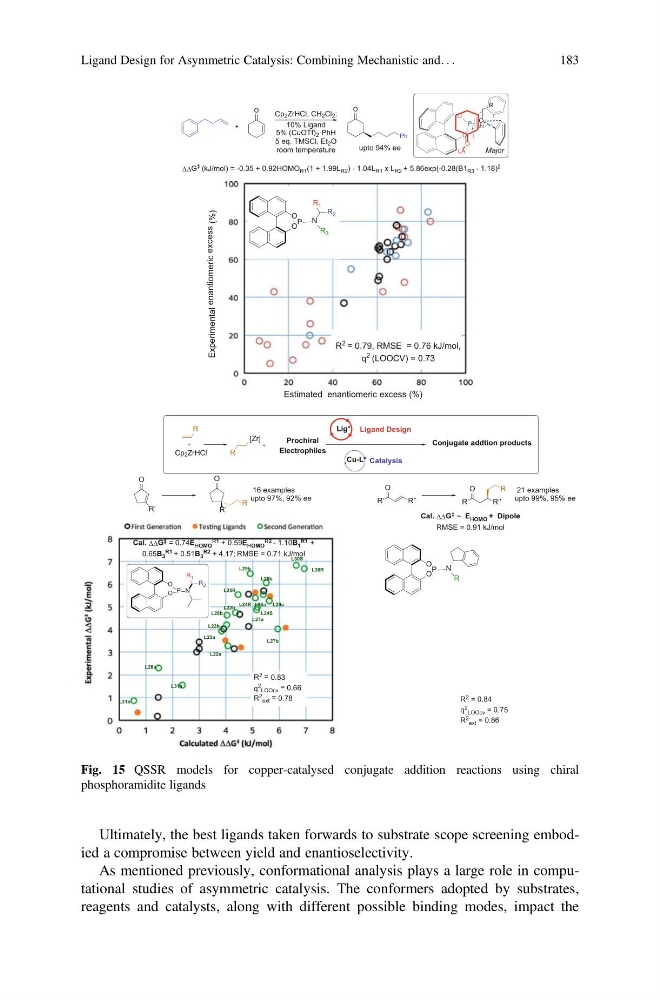
Ultimately, the best ligands taken forwards to substrate scope screening embodied a compromise between yield and enantioselectivity.
As mentioned previously, conformational analysis plays a large role in computational studies of asymmetric catalysis. The conformers adopted by substrates,
reagents and catalysts, along with different possible binding modes, impact the
N
O
O
Cu
R
P
O
LA
Major
O
O
Cp2ZrHCl, CH2Cl2;
10% Ligand
5% (CuOTf) 2 ·PhH
5 eq. TMSCl, Et 2 O
room temperature
Ph
+
upto 94% ee
Estimated enantiomeric excess (%)
Experimental enantiomeric excess
(%)
O
O
P N
R 3
R 1
R 2
ΔΔG ‡ (kJ/mol) = -0.35 + 0.92HOMO R1 (1 + 1.99L R2 ) - 1.04L R1 x L R2 + 5.86exp(-0.28(B1 R3 - 1.18) 2
R
O
R’
Cu-L*
O
R’
R
Cp2ZrHCl
[Zr]
Catalysis
Ligand Design
16 examples
upto 97%, 92% ee
R
Lig*
O
O P N
R 1
R 2
Cal. ΔΔG ‡ = 0.74E HOMO
R1 + 0.59E HOMO
R2 - 1.10B 1
R1 +
0.65B 3
R1 + 0.51B 3
R2 + 4.17; RMSE = 0.71 kJ/mol
R 2 = 0.83
q 2
LOOcv = 0.66
R 2
ext = 0.78
L30S
L30R
L29b
L26b
L25R
L24R L26a L29a
L24S
L27a
L22b
L28b
L23b
L23a
L27b
L22a
L28a
L31a
L31b
O
O
P N
R
Prochiral
Electrophiles
Conjugate addtion products
R’
O
21 examples
upto 99%, 95% ee
R’’
R’
O
R’’
R
R 2 = 0.79, RMSE = 0.76 kJ/mol,
q
2 (LOOCV) = 0.73
Cal. ΔΔG ‡ ~ E HOMO + Dipole
RMSE = 0.91 kJ/mol
R 2 = 0.84
q 2
LOOcv = 0.75
R 2
ext = 0.86
Fig. 15 QSSR models for copper-catalysed conjugate addition reactions using chiral
phosphoramidite ligands
Ligand Design for Asymmetric Catalysis: Combining Mechanistic and. . .
183
As mentioned previously, conformational analysis plays a large role in computational studies of asymmetric catalysis. The conformers adopted by substrates,
reagents and catalysts, along with different possible binding modes, impact the
N
O
O
Cu
R
P
O
LA
Major
O
O
Cp2ZrHCl, CH2Cl2;
10% Ligand
5% (CuOTf) 2 ·PhH
5 eq. TMSCl, Et 2 O
room temperature
Ph
+
upto 94% ee
Estimated enantiomeric excess (%)
Experimental enantiomeric excess
(%)
O
O
P N
R 3
R 1
R 2
ΔΔG ‡ (kJ/mol) = -0.35 + 0.92HOMO R1 (1 + 1.99L R2 ) - 1.04L R1 x L R2 + 5.86exp(-0.28(B1 R3 - 1.18) 2
R
O
R’
Cu-L*
O
R’
R
Cp2ZrHCl
[Zr]
Catalysis
Ligand Design
16 examples
upto 97%, 92% ee
R
Lig*
O
O P N
R 1
R 2
Cal. ΔΔG ‡ = 0.74E HOMO
R1 + 0.59E HOMO
R2 - 1.10B 1
R1 +
0.65B 3
R1 + 0.51B 3
R2 + 4.17; RMSE = 0.71 kJ/mol
R 2 = 0.83
q 2
LOOcv = 0.66
R 2
ext = 0.78
L30S
L30R
L29b
L26b
L25R
L24R L26a L29a
L24S
L27a
L22b
L28b
L23b
L23a
L27b
L22a
L28a
L31a
L31b
O
O
P N
R
Prochiral
Electrophiles
Conjugate addtion products
R’
O
21 examples
upto 99%, 95% ee
R’’
R’
O
R’’
R
R 2 = 0.79, RMSE = 0.76 kJ/mol,
q
2 (LOOCV) = 0.73
Cal. ΔΔG ‡ ~ E HOMO + Dipole
RMSE = 0.91 kJ/mol
R 2 = 0.84
q 2
LOOcv = 0.75
R 2
ext = 0.86
Fig. 15 QSSR models for copper-catalysed conjugate addition reactions using chiral
phosphoramidite ligands
Ligand Design for Asymmetric Catalysis: Combining Mechanistic and. . .
183