

transformation, given that their descriptors are suitable for describing relations
underlying the enantioselectivity in question.
5.5 QSSR-Driven Ligand Optimization
One goal of applying a quantitative structure-selectivity relationship (QSSR) is that
it can be used during an optimization campaign to focus (or refocus) synthesis and
experimental screening towards more profitable areas. In principle, provided ligand
synthesis is tractable, such an approach is versatile and can be applied across various
transformations (Scheme 1).
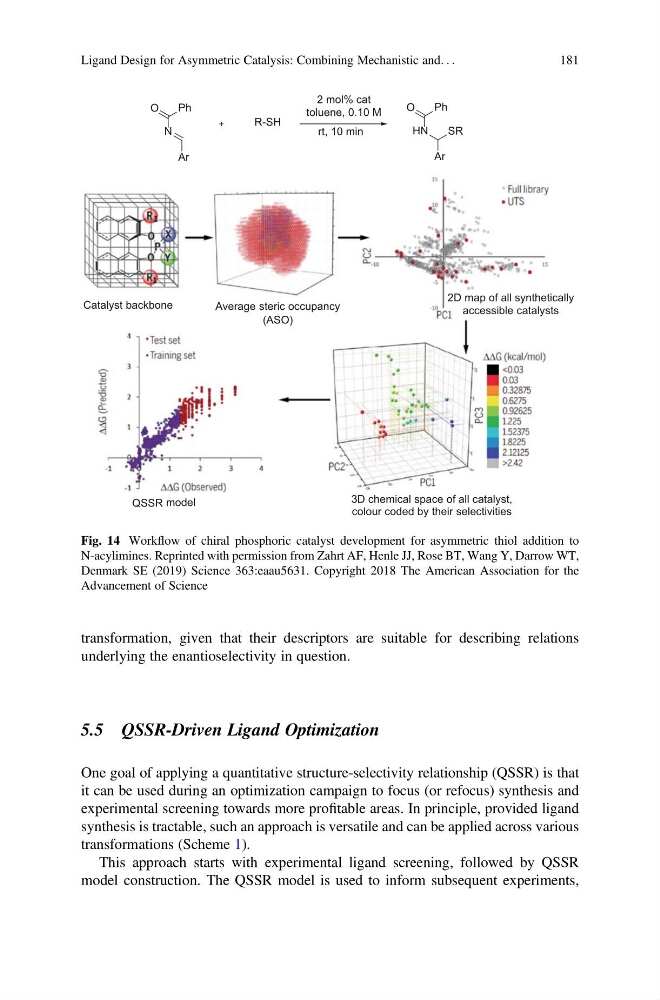
This approach starts with experimental ligand screening, followed by QSSR
model construction. The QSSR model is used to inform subsequent experiments,
N
O
Ph
Ar
R-SH
HN
O
Ph
Ar
SR
2 mol% cat
toluene, 0.10 M
rt, 10 min
Catalyst backbone
Average steric occupancy
(ASO)
3D chemical space of all catalyst,
colour coded by their selectivities
QSSR model
2D map of all synthetically
accessible catalysts
Fig. 14 Workflow of chiral phosphoric catalyst development for asymmetric thiol addition to
N-acylimines. Reprinted with permission from Zahrt AF, Henle JJ, Rose BT, Wang Y, Darrow WT,
Denmark SE (2019) Science 363:eaau5631. Copyright 2018 The American Association for the
Advancement of Science
Ligand Design for Asymmetric Catalysis: Combining Mechanistic and. . .
181
underlying the enantioselectivity in question.
5.5 QSSR-Driven Ligand Optimization
One goal of applying a quantitative structure-selectivity relationship (QSSR) is that
it can be used during an optimization campaign to focus (or refocus) synthesis and
experimental screening towards more profitable areas. In principle, provided ligand
synthesis is tractable, such an approach is versatile and can be applied across various
transformations (Scheme 1).
This approach starts with experimental ligand screening, followed by QSSR
model construction. The QSSR model is used to inform subsequent experiments,
N
O
Ph
Ar
R-SH
HN
O
Ph
Ar
SR
2 mol% cat
toluene, 0.10 M
rt, 10 min
Catalyst backbone
Average steric occupancy
(ASO)
3D chemical space of all catalyst,
colour coded by their selectivities
QSSR model
2D map of all synthetically
accessible catalysts
Fig. 14 Workflow of chiral phosphoric catalyst development for asymmetric thiol addition to
N-acylimines. Reprinted with permission from Zahrt AF, Henle JJ, Rose BT, Wang Y, Darrow WT,
Denmark SE (2019) Science 363:eaau5631. Copyright 2018 The American Association for the
Advancement of Science
Ligand Design for Asymmetric Catalysis: Combining Mechanistic and. . .
181