

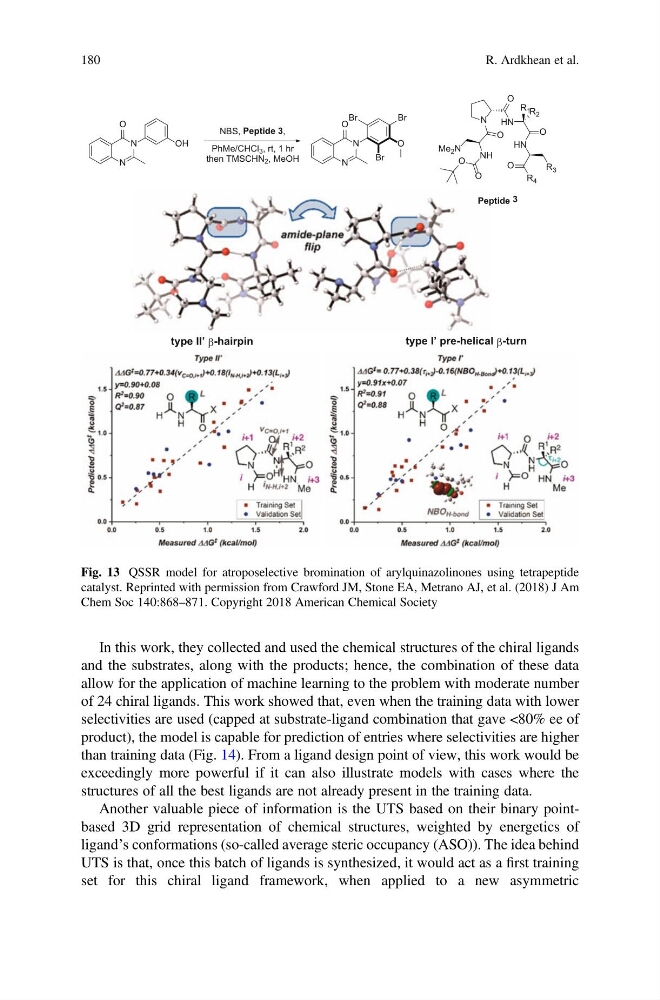
In this work, they collected and used the chemical structures of the chiral ligands
and the substrates, along with the products; hence, the combination of these data
allow for the application of machine learning to the problem with moderate number
of 24 chiral ligands. This work showed that, even when the training data with lower
selectivities are used (capped at substrate-ligand combination that gave <80% ee of
product), the model is capable for prediction of entries where selectivities are higher
than training data (Fig. 14). From a ligand design point of view, this work would be
exceedingly more powerful if it can also illustrate models with cases where the
structures of all the best ligands are not already present in the training data.
Another valuable piece of information is the UTS based on their binary pointbased 3D grid representation of chemical structures, weighted by energetics of
ligand’s conformations (so-called average steric occupancy (ASO)). The idea behind
UTS is that, once this batch of ligands is synthesized, it would act as a first training
set for this chiral ligand framework, when applied to a new asymmetric
N
N
O
OH
N
N
O
O
Br
Br
Br
NBS, Peptide 3,
PhMe/CHCl 3 , rt, 1 hr
then TMSCHN 2 , MeOH
N
HN
O
O
HN
O
R 4
R 3
O
NH
Me 2 N
R 1 R 2
O
O
Peptide 3
type I’ pre-helical β-turn
type II’ β-hairpin
Fig. 13 QSSR model for atroposelective bromination of arylquinazolinones using tetrapeptide
catalyst. Reprinted with permission from Crawford JM, Stone EA, Metrano AJ, et al. (2018) J Am
Chem Soc 140:868–871. Copyright 2018 American Chemical Society
180
R. Ardkhean et al.
and the substrates, along with the products; hence, the combination of these data
allow for the application of machine learning to the problem with moderate number
of 24 chiral ligands. This work showed that, even when the training data with lower
selectivities are used (capped at substrate-ligand combination that gave <80% ee of
product), the model is capable for prediction of entries where selectivities are higher
than training data (Fig. 14). From a ligand design point of view, this work would be
exceedingly more powerful if it can also illustrate models with cases where the
structures of all the best ligands are not already present in the training data.
Another valuable piece of information is the UTS based on their binary pointbased 3D grid representation of chemical structures, weighted by energetics of
ligand’s conformations (so-called average steric occupancy (ASO)). The idea behind
UTS is that, once this batch of ligands is synthesized, it would act as a first training
set for this chiral ligand framework, when applied to a new asymmetric
N
N
O
OH
N
N
O
O
Br
Br
Br
NBS, Peptide 3,
PhMe/CHCl 3 , rt, 1 hr
then TMSCHN 2 , MeOH
N
HN
O
O
HN
O
R 4
R 3
O
NH
Me 2 N
R 1 R 2
O
O
Peptide 3
type I’ pre-helical β-turn
type II’ β-hairpin
Fig. 13 QSSR model for atroposelective bromination of arylquinazolinones using tetrapeptide
catalyst. Reprinted with permission from Crawford JM, Stone EA, Metrano AJ, et al. (2018) J Am
Chem Soc 140:868–871. Copyright 2018 American Chemical Society
180
R. Ardkhean et al.