

in which oxidative cyclization occurs prior to activation of a vinylcyclopropane. The
improved ligand gives 99.9% ee (Fig. 10a). Liu and Brummond optimized
enantioselectivity in a dynamic kinetic asymmetric Pauson-Khand reaction of allenyl
acetates based on computations of competing transition states. This analysis (M06//
B3LYP) revealed an unexpected ‘alkene unbound’ pathway for the predicted best
phosphoramidite ligand, which gave an er of 86:14 in experiment after only four
experimental variants (Fig. 10b) [47]. More recent efforts have focussed on automation of the computational workflow to obtain competing transition structures.
Wheeler reported an automated reaction optimizer for new catalysts (AARON)
based on DFT screening which was applied to enantioselective rhodium-catalysed
asymmetric hydrogenation of enamines (Fig. 10c) [48]. This tool was developed to
enable the automated construction, calculation and analysis of transition structures
without the need for manual manipulation.
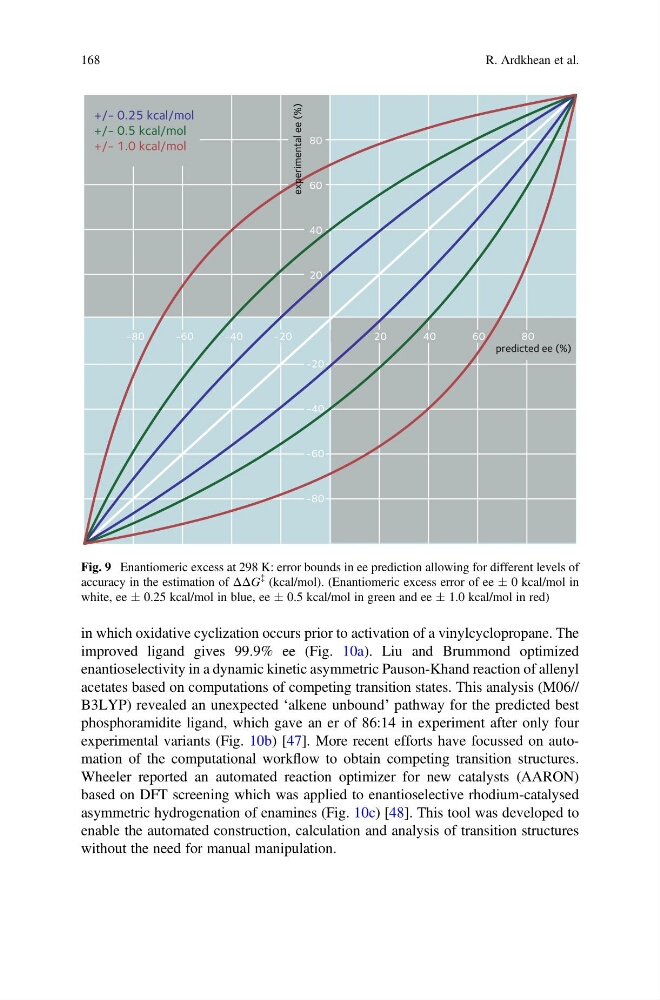
Fig. 9 Enantiomeric excess at 298 K: error bounds in ee prediction allowing for different levels of
accuracy in the estimation of ΔΔG
{ (kcal/mol). (Enantiomeric excess error of ee Æ 0 kcal/mol in
white, ee Æ 0.25 kcal/mol in blue, ee Æ 0.5 kcal/mol in green and ee Æ 1.0 kcal/mol in red)
168
R. Ardkhean et al.
improved ligand gives 99.9% ee (Fig. 10a). Liu and Brummond optimized
enantioselectivity in a dynamic kinetic asymmetric Pauson-Khand reaction of allenyl
acetates based on computations of competing transition states. This analysis (M06//
B3LYP) revealed an unexpected ‘alkene unbound’ pathway for the predicted best
phosphoramidite ligand, which gave an er of 86:14 in experiment after only four
experimental variants (Fig. 10b) [47]. More recent efforts have focussed on automation of the computational workflow to obtain competing transition structures.
Wheeler reported an automated reaction optimizer for new catalysts (AARON)
based on DFT screening which was applied to enantioselective rhodium-catalysed
asymmetric hydrogenation of enamines (Fig. 10c) [48]. This tool was developed to
enable the automated construction, calculation and analysis of transition structures
without the need for manual manipulation.
Fig. 9 Enantiomeric excess at 298 K: error bounds in ee prediction allowing for different levels of
accuracy in the estimation of ΔΔG
{ (kcal/mol). (Enantiomeric excess error of ee Æ 0 kcal/mol in
white, ee Æ 0.25 kcal/mol in blue, ee Æ 0.5 kcal/mol in green and ee Æ 1.0 kcal/mol in red)
168
R. Ardkhean et al.