

ΔΔG
{
R=S
ð
Þ ¼ ÀRT ln R=S
ð
Þ ¼ ÀRT ln
100 þ %ee R
ð
Þ
100 À %ee R
ð
Þ
ð2Þ
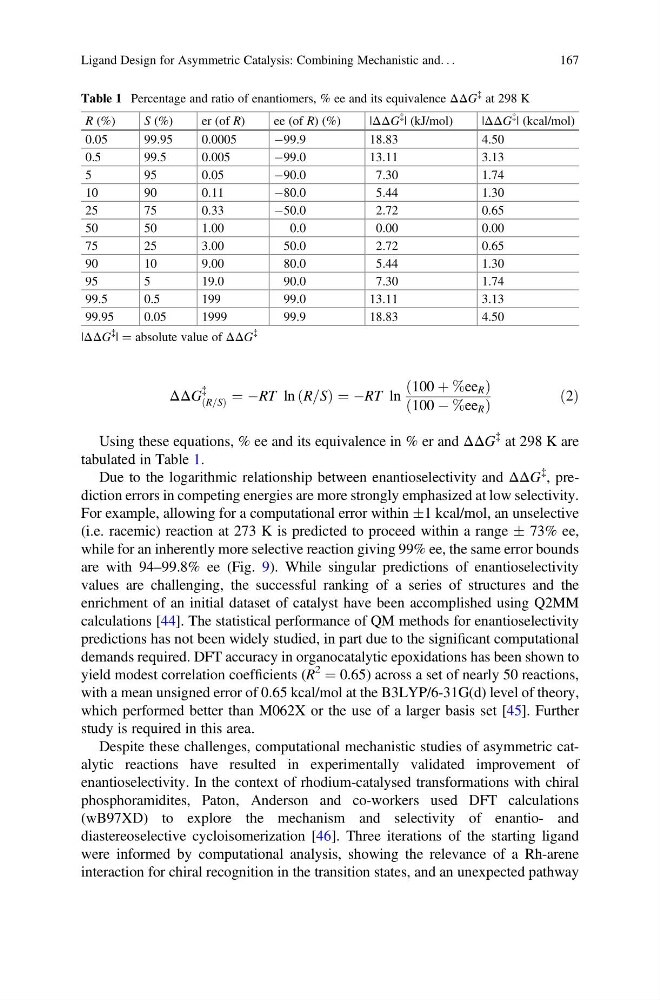
Using these equations, % ee and its equivalence in % er and ΔΔG
{ at 298 K are
tabulated in Table 1.
Due to the logarithmic relationship between enantioselectivity and ΔΔG
{ , prediction errors in competing energies are more strongly emphasized at low selectivity.
For example, allowing for a computational error within Æ1 kcal/mol, an unselective
(i.e. racemic) reaction at 273 K is predicted to proceed within a range Æ 73% ee,
while for an inherently more selective reaction giving 99% ee, the same error bounds
are with 94–99.8% ee (Fig. 9). While singular predictions of enantioselectivity
values are challenging, the successful ranking of a series of structures and the
enrichment of an initial dataset of catalyst have been accomplished using Q2MM
calculations [44]. The statistical performance of QM methods for enantioselectivity
predictions has not been widely studied, in part due to the significant computational
demands required. DFT accuracy in organocatalytic epoxidations has been shown to
yield modest correlation coefficients (R
2
¼ 0.65) across a set of nearly 50 reactions,
with a mean unsigned error of 0.65 kcal/mol at the B3LYP/6-31G(d) level of theory,
which performed better than M062X or the use of a larger basis set [45]. Further
study is required in this area.
Despite these challenges, computational mechanistic studies of asymmetric catalytic reactions have resulted in experimentally validated improvement of
enantioselectivity. In the context of rhodium-catalysed transformations with chiral
phosphoramidites, Paton, Anderson and co-workers used DFT calculations
(wB97XD) to explore the mechanism and selectivity of enantio- and
diastereoselective cycloisomerization [46]. Three iterations of the starting ligand
were informed by computational analysis, showing the relevance of a Rh-arene
interaction for chiral recognition in the transition states, and an unexpected pathway
Table 1 Percentage and ratio of enantiomers, % ee and its equivalence ΔΔG
{ at 298 K
R (%)
S (%)
er (of R)
ee (of R) (%)
|ΔΔG
{
| (kJ/mol)
|ΔΔG
{
| (kcal/mol)
0.05
99.95
0.0005
À99.9
18.83
4.50
0.5
99.5
0.005
À99.0
13.11
3.13
5
95
0.05
À90.0
7.30
1.74
10
90
0.11
À80.0
5.44
1.30
25
75
0.33
À50.0
2.72
0.65
50
50
1.00
0.0
0.00
0.00
75
25
3.00
50.0
2.72
0.65
90
10
9.00
80.0
5.44
1.30
95
5
19.0
90.0
7.30
1.74
99.5
0.5
199
99.0
13.11
3.13
99.95
0.05
1999
99.9
18.83
4.50
|ΔΔG
{
| ¼ absolute value of ΔΔG
{
Ligand Design for Asymmetric Catalysis: Combining Mechanistic and. . .
167
{
R=S
ð
Þ ¼ ÀRT ln R=S
ð
Þ ¼ ÀRT ln
100 þ %ee R
ð
Þ
100 À %ee R
ð
Þ
ð2Þ
Using these equations, % ee and its equivalence in % er and ΔΔG
{ at 298 K are
tabulated in Table 1.
Due to the logarithmic relationship between enantioselectivity and ΔΔG
{ , prediction errors in competing energies are more strongly emphasized at low selectivity.
For example, allowing for a computational error within Æ1 kcal/mol, an unselective
(i.e. racemic) reaction at 273 K is predicted to proceed within a range Æ 73% ee,
while for an inherently more selective reaction giving 99% ee, the same error bounds
are with 94–99.8% ee (Fig. 9). While singular predictions of enantioselectivity
values are challenging, the successful ranking of a series of structures and the
enrichment of an initial dataset of catalyst have been accomplished using Q2MM
calculations [44]. The statistical performance of QM methods for enantioselectivity
predictions has not been widely studied, in part due to the significant computational
demands required. DFT accuracy in organocatalytic epoxidations has been shown to
yield modest correlation coefficients (R
2
¼ 0.65) across a set of nearly 50 reactions,
with a mean unsigned error of 0.65 kcal/mol at the B3LYP/6-31G(d) level of theory,
which performed better than M062X or the use of a larger basis set [45]. Further
study is required in this area.
Despite these challenges, computational mechanistic studies of asymmetric catalytic reactions have resulted in experimentally validated improvement of
enantioselectivity. In the context of rhodium-catalysed transformations with chiral
phosphoramidites, Paton, Anderson and co-workers used DFT calculations
(wB97XD) to explore the mechanism and selectivity of enantio- and
diastereoselective cycloisomerization [46]. Three iterations of the starting ligand
were informed by computational analysis, showing the relevance of a Rh-arene
interaction for chiral recognition in the transition states, and an unexpected pathway
Table 1 Percentage and ratio of enantiomers, % ee and its equivalence ΔΔG
{ at 298 K
R (%)
S (%)
er (of R)
ee (of R) (%)
|ΔΔG
{
| (kJ/mol)
|ΔΔG
{
| (kcal/mol)
0.05
99.95
0.0005
À99.9
18.83
4.50
0.5
99.5
0.005
À99.0
13.11
3.13
5
95
0.05
À90.0
7.30
1.74
10
90
0.11
À80.0
5.44
1.30
25
75
0.33
À50.0
2.72
0.65
50
50
1.00
0.0
0.00
0.00
75
25
3.00
50.0
2.72
0.65
90
10
9.00
80.0
5.44
1.30
95
5
19.0
90.0
7.30
1.74
99.5
0.5
199
99.0
13.11
3.13
99.95
0.05
1999
99.9
18.83
4.50
|ΔΔG
{
| ¼ absolute value of ΔΔG
{
Ligand Design for Asymmetric Catalysis: Combining Mechanistic and. . .
167