

stereoselectivity [42]. This emphasizes the necessity in thorough and comprehensive
conformational sampling of the transition structures. Nonetheless, collaborative
computational and experimental approaches have shown promise. A plethora of
successful mechanistic studies prior to 2014 have been highlighted by Wu, showing
examples where experimental findings were explained by modelling, models substantiated or eliminated by experimental results, and cases which led to the development of more powerful solutions to reactivity or selectivity problems [43].
4.2.1 QM-Based Methods
Quantum mechanical calculations have proven to be very useful in the elucidation of
reaction mechanisms and rationalizing experimental findings. Qualitative models
often provide satisfying rationalizations of experimental results but lack the ability to
make quantitative predictions. Modelling (and hopefully predicting)
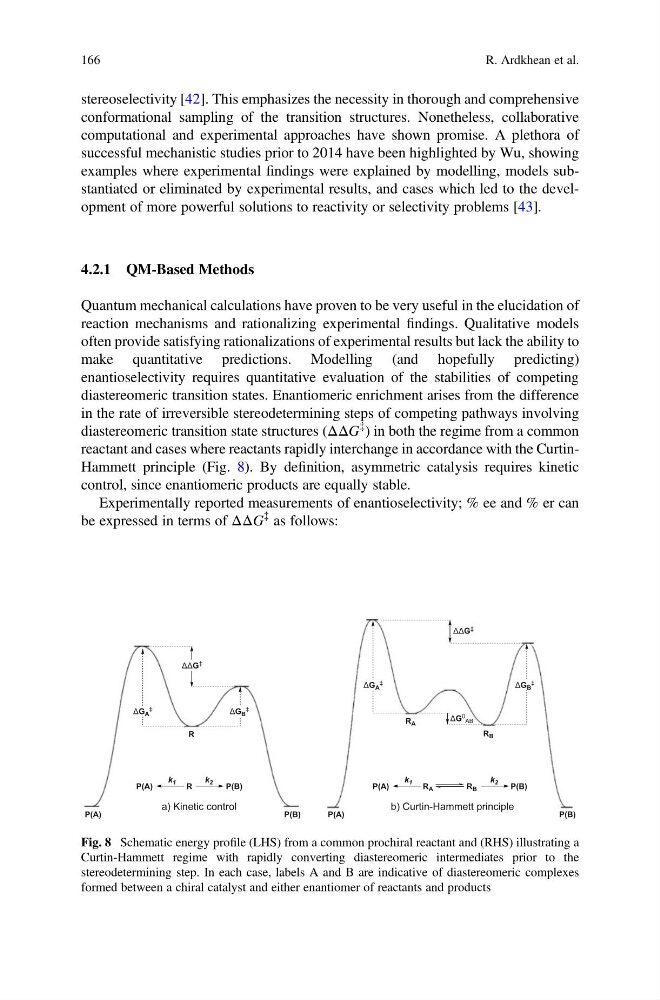
enantioselectivity requires quantitative evaluation of the stabilities of competing
diastereomeric transition states. Enantiomeric enrichment arises from the difference
in the rate of irreversible stereodetermining steps of competing pathways involving
diastereomeric transition state structures (ΔΔG
{ ) in both the regime from a common
reactant and cases where reactants rapidly interchange in accordance with the CurtinHammett principle (Fig. 8). By definition, asymmetric catalysis requires kinetic
control, since enantiomeric products are equally stable.
Experimentally reported measurements of enantioselectivity; % ee and % er can
be expressed in terms of ΔΔG
{ as follows:
P(A)
P(B)
R
P(A)
P(B)
R A
R B
ΔΔG ‡
ΔG A
‡
ΔG B
‡
P(A)
R
P(B)
k 1
k 2
P(A)
R A
R B
P(B)
k 1
k 2
ΔΔG ‡
ΔG A
‡
ΔG B
‡
ΔG 0
AB
b) Curtin-Hammett principle
a) Kinetic control
Fig. 8 Schematic energy profile (LHS) from a common prochiral reactant and (RHS) illustrating a
Curtin-Hammett regime with rapidly converting diastereomeric intermediates prior to the
stereodetermining step. In each case, labels A and B are indicative of diastereomeric complexes
formed between a chiral catalyst and either enantiomer of reactants and products
166
R. Ardkhean et al.
conformational sampling of the transition structures. Nonetheless, collaborative
computational and experimental approaches have shown promise. A plethora of
successful mechanistic studies prior to 2014 have been highlighted by Wu, showing
examples where experimental findings were explained by modelling, models substantiated or eliminated by experimental results, and cases which led to the development of more powerful solutions to reactivity or selectivity problems [43].
4.2.1 QM-Based Methods
Quantum mechanical calculations have proven to be very useful in the elucidation of
reaction mechanisms and rationalizing experimental findings. Qualitative models
often provide satisfying rationalizations of experimental results but lack the ability to
make quantitative predictions. Modelling (and hopefully predicting)
enantioselectivity requires quantitative evaluation of the stabilities of competing
diastereomeric transition states. Enantiomeric enrichment arises from the difference
in the rate of irreversible stereodetermining steps of competing pathways involving
diastereomeric transition state structures (ΔΔG
{ ) in both the regime from a common
reactant and cases where reactants rapidly interchange in accordance with the CurtinHammett principle (Fig. 8). By definition, asymmetric catalysis requires kinetic
control, since enantiomeric products are equally stable.
Experimentally reported measurements of enantioselectivity; % ee and % er can
be expressed in terms of ΔΔG
{ as follows:
P(A)
P(B)
R
P(A)
P(B)
R A
R B
ΔΔG ‡
ΔG A
‡
ΔG B
‡
P(A)
R
P(B)
k 1
k 2
P(A)
R A
R B
P(B)
k 1
k 2
ΔΔG ‡
ΔG A
‡
ΔG B
‡
ΔG 0
AB
b) Curtin-Hammett principle
a) Kinetic control
Fig. 8 Schematic energy profile (LHS) from a common prochiral reactant and (RHS) illustrating a
Curtin-Hammett regime with rapidly converting diastereomeric intermediates prior to the
stereodetermining step. In each case, labels A and B are indicative of diastereomeric complexes
formed between a chiral catalyst and either enantiomer of reactants and products
166
R. Ardkhean et al.